





Introduction
Bill Gates once said, “Your most unhappy customers are your greatest source of learning.” Long gone are the times when call centers were synonymous with long wait times and unpleasant interactions with agents. Nowadays, they are integral to most businesses, serving as a crucial link between customers and companies. From managing calls to addressing customer inquiries, call centers play a vital role in shaping a company’s image. In this guide, we’ll explore everything about call centers, including their functions, operations, and even tips on starting your own. So, let’s delve into the world of these customer service champions and unveil their secrets!
Basics of Call Centers
What do call centers do?
Call centers are generally regarded as the face of the company, where a single mistake could place the entire company in a position where everyone is held accountable outsourcing this business task to a specialized organization allows you to focus on the main tasks of your business. Research indicates a significant connection between call center effectiveness and customer satisfaction. Specifically, according to a Deloitte study, companies that prioritize customer-centric approaches are 60% more profitable compared to those that do not. Call centers wield the power not only to acquire new customers but also to retain existing ones. Below are some tasks that call centers generally handle:
- Call center executives make calls to potential or existing customers, informing them about the services or offers available, directly contributing to the increase in your company’s sales.
- They assist existing or potential customers with technical issues or provide information about products. Additionally, they have the authority to schedule repairs, facilitate refunds after cancellations, or even arrange for emergency services such as booking an ambulance.
- Call centers offer support to customers in technical perspectives, such as installation or troubleshooting.
- They can play a major role in conducting market research, both at the local and international levels.
- Call centers may play a crucial role in redirecting calls to specific departments, a process known as rerouting, which enhances productivity and efficiency.
How do call centers work?
It would be perfect to say that call centers are the perfect example of the interaction between machine and human. It has increased the relationship between human and business. Below is the process which has been followed:-
Firstly, technological tools are employed to maintain a streamlined process. Routing then comes into play, describing the process of handling incoming calls, connecting the customer (CX) to the business. Customer care agents are equipped with the latest tools and databases accessed through various software applications, containing personalized interaction data of the customers.
Following this, customer assurance metrics, where supervisors and managers monitor quality on various parameters. Feedback mechanisms are utilized to identify data trends and system loopholes. Agents receive frequent training from trainers or industry experts to enhance their skills.
Customer care extends beyond resolving employee queries; it involves building lifelong relationships and ultimately increasing business opportunities.
Working in a Call Center
According to Vijay Mehrotra from ResearchGate, call centers have made significant strides in today’s business landscape. They serve as the face of a company and provide employment opportunities for millions of people. Let’s explore the types of call centers available today:
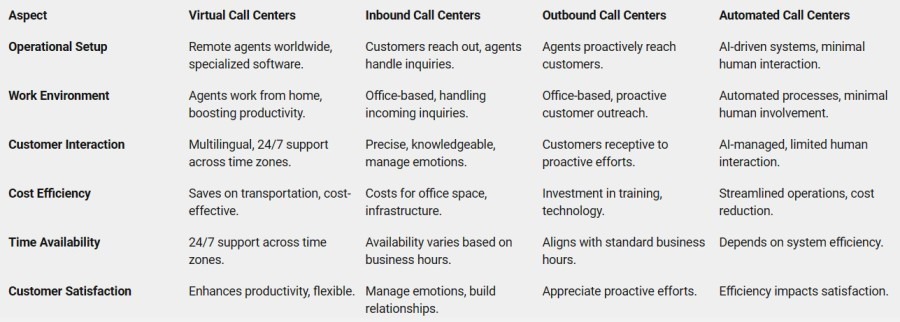
Virtual call centers: Virtual call assistant have revolutionized customer service by introducing efficient technological solutions. The virtual call center agent workforce is expected to increase by 60% from 2022 to 2024. Utilizing specialized software for customer interactions, agents are stationed at different locations worldwide, working remotely to benefit the organization. This setup offers flexibility for agents to work from home, enhancing productivity and serving as a cost-saving tool for businesses. By eliminating transportation expenses, businesses can operate more efficiently. Moreover, virtual call centers enable businesses to provide 24/7 customer support across different time zones. Additionally, they have the flexibility to hire multilingual agents to cater to diverse customer needs.
Inbound call centers: In this type of call center, customers reach out to agents for assistance with their queries or to resolve issues. Customers typically wait for a period before being connected to an agent. Agents in inbound call centers need to be precise, knowledgeable, and skilled in communication. LeadGenius reports that 70% of leads generated through phone calls have a conversion rate into paying customers, whereas only 2% of web leads convert into paying customers.They should also possess technical expertise, as customers may exhibit emotions such as frustration or confusion. The key for agents in these situations is to effectively manage customer emotions and build lasting relationships with them.
Outbound call centers: In this type of call center, agents proactively reach out to customers to ensure their satisfaction with products or services. Although it may seem daunting, this proactive approach is essential for gathering feedback and strengthening customer relationships. In outbound centers, customers are generally receptive during these interactions, appreciating the company’s efforts to ensure their happiness.
Automated call centers: Automated call centers rely on computer-based systems to manage the call center process. Tasks may include booking appointments, checking the status of orders, or providing information about products or services.The use of Artificial Intelligence (AI) in call centers is expected to become a $4 billion industry by 2027. Companies implement automated call centers to streamline operations and reduce costs. Artificial intelligence (AI) plays a significant role in these systems, enhancing efficiency and responsiveness.
Below is the table which depicts the key features in the summary:-
At Katrium, we take pride in our 16-year track record of expertise in the call center industry, with a focus on serving businesses throughout the European Union, by providing our service in 24 official languages. Our language proficiency spans Bulgarian, Croatian, Czech, Danish, Dutch, English, Estonian, Finnish, French, German, Greek, Hungarian, Irish, Italian, Latvian, Lithuanian, Maltese, Polish, Portuguese, Romanian, Slovak, Slovene, Spanish, Swedish, and even Russian. I propose scheduling a meeting to explore how our specialized knowledge can add value to your endeavors.
Pros and cons of working in a call center
It is rightly said that “Every rose has its thorn,” so it is true to acknowledge that while there are numerous merits to working in call centers, there are also some associated demerits.
Pros:
Learning Transferable Skills: This job cultivates politeness and patience, which are invaluable traits for long-term success in any profession. As a recent graduate, these skills not only provide a solid foundation for future roles such as blog writing or market research but also help in understanding the company’s values and culture. Thus, it serves as an ideal starting point for your career journey. A study conducted by the City of London revealed that an impressive 96% of employers view transferable skills as highly effective in identifying suitable candidates for positions.
Enhanced Communication Skills: Call center roles not only improve professional communication but also overall interpersonal skills. Continuous feedback and training are pivotal in this regard, fostering confidence and proficiency in engaging listening and quality probing questioning, crucial for problem-solving.
Great Career Opportunities: Within this field, one’s work performance speaks volumes. Regardless of being new to the workforce, there are ample opportunities for career advancement, along with benefits such as medical coverage and company perks, coupled with competitive remuneration.
Cons:
More Working Hours and Stress: Working in different shifts to accommodate clients across diverse time zones can disrupt one’s routine, especially when working night shifts. This can affect personal life but also builds resilience for future challenges and enhances leadership skills.
Monotony: Spending 8-9 hours a day in the same position, engaging with different customers, can lead to feelings of boredom and a lack of productivity. Taking regular breaks to visit family or go on trips can help recharge and maintain motivation. Additionally, prioritizing health through activities like exercise, staying hydrated, and meditation is essential.
Mood Swings: Dealing with angry customers who may use harsh language can negatively impact one’s mood. However, with experience, individuals learn how to effectively handle such situations and minimize their impact on overall well-being.
Benefits of Outsourcing Call Center
The call center is equipped with the latest technology to enhance the customer experience. Let’s explore the reasons why you should invest in a call center:
Cost-effective staffing: Businesses aim to focus on their core operations without the burden of hiring and managing additional staff. Setting up the infrastructure for new employees, including recruitment, onboarding, and insurance, can be prohibitively expensive. According to a customer satisfaction survey conducted by Clutch, 73% of companies reported experiencing a boost in customer satisfaction after outsourcing their call centers. By outsourcing customer support services to third-party vendors, businesses can save costs and concentrate on their primary objectives, thereby enhancing their reputation in the market.
Utilizing new technology: Given the rapid evolution of technology, staying updated with the latest tools to stay connected with customers becomes essential. Outsourcing companies strive to stay abreast of these advancements and integrate them effectively for improved productivity and customer satisfaction.
24/7 support: Businesses strive to maintain constant connectivity with their existing and potential customers. However, most companies operate during regular business hours (9-5), making it challenging for them to provide round-the-clock support.According to a study conducted by Zendesk, 58% of customers anticipate having access to customer support services around the clock. Outsourcing this service enables businesses to offer better-quality experiences to their customers, ensuring support is available whenever needed.
Easily scalable: Business operations fluctuate, and it’s crucial to adapt to changing demands. Outsourcing customer care allows for flexible scalability, enabling businesses to adjust their workforce according to seasonal fluctuations or market trends. For instance, during peak seasons like summer when tourism is high, travel agencies may require additional staff to handle customer queries. Conversely, during slower periods like winter, they can scale down their operations. Outsourcing customer care provides the flexibility to meet these varying needs effectively.
Multilingual support: Operating in multiple nations presents linguistic challenges that can lead to miscommunication and inefficiency. Multilingual support addresses these issues by ensuring effective communication with customers across different languages and regions. Outsourcing customer care provides an easy solution to manage linguistic diversity, improving productivity, customer service, and overall operations.
Call centers must possess skill, renown, and experience to ensure optimal customer experience. Neglecting any of these factors can significantly impact customer satisfaction. With Katrium’s established name and extensive experience, you can rest assured of quality service . Book a meeting with us and explore how we can enhance your customer relationships.

How to begin a call center in 10 steps:
1. Build up the objectives and targets of your call center
The primary and the foremost basic step to a fruitful call center setup preparation is characterizing the objectives, targets, and the purpose of your call center. Those are reaching to direct the major center and the kind of operations you may handle. For occasion; inbound/outbound or both. Additionally, the number of workers you’ll got to enlist for your team, the forms you’ll actualize.
2. Decide the setup sort (On-site Vs. virtual)
Choose in case you take a physical call center with in-house operators or a virtual call center with inaccessible operators. A physical call center will work on-site. Meaning, from a central area with all the required assets. Such as; framework, computer program, and representatives in one put. It is frequently a structure inside the trade premises.
In a virtual, or farther call center, equipment and foundation is the obligation of a benefit supplier. The operators will be working remotely. This implies most likely from their possess homes, or any other put.
3. Gauge the budget and staffing necessities
Set the budget that is aligned with your business objectives and set up parameters with respect to the least and the greatest costs. The budget at your transfer will in the long run decide what kind of office and technology will be utilized, as well as the labor included. Differentiate between your beginning speculation to construct a call center and continuous working costs to keep it running. You ought to moreover be able to define the staffing necessities. These are based on expectations, call volume forecasting, taking under consideration all shifts, staff truancy, and days off.
4. Decide on the sort of call center program
There are four sorts of call center computer program arrangements (on-premises, facilitated, cloud-based, and browser-based) that vary in terms of fetched, sending demonstrate, upkeep, versatility, and strength. It is essential to begin with distinguishing the foremost appropriate sort of call center program for your trade some time recently shortlisting potential suppliers.
In expansion to the quick arrangement time, cloud-based and browser-based call center computer program arrangements are for the most part more cost-effective. The reason is that they require negligible forthright speculation. Additionally it is less demanding to execute and scale, not at all like their on-premises and facilitated partners.
5. Select the computer program supplier based on your requirements
Since there are various call center program suppliers on the showcase, selecting the proper arrangement that will best fit your organization’s needs may be challenging. Make the list of ‘must-have’ highlights that you just unquestionably need. In this way, your group can work at their ideal levels. Another section on your list ought to be ‘nice-to-have’ features that are alluring but not basic.
When inquiring about the alternatives, separated from the highlight set, take into account ease of sending, utilize, adaptability, security, integration choices, tech bolster, and estimating.
6. Design your call center computer program ideally
Once you’ve chosen the correct call center software tool, customize it concurring to your team’s needs and necessities. Beyond any doubt all the highlights are designed ideally from both; an agent’s and a caller’s point of view. Your group ought to be able to utilize the call observing computer program easily and efficiently in their workflow. When it comes to inbound calls, make an easy-to-navigate IVR menu. It ought to incorporate welcome and messages that are suitable to supply a consistent encounter for callers.
7. Staff your call center group
Your call center group ought to comprise operators who are specialized in item support, technical back, or other components of client benefit. Having a call center chief who will oversee all call center operations, guarantees operators follow internal policies and procedures.
Depending on your needs and the estimate of your team, other parts might incorporate a group pioneer/ administrator, a call center analyst, a call center coach, etc. Notwithstanding a position, all call center representatives simply hired should possess certain skills/abilities. Such as; fabulous communication aptitudes, show tolerance, sympathy, and problem-solving capacities.
8. Get fitting call center hardware
On-premises call centers require all the equipment and whole foundation counting servers and call center phone frameworks to be set up in your area. In any case, with cloud-based call center software, hosted or browser-based arrangements, your call gear list fundamentally comes down to computers, USB headsets, a high-speed web association, call center work areas, and ergonomic chairs for the consolation of your group.
9. Organize your call center processes
To guarantee your call center setup works consistently and proficiently, plan and make well-thought-out forms for your group to take after. In this way the operators can easily refer to their day-to-day exercises. In common, call center forms characterize; how the agents reply calls, how they heighten an issue in the event that they can’t reply a question, how they track client inquiries, what happens after a call is total, etc.
To diminish hold up times, you ought to build comprehensive call center scripts that specialists can utilize when interacting with clients.
10. Make a robust catastrophe recuperation arrange
To ensure continuous customer satisfaction, it’s crucial to develop robust disaster recovery and backup plans for the final stage of a call center setup. Design these plans to keep the business operational constantly, minimizing potential risks or disruptions’ impact on the network and call center operations. It is essential to document and regularly test the recovery plan, as well as train agents on the necessary steps to take in the event of any unexpected disruptions.
Bottom line
Think of call centers as your business’s secret Santa. They use advanced tools and people skills to turn unhappy customers into happy ones and keep the satisfied ones engaged. By learning how they work and fitting them into your business plan, you can unlock new success in the market. That’s why it would be apt to say that call centers are like the unsung heroes of business.
Katrium stands as a seasoned player in the call center industry, boasting over 16 years of experience. With a focus on flexibility, affordability, and fostering long-term relationships, Katrium has maintained partnerships with some clients for over 16 years. Grounded in strong values and mission, Katrium invites you to explore how they can elevate your business through a virtual meeting.


3 Responses