In 2026, the number of companies utilizing the services of experts in the expert network would be 11,200. In 2012, the number was just over a thousand, which included hedge funds and top-end consultancies. The rest of the world has no idea this even exists. The rest of the world still has no idea. One of the most underappreciated advantages in business today is the gap between the world that understands how to access this kind of industry intelligence and the world that still relies on secondary research.
What are Expert Network Services
Expert network services provide access to industry specialists for consulting purposes. An expert is an industry specialist, former executive, former operator, or former regulator. An expert shares their knowledge and experience with the client based on their own experiences and involvement in a specific industry, market, or function.
Expert network services provide the client with access to the expert for a period of time, usually 30 to 60 minutes. This is unique information that cannot be found anywhere else.
Who uses expert network services:
- Private equity and venture capital firms doing deal due diligence
- Management consultants seeking to validate client strategies
- Corporate strategy and M&A teams evaluating new markets
- Hedge funds and investment managers building investment theses
- Market researchers seeking primary qualitative research
Of all the expert network services users, consulting firms make up about 40% – 50% of the expert network services demand. Private equity firms make up about 35% – 40% of the demand. However, the fastest-growing segment is the corporate strategy teams. These are businesses that have moved from traditional research to expert network services.
How Expert Network Services Work
The model is simple but the execution varies from company to company.
- Brief Submission – Client specifies what information is required and who they need to talk to
- Expert Identification – Network uses database and actively seeks experts who match the brief
- Screening & Vetting – Experts are checked for suitability, timeliness, and regulatory compliance
- Scheduling – A call is arranged between the client and the expert
- Call – A discussion is held between the client and the expert
- Compliance Sign-off – Final confirmation that no material non-public information was discussed
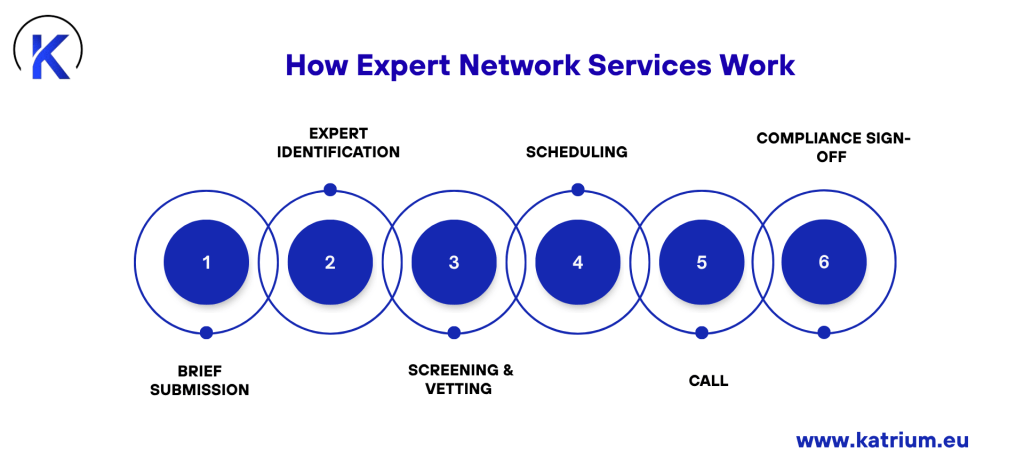
The entire process can be over in 24 to 48 hours for simple briefs. More complex or niche requirements can take longer.
Types of Expert Network Services
Not all expert network services are created equal. The main types of expert network services are as follows:
- Expert calls, which are 30 to 60 minute calls with experts, are the main service provided by most expert networks. This is the most effective service for obtaining in-depth, qualitative information.
- Transcript libraries, which are libraries of expert calls, can be useful for quick background information but are limited to information obtained in the past.
- Surveys, which involve sending questions to verified experts, can be useful for obtaining quantitative validation from a larger group of experts.
- Written reports, which involve obtaining expert-written reports, are useful for obtaining expert information but can be expensive.
- AI-assisted search, which is an increasingly popular service offered by larger expert networks, is useful for high-volume expert research teams.
Transaction-based models, in which clients pay per consultation, dominate the expert network industry, with 60% of expert network engagements, while subscription models make up 40%.
Selecting the Right Expert Network Services Provider
There are now more than 120 active expert networks worldwide. However, there are big variations in terms of quality, specialisation, and cost.
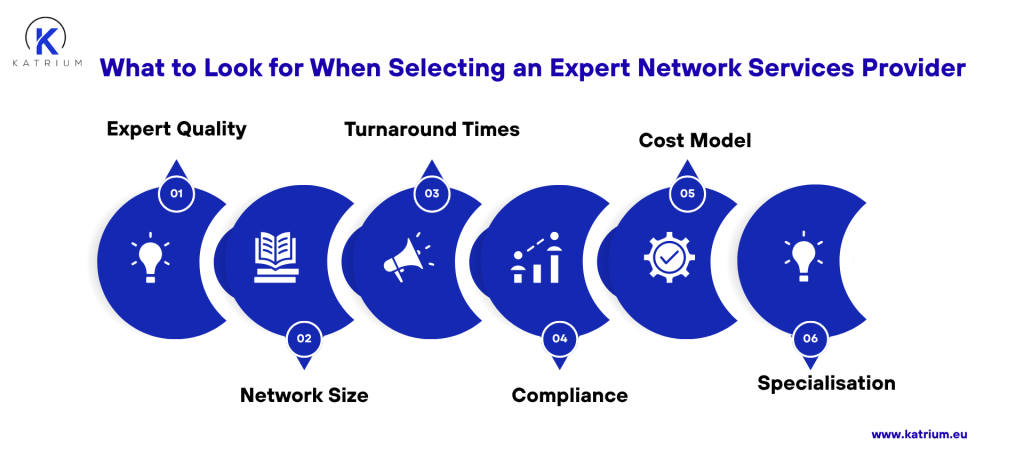
What to look for when selecting an expert network services provider:
- Expert Quality: How thoroughly are these experts vetted? How fresh is their relevant experience?
- Network Size: Does the network have real presence in all areas you want to research?
- Turnaround Times: How quickly can they source for hard-to-find or highly specific requests?
- Compliance: What are their standards for avoiding conflicts of interest and insider information?
- Cost Model: Per-call plans are good for one-time users. But for teams doing continuous research, subscription plans are better.
- Specialisation: Generalist networks have breadth, while specialist boutiques have depth in particular industries
Expert Network Services vs. Traditional Research
Traditional research, which includes analysts’ reports, publicly available data, secondary research, provides breadth and history. In comparison to that, expert network services provide depth and timeliness.
Where Expert Network Services excel:
- Speed – weeks to commission a report, and often out-of-date when received. Expert calls are delivered within days
- Specificity – you call someone to discuss your specific question, not a general market overview
- Recency – you talk to someone living in the market today, not someone writing about it six months ago
- Honesty – a straightforward conversation reveals information that may not have appeared in published reports
- Customization – you ask the questions you need to know, not those you were told you need to know
Where traditional research still plays a role:
- Establishing a general knowledge base before undertaking expert calls
- Quantitative data on a large scale that cannot efficiently be collected otherwise
- Historical trend analysis
- Regulatory and compliance information
The ideal research program will use both. Expert network services address a gap that secondary research inherently cannot.
Final Thoughts
This is why expert network services exist: the best information in any market is not in a report; it’s in the mind of someone who’s actually lived in the market. The reason the expert network industry is growing so fast is that the companies making the best decisions are the companies that are talking to the right people, not reading about them.
Most companies already realize the need for better information. The problem is not knowing where to begin. Katrium can help with that if you reach out.