
Quantitative research is a widely used approach in market research that focuses on collecting and analyzing numerical data. From understanding consumer preferences to evaluating market trends, it plays a crucial role in helping businesses make informed, evidence-based decisions.
This article explores everything you need to know about quantitative research—what it is, why it’s important, how it works, and how Katrium uses it to help clients grow in local and international markets.
What Is Quantitative Research?
Quantitative research is a systematic investigation technique that relies on numerical data to describe, explain, or predict phenomena. It is used to quantify opinions, behaviors, attitudes, or other defined variables and generalize results from a larger population sample.
For example, a retail company may want to know how many customers are satisfied with their service. Instead of conducting open-ended interviews, they use a survey where customers can rate their satisfaction on a scale from 1 to 10. This is a perfect example of quantitative research in action.
Importance of Quantitative Research in Business and Market Strategy
The role of quantitative research in market research cannot be overstated. It provides the foundation for data-driven decisions by enabling:
- Accurate measurement of customer preferences
- Predictive analysis based on consumer behavior
- Tracking trends over time
- Benchmarking marketing performance
- Assessing brand perception
At Katrium, we use quantitative methods to help businesses explore new markets, understand customer needs, and gain competitive advantage. With our multilingual and cross-border capabilities, we ensure that the insights we gather are both reliable and culturally relevant.
Core Methods Used in Quantitative Research
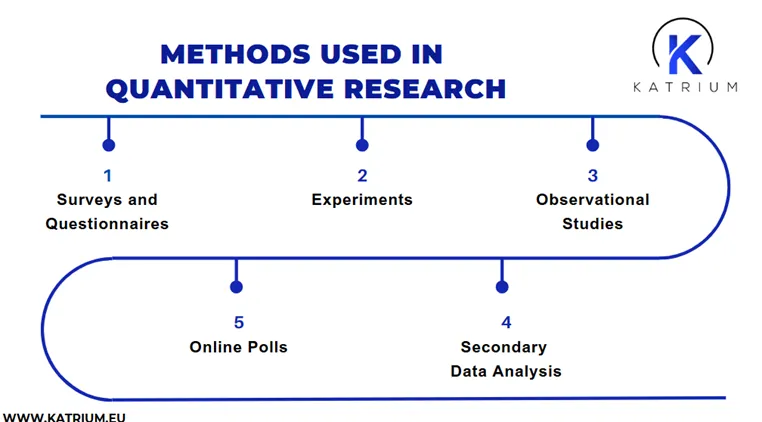
There are several methods used to conduct quantitative research, each suitable for different types of market questions:
1. Surveys and Questionnaires
These are the most common tools. Participants answer pre-set questions with structured responses such as yes/no, multiple choice, or rating scales.
2. Experiments
In experimental research, researchers control and manipulate variables to identify cause-and-effect relationships. For example, A/B testing in digital marketing helps determine which ad format performs better.
3. Observational Studies
This involves tracking and recording behavior without interference. Businesses use this to analyze customer movement patterns in stores or clicks on a website.
4. Online Polls
Polls offer quick insights into public opinion on specific topics. They are useful for collecting large volumes of data quickly.
5. Secondary Data Analysis
Also known as desk research, this method involves analyzing already available data such as industry reports, census data, or business analytics.
Want to design better surveys? Harvard’s questionnaire design tips offer you some simple ways to improve your survey accuracy and clarity.
Quantitative vs. Qualitative Research: What is the Difference?
Understanding the distinction between quantitative and qualitative research helps in choosing the right approach for your objectives.
| Aspect | Quantitative Research | Qualitative Research |
| Data Type | Numerical | Descriptive or textual |
| Purpose | Measure and predict | Explore and understand |
| Sample Size | Large | Small |
| Tools | Surveys, experiments, polls | Interviews, focus groups, observations |
| Analysis | Statistical and mathematical | Thematic or narrative |
Many companies, including Katrium, use a mixed-methods approach to gain deeper and more comprehensive insights. For example, you may first conduct interviews to gather themes and then design a quantitative survey to validate those findings on a large scale.
Steps in the Quantitative Research Process
Conducting successful quantitative research involves a clear and systematic process:
1. Define the Research Problem
What do you want to understand or solve? The problem must be clear and specific.
2. Formulate Hypotheses
Based on initial understanding, researchers propose hypotheses to test. For example, “Customers aged 18–25 prefer digital products more than older age groups.”
3. Design the Research Tool
Create surveys or experiments that include close-ended questions designed to capture measurable responses.
4. Sampling
Choose a representative group from your target population. The sample must be large enough for reliable results.
5. Data Collection
Collect responses using online platforms, face-to-face interviews, or phone surveys. Katrium specializes in multilingual surveys to cover broader demographics.
6. Data Analysis
Use statistical tools like SPSS, R, or Excel to analyze results. This step reveals patterns, correlations, and trends.
7. Interpretation and Reporting
The final analysis of the report presents the findings in a clear and digestible format, such as charts, graphs, and percentages. This presentation is accompanied according to the business recommendations.
Learn more about top statistical analysis softwares that are used for analyzing the research data.
Advantages of Quantitative Research
Some of the most prominent & key benefits of the quantitative research are:
- Objectivity: Data is measured by the help of unbiased methods, and by reducing personal bias.
- Scalability: This research works well for large group data such as global populations.
- Repeatability: You can further replicate the same study under most similar conditions.
- Data Visualization: Results can be finely presented in a highly appropriate way, like in charts and graphs. It makes them easy to further interpret.
Limitations of Quantitative Research
In addition to all its strengths, the quantitative research has a few limitations:
- Lacks depth: It does not capture emotions, opinions, or reasons behind choices.
- Rigid questions: Participants cannot elaborate on their answers.
- Requires skills: Designing effective surveys and interpreting statistics require expertise.
In order to deal with these limitations, many of the researchers tend to combine the qualitative and quantitative research methods. So that they can get more refined results.
Applications of Quantitative Research in Real Markets
Quantitative research can be used across industries for multiple business purposes, such as:
- Brand Health Tracking: Measuring brand awareness and customer loyalty
- Product Testing: Identifying preferred features or price points
- Customer Satisfaction Surveys: Using NPS (Net Promoter Score) and CSAT scores
- Market Segmentation: Identifying different groups based on buying behavior
- Campaign Evaluation: Measuring the impact of marketing campaigns
Best Practices for Conducting Quantitative Research
Here are some expert tips to make your research more effective:
- Use clear and simple language in surveys
- Pilot test your questionnaire before full rollout
- Maintain respondent anonymity and data privacy (e.g. GDPR compliance)
- Ensure sample diversity to avoid biased results
- Use appropriate statistical tools for deeper insights

You can check Katrium’s market research strategy to learn more about our approach to quantitative insights. We follow industry best practices to ensure our research results are not only accurate but also actionable. We believe that effective research is not just about numbers—it’s about turning numbers into decisions.
Katrium’s Approach to Quantitative Research
Katrium is a trusted partner for companies looking to expand their markets, improve customer service, or test new product ideas. We conduct quantitative research across borders and languages with a deep understanding of local cultures and global markets.
Some of our featured services include:
- Multilingual market surveys
- Data collection and analysis
- Business environment research
- Customer satisfaction tracking
Check out Katrium’s blog post on how multilingual customer support increases brand loyalty—a perfect example of how data can inform strategy.
Conclusion
Quantitative research is a highly essential approach for companies that want to build strategic, and evidence-based decisions for the business growth. We at Katrium are committed to delivering high-quality quantitative research. The services help clients to navigate complex markets with clarity and confidence. If you are looking to unlock real market value by the help of data, our expert team is here to help you & your company.Want to explore more insights? Contact us to learn about customer behavior, market entry strategies, and global business trends.
One Response