
Types of research data are generally classified based on their qualities, sources, measurement methods, and structure of organization. In order to aid researchers in selecting the appropriate research methodology to implement and in selecting the correct analytical tools or developing the proper means of collecting, storing and analysing data to arrive at valid conclusions.
If an organization understands how to categorize its research information accurately, it will be able to interpret the results of research properly and to use the knowledge gained through research in its decision-making process.
Business and organisational research projects will have many different forms of research data associated with them. Businesses and organisations will commonly combine these classifications together to obtain a complete overview of the market, customer behaviour and trends.
Data Classification by Nature
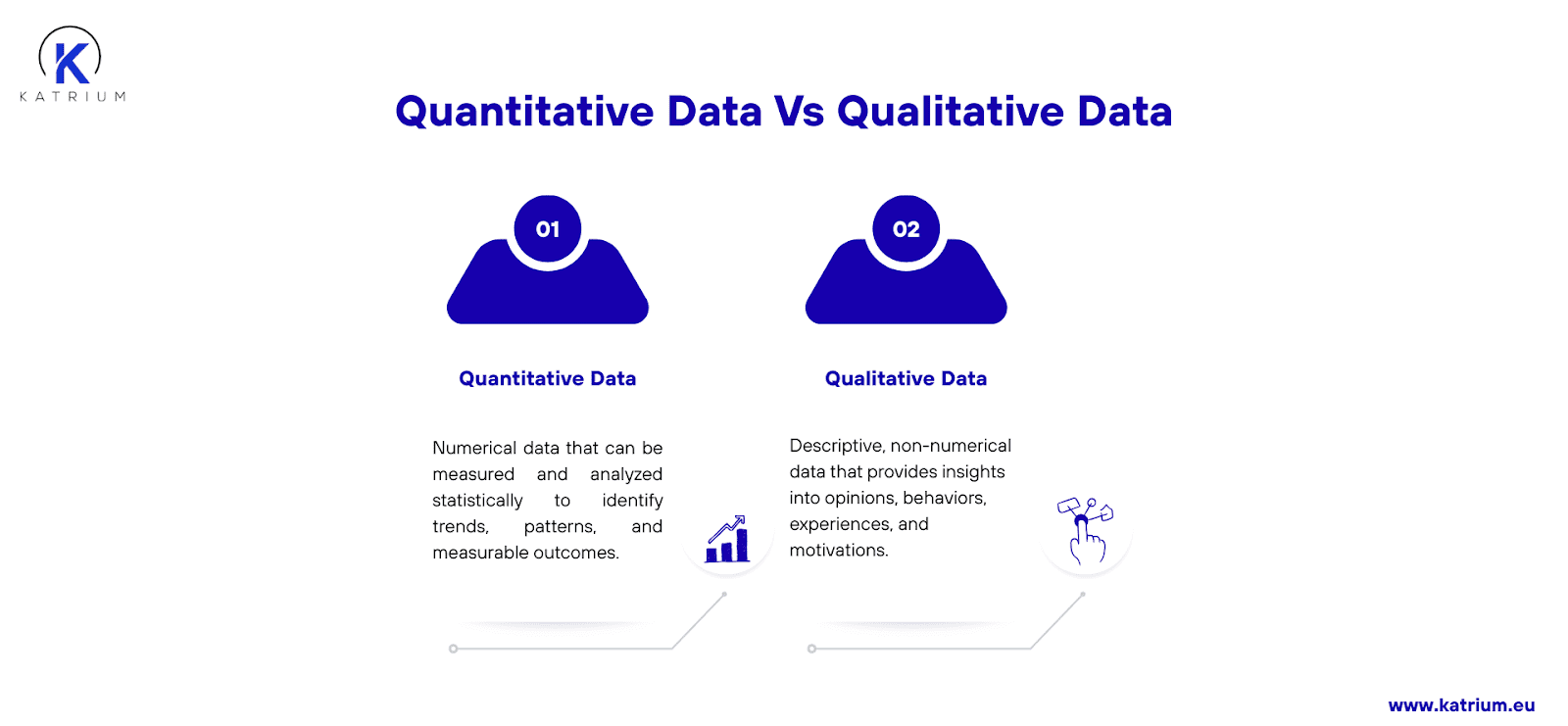
Researchers classify research data to better understand it. A common way to classify research data is according to its nature. For example, there are two types of research data: quantitative data and qualitative data.
Quantitative data is used to determine how many of something there are or the size of an object, which refers to measurement that can be analyzed statistically. Examples of quantitative data include financial reports (i.e., dollars created through sales), survey results, number of visitors to a website, and number of people in a specific geographic area. Because quantitative data can be mathematically calculated, they usually become a fundamental source for the collection of information to perform statistical analysis and/or to use as input for predictive modeling.
Quantitative data can be further broken down into two distinct types:
- Discrete quantitative data which consists of discrete values that cannot be subdivided (example: number of employees in a business organisation).
- Continuous quantitative data which can assume all values in a defined range (example temperature, height, income levels).
Qualitative data provides descriptive information about subjects as opposed to numbers. Descriptive data helps researchers to gain insights into and explain individuals’ opinions, behavior, and experiences. Examples of qualitative data include transcripts from interviews, open-ended survey answers, customer comments, and notes from observations made by a researcher. Qualitative data does not allow researchers to easily assign numerical values to it, but qualitative research is very good at helping researchers understand the reasons for individuals’ behavior towards an object/brand.
Data Classification by Source
Another important distinction is based on how the data is collected, commonly referred to as primary data and secondary data.
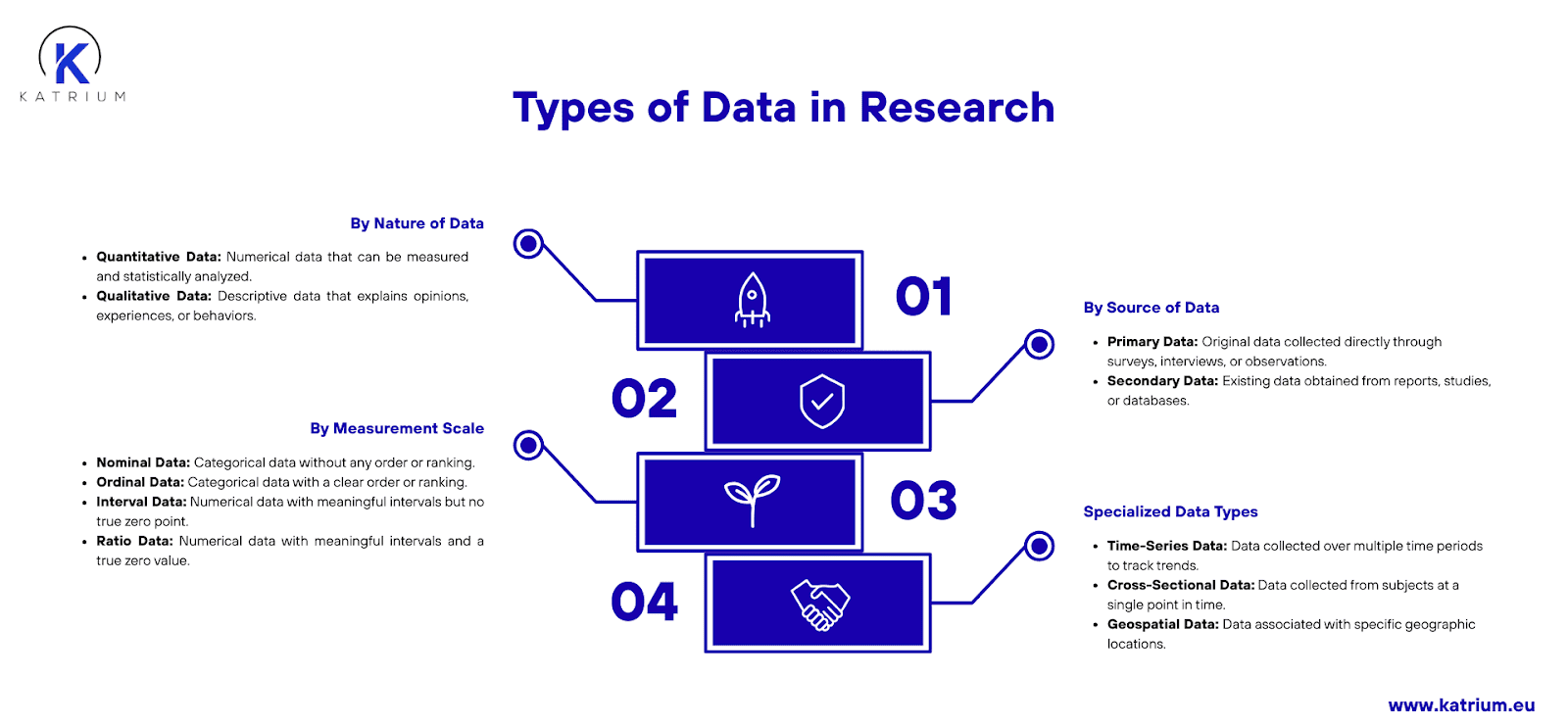
Primary data is collected directly for research purposes. Surveys, interviews, experiments, and field observations are common methods of primary data collection. Because primary data is collected firsthand, it has the highest relevance for providing accurately targeted insights into the specific researcher’s objective.
In contrast, secondary data is defined as information (or data) already collected and published by others. Secondary data can be obtained from such sources as government databases, academic papers/research publications, industry studies/reports, and global/foreign statistics. Researchers can use secondary data to either determine trends across a larger sample before conducting their own studies or to provide background for designing a new, original research study.
For those researchers that seek to analyze the economic conditions in a particular market, they may research various economic reports (or publications) to determine what type of surveys they will design for their own studies. Credible external sources of secondary data would include government entities and international research organizations. To understand the distinction between primary and secondary data better, you can refer to this article.
Data Classification by Measurement Scale
Research data can also be classified based on the measurement scale, which defines the type of analysis that can be done on the data.
Nominal data is used to classify categories that do not have a specific order. Examples of nominal data include gender, nationality, or product categories.
Ordinal data is used to classify categories that have a specific order or ranking. Examples of ordinal data include survey responses such as “strongly agree,” “agree,” and “disagree.”
Interval data is used to classify data that has numerical values, and the difference between the values is significant, but there is no zero point. Examples of interval data include temperature measured in Celsius.
Ratio data is similar to interval data but it has a zero point. Examples of ratio data include age, income, distance, or weight. Ratio data enables the researcher to make comparisons and calculate ratios between values.
Having the knowledge of the measurement scale is important because it defines the type of analysis that can be done on the data during analysis.
Specialized Types of Data in Research
Apart from the general categories, research may also involve specialized types of data based on the research design.
Time series data is collected over a series of time points, enabling the researcher to monitor trends and changes over time. For instance, monthly sales data or annual population data are common examples.
Cross-sectional data is collected at a single point in time from a series of research participants or observations. Most surveys and market research studies rely on cross-sectional data to provide insights into the current situation.
Geospatial data, on the other hand, is information that is associated with geographical locations. Examples include satellite images, mapping information, or location-specific demographic data. This type of data has become more prominent in areas such as urban planning, environmental studies, and location-based marketing.
Conclusion about types of data in research
Recognition of various types of data in research allows researchers and organizations to use suitable methods for collecting and analyzing data. The various classifications based on data nature, data sources, measurement scales, and research designs offer us a framework for understanding data in a correct manner and utilising it to derive meaningful insights from them.
Diverse data types are more reliable in providing insights since numerical data analysis is supplemented by qualitative data analysis. Organizations that effectively manage various data sources are in a better position to understand market trends and opportunities, thereby aiding in informed decisions. Organizations that want to gain more insights about their market and consumer behavior often use a systematic process for research. At Katrium, we assist organizations in collecting and analyzing various types of data for research. You can contact us to know more about how we can help your organisation gather and derive meaningful insights from research data.