
One of the most effective steps in decision-making for businesses is a market research plan. It enables them to truly understand the needs of their target audience, along with the way their competitors are operating. Many businesses are found to be investing vast amounts in developing their products. But they fail to check the extent to which their product or service is required in the niche they’re targeting. With no prior market research data, the business owners could misuse the marketing budget on the wrong channels. This would only give them a little return on the investment. When businesses have a practical plan set, they can get an opportunity to see the big risks right at the early stages. Instead of guesswork, the teams can act on the real facts about how and when they need to expand into new sectors.
What are the core objectives of a market research plan?
In the initial phases, businesses identify the objectives for their research. This way, they don’t waste any unnecessary time or capital on collecting irrelevant data. With the well-structured market research plan in place, the teams can find out ways the competitors are pricing their products. They can also learn their customers’ needs and challenges, and identify the gaps competitors could have missed.
More importantly, a market research plan is not a one-time job. Instead, it runs on a permanent basis to continue the sustainable growth journey. The market changes, and the needs and behavior of customers shift over time. Businesses that keep monitoring customer feedback and industry benchmarks can always align their services proactively. This enables businesses to hone their go-to-market strategy, stay ahead of the competition, and expand their businesses at minimal risk.
How to build an effective market research plan
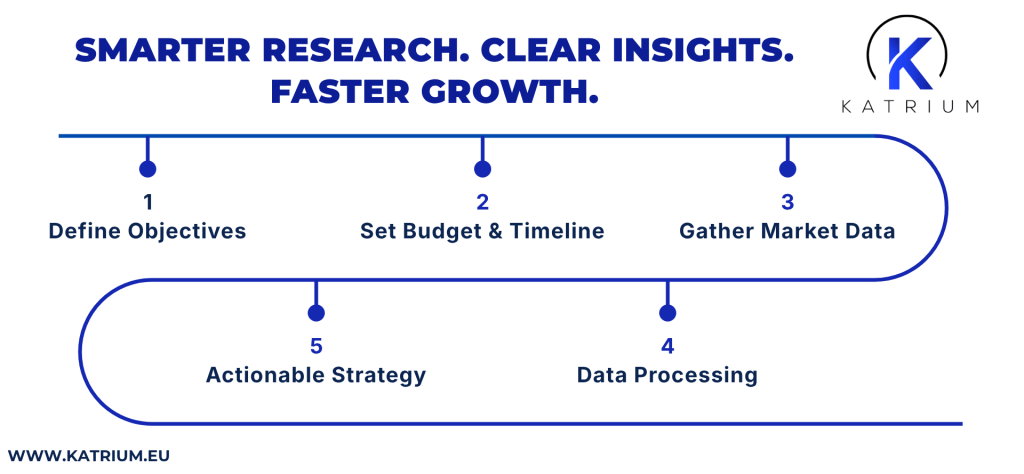
When companies break their objectives into small steps, they’ll stay organized. The most popular objectives in a growing business revolve around factors like the demand for the product, competitors’ advantages, and customer satisfaction. Teams should decide which of those areas they need to work on. The first step towards building a market research plan is to identify the key questions the business needs to answer.
After getting a clear idea about the key objectives, businesses need to set a realistic budget and a practical time limit. This keeps the project on track. Defining the budget and duration early helps the teams to plan their resources effectively and select the best research methods. Teams won’t waste the money or face any delay. Once teams are set with clear deadlines, they can progress into gathering the relevant data about the market. This includes both primary data, such as customer interviews and direct customer surveys, and secondary data from competitor analysis and industry reports. With a structured schedule and budget, the data collection process stays focused, accurate, and aligned with the company’s core business objectives.
Addressing data and resource problems
Reliable data collection is more challenging than most growing businesses realize. The internal teams get excited in the first phases and start the job with passion. However, over time, they have to keep up with the everyday job of answering customers and closing fast-paced sales. According to Investopedia, an effective market research process should engage target buyers directly to test the actual demand. Still, when no schedule or boundaries are set, the important customer communications get neglected easily as the regular job workload piles up.
It’s no different for small businesses with a few employees. Their internal teams cannot go through detailed interviews, nor can they keep an eye on their competitors in the market. The use of professional support partners during early business phases really makes a difference. They keep collecting information in the background. By partnering with Katrium’s market research services, businesses can easily access verified international market data. They can also keep track of rival brands in the market, without stressing the teams.
From data to actionable strategy
Accessing the data is only half the work. The real change happens when organizations process the findings into an actionable strategy. Many teams end up with a complex spreadsheet that they’ll never use. The team is too busy to organize the raw numbers. That’s where the professional data processing service at Katrium makes a vital difference. It organizes messy raw numbers, survey responses, customer feedback, etc. into a structured report that decision makers can easily interpret.
Once the market patterns are well-organized, the leadership teams no longer need to work based on assumptions. By including a structured market research process in the modern business strategy, businesses can test their ideas directly with real consumers, prevent expensive mistakes, and set an effective, reliable base for long-term growth.
Conclusion & Key Takeaways
An effective market research plan is never a one-time project that a business completes and then abandons. Customers have changing behaviors, competitors are updating their strategies, and new channels keep appearing in the market all the time. This makes relying on past data a big risk for a business. The businesses that achieve sustainable growth set up a regular review cycle. They check at least every few quarters to see the customer feedback and their benchmarks in the market.
It’s always better to treat your market research plan as a permanent routine, not a one-time fix. When teams no longer rely on guesswork for decisions like pricing, budgeting, and developing products for the market, they have a higher chance of growing with less risk. Contact Katrium to learn more about how our research support services can help you to build an effective strategy for international growth.