




Data collection in Europe presents an intriguing opportunity for businesses to gain insights into European markets and expand their operations. Nevertheless, data collection in Europe is a tightly regulated process. The General Data Protection Regulation (GDPR) has become the world’s most influential privacy framework, setting high bars for transparency, accountability and individual rights.
At Katrium, we work daily with international companies navigating European markets. A big uncertainty related to data collection in Europe is about what the GDPR actually demands in practice. This blog post will thus outline the essentials that every organization must know when collecting and processing personal data in Europe.
What is the GDPR?
As mentioned above, data collection in Europe is strictly regulated by the General Data Protection Regulation, i.e. the GDPR. The EU adopted the GDPR and requires all member states to implement it as written. It aims to comprehensively protect EU citizens’ and residents’ personal data.
What counts as data collection in Europe?
The GDPR defines personal data broadly: it is any information that can identify a person, be it directly or indirectly. This includes obvious details like names and email addresses, but also behavioral analytics, device identifiers, IP addresses, geolocation, online tracking data and even customer segmentation profiles created through analytics. The person whose data is being collected and processed is referred to as the data subject.
In the GDPR, a distinction between the controller and the processor is also made. The controller determines the purpose and means of processing, whilst the processor processes personal data on behalf of the controller. To exemplify, if your company outsources data collection tasks to a third party like Katrium, you remain the controller, as you decide why and how the data should be processed. Katrium acts as the processor, executing tasks according to your instructions. Despite outsourcing, therefore, you remain in control of the data collection process.
From the GDPR’s perspective, data collection in Europe begins the moment an organization acquires or observes personal information, be it through online forms, CRM systems, surveys or sales processes. It also covers data obtained from third party tools, AI systems and marketing platforms. GDPR makes no distinction between manual and automated collection. What matters is the purpose behind the data and the company’s ability to justify and protect it.
Uniquely, the GDPR applies extraterritorially. Consequently, the GDPR applies to organizations located outside the EU if they collect and process the personal data of EU citizens and residents. Such is the case when an organization offers products or services to persons in the EU, or when an organization monitors their online behavior.

Legal grounds for data collection
European data protection law permits organizations to collect and process data only when they rely on one of the legal bases defined below. Each legal basis carries strict requirements and requires prior selection, with no possibility of retroactive change.
- Consent: Consent must be freely given, informed, specific and unambiguous. Individuals must understand what data will be collected, for which purpose and must actively indicate consent for such processing, for instance by checking a box. Withdrawing consent must be as easy as giving it.
- Legitimate interest: Legitimate interest allows processing when it is necessary for the organization’s legitimate business purposes, provided it does not override the rights and freedoms of individuals.
- Contractual necessity: Organizations may process personal data when necessary to fulfill a contract with the individual or to take steps at their request before entering into a contract. A typical example includes processing customer information to deliver a purchased service or responding to questions about potential agreements.
- Legal obligation: If an organization is required by law to process personal data, this constitutes a valid legal basis. For instance, businesses may be storing financial records to comply with tax regulations or report suspicious transactions under relevant anti-money laundering rules.
- Vital interests: This legal ground applies when processing is required to protect the vital interests of the data subject of another party. Such a reason arises, for instance, when protecting someone’s life or physical safety. This legal basis is rarely used in commercial contexts.
- Public task: Organizations may process data if necessary to perform a task carried out in the public interest or under official authority. The processing must be necessary. Such a legal basis is most relevant to public bodies, but may be used by private companies if applicable.
Key principles embedded in the GDPR
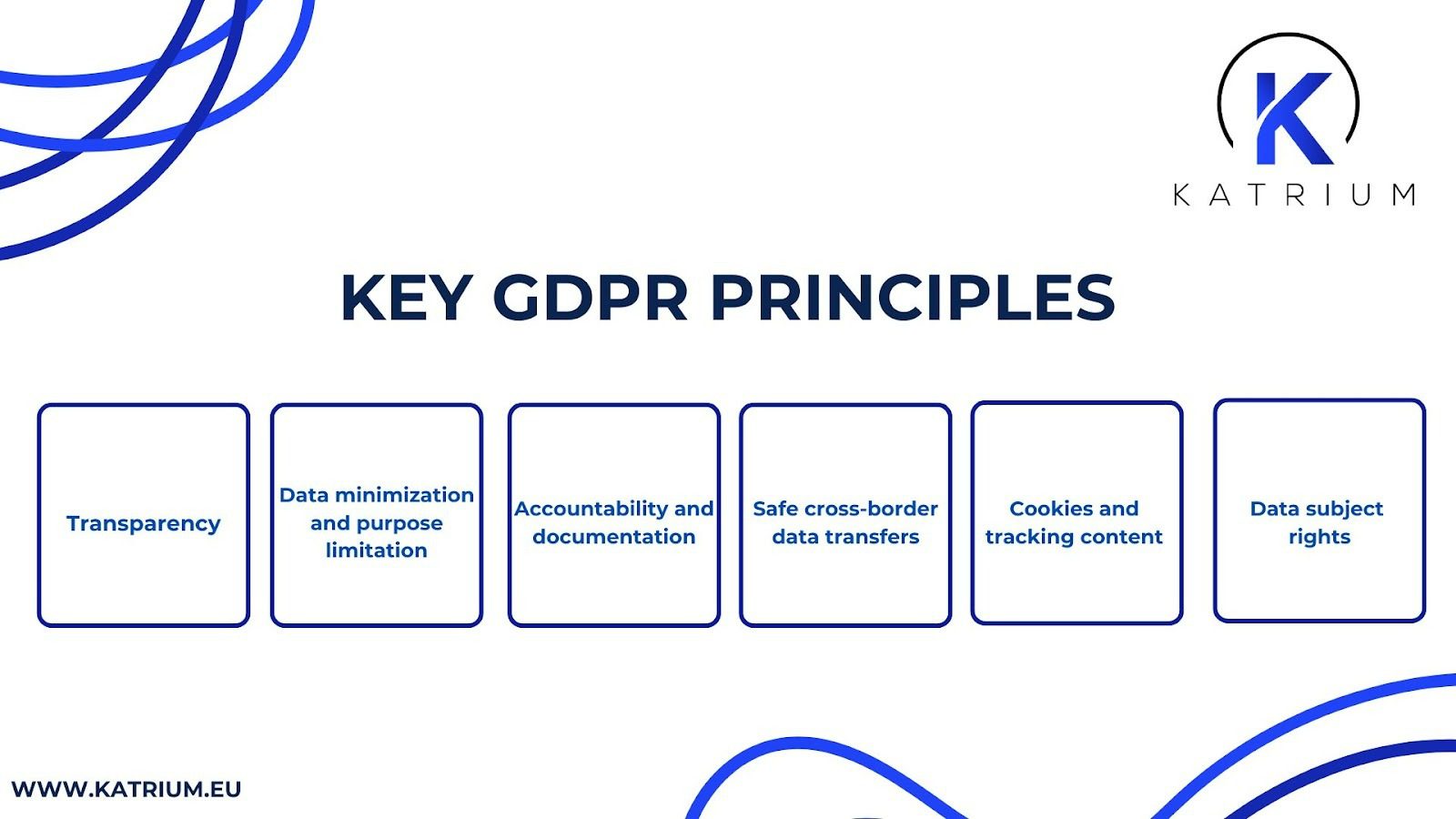
Organizations that collect data in Europe must adhere to the core GDPR principles that regulate the processing of personal data. These apply regardless of the technology used or whether the processing is manual or automated. Every company must be able to demonstrate compliance upon request.
Transparency in data collection
European data protection authorities place a lot of focus on transparency, that is the obligation to clearly explain to individuals what data is collected, how long it is retained for and with whom it will be shared. Therefore, it is important that organizations have a privacy policy. A good privacy policy should cover the controller’s identity, processing purposes and legal basis, retention periods, data subject rights, third-party processors, cross-border transfers, profiling or automated decisions, and complaint channels.
Such information should be provided before or at the time of the data collection, not after. The privacy policy should thus be easily accessible, written in clear language and adapted to its target audience.
Data minimization and purpose limitation
The days of ‘collect now, use later’ are over. The GDPR requires that companies only collect data they genuinely need, use it for only the purposes initially determined and delete or anonymize data when it is no longer necessary. Should an organization wish to use personal data for a new purpose, it must either conduct compatibility testing or, if not feasible, request renewed consent from the data subject. Organizations are required to retain personal data solely for the duration specified in their privacy policy.
Accountability and documentation
Another important aspect of data collection in Europe and the GDPR is the accountability principle. It requires organizations to take responsibility for what they do with personal data, as well as to be able to demonstrate their compliance with GDPR requirements. Every company should therefore have adequate documentation and procedures for collecting and processing data.
For example, if a data breach occurs, the controller must demonstrate active risk-mitigation measures and must notify the supervisory authority and the affected data subjects when the breach is likely to result in a high risk to the rights and freedoms of those individuals.
The role of the Data Protection Officer (DPO)
The law requires companies that carry out large-scale processing of personal data to appoint a Data Protection Officer (DPO). This requirement applies, for example, to security companies monitoring shopping centers and hospitals processing large amounts of sensitive data. The DPO monitors compliance, advises on data protection and handles queries or requests received regarding personal data, among others.
Cross-border data transfers
After data collection in Europe, a company can only transfer said data outside the EU if the destination country provides “adequate protection”. Adequate protection mechanisms include adequacy decisions for countries such as the UK and Canada, Standard Contractual Clauses (SCCs) and Binding Corporate Rules (BCRs). When transferring data to countries that do not have an adequacy decision, companies must conduct Transfer Impact Assessments (TIAs) to evaluate the level of protection in third countries.
Cookies, tracking and online behavioral data
Additionally, companies must be aware of the rules surrounding cookies and tracking technologies. Data protection rules require organizations to obtain active consent for all non-essential cookies, prohibit pre-checked boxes, and mandate that organizations properly record and enable withdrawal of consent.
Data subject rights in data collection
In Europe, data collection also requires enabling individuals to exercise their rights, including access, rectification, erasure, restriction, portability, and objection.
Looking ahead: AI and profiling
As companies increasingly use artificial intelligence (AI) for data collection in Europe, new regulatory trends are emerging. One crucial development is the EU AI Act, which complements the GDPR and establishes a risk-based legal framework for AI systems. The regulatory framework classifies AI systems as unacceptable risk, high risk, or limited/minimal risk and imposes different compliance obligations accordingly. It fully bans unacceptable-risk systems, such as social scoring. High risk systems, often used in recruiting, on the other hand, must meet strict requirements. Businesses should thus be aware of both the GDPR and the AI act to ensure compliance and avoid unfortunate consequences.
The bottom line
European data protection rules require organizations to justify, protect, and explain any data they collect. Failure to comply with the GDPR could pose serious consequences: a fine of up to 20 million euros or 4% of the company’s annual worldwide turnover.
At Katrium, we help businesses collect and utilize data in Europe in a business-driven and compliant way. Our services include multilingual market research, customer surveys, interviews and competitor analysis. All conducted in accordance with GDPR requirements and best practices in data protection. Contact us today to discuss how we can turn your data into true growth!