The world’s top consultancies, investment organizations, and research companies have one thing in common: before making critical decisions, they consult experts. This makes expert interviews one of the most reliable research techniques in today’s business world.
Expert interviews are a qualitative research methodology where experts in a given field or area are asked questions in a structured or semi-structured conversation in order to gain in-depth and firsthand information about a particular area or subject of interest. This is a unique research methodology compared to surveys and focus groups, where interviews are conducted among people whose opinions or views are exceptionally credible, either by their experience, qualifications, or market position, to gather rich information that is beyond the scope of data surveys.
Why Expert Interviews Matter
This is a go-to approach for any organization or research group that wishes to get access to:
- Contextual richness – to gather a better understanding of the ‘why’ of market trends apart from the ‘what’
- Forward thinking – experts often see trends before they are officially recorded in data and reports
- Tested theories – verify your theories directly from the expert in a particular industry or sector
- Authoritative sources – information from experts is considered more authoritative in reports and documents
When to Use Expert Interviews
Such a research methodology could prove to be most valuable in the following use cases:
- Market entry strategies: To navigate an unknown industry in a quick and precise manner.
- Competitive Intelligence: To get a perspective from peers, government, or customers about your industry.
- Product Development: To get validation of problems and solutions from people in the industry before investing.
- Investment due diligence: Stress-testing your thesis with people who have ground-level visibility.
Benefits of Expert Interview
There is no other research methodology that has the same advantages in terms of speed, completeness, flexibility, and accuracy as that of an expert interview. The benefits of conducting an expert interview as a research methodology for decision-makers who need accurate intelligence in a timely fashion are stated below:

- Depth of insights: Insights that are informed by real-world experiences.
- Speed and efficiency: Expert interviews are quicker compared to quantitative research.
- Flexibility: Ability to make changes in real-time.
- Contextual understanding: Ability to look beyond numbers and gain a “why.”
- Access to niche knowledge: Ability to penetrate areas that lack publicly available data.
The benefits of conducting an expert interview as a research methodology make it a highly sought-after research methodology for conducting market research, competitive intelligence research, policy research, and academic research in areas where the cost of an ill-informed decision is much higher than the cost of thorough research.
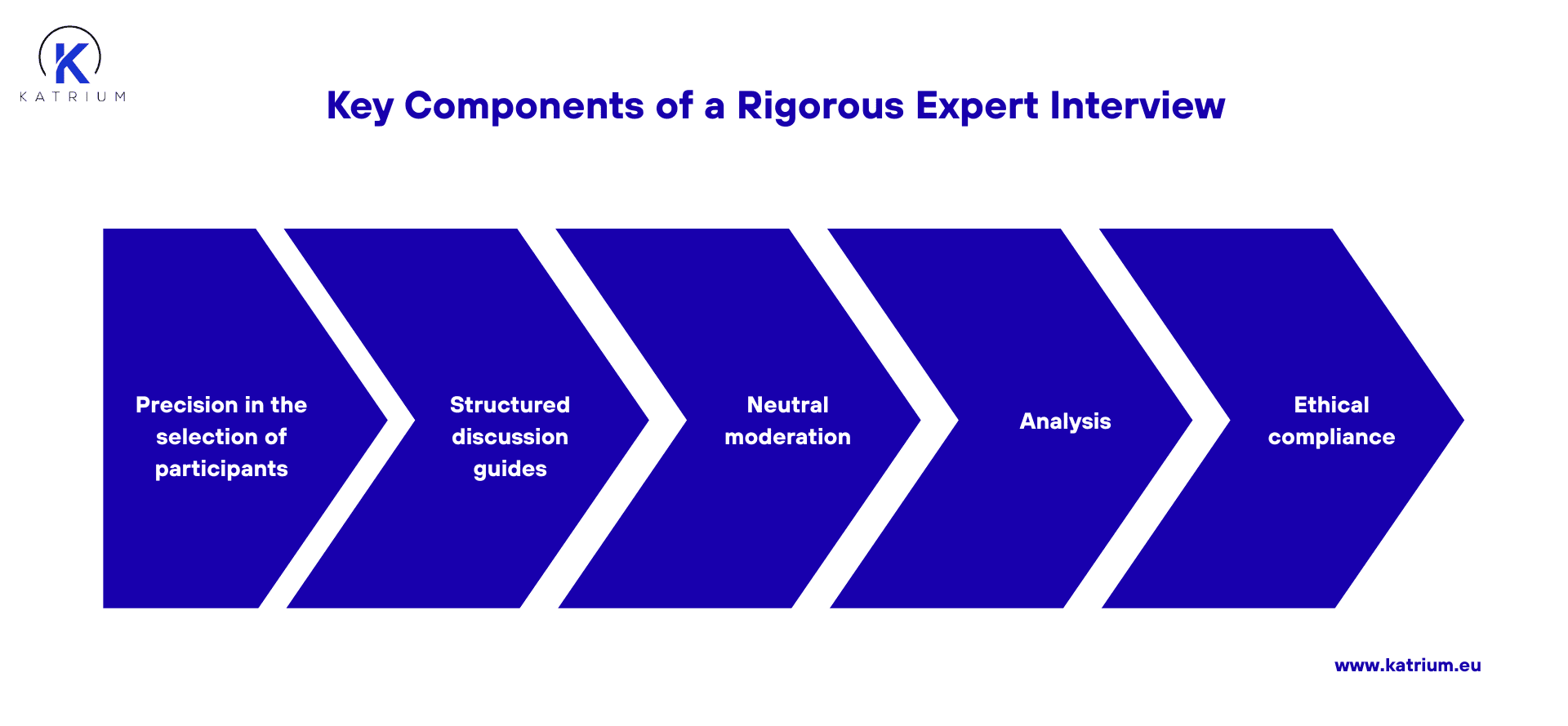
Key Components of a Rigorous Expert Interview
Not all expert interviews are equal in their contribution to the final outcome. For rigorous execution, there needs to be:
- Precision in the selection of participants, where their credentials and direct experiences align perfectly with the research question
- Structured discussion guides, where open-ended questions are asked to promote discovery and not elicit a specific response from the participants
- Neutral moderation, where experts are allowed to ask questions and not impose a framework for response
- Analysis, where data is synthesized across all participants and not cherry-picked for effect
- Ethical compliance, where consent and handling of data are compliant with the requirements
When Expert Interviews Fall Short
Expert interviews as a research methodology have great potential, but at the same time, there are situations where you cannot apply this methodology. Knowing the limitations of expert interviews will provide you guidance on utilizing expert interviews in situations where you can derive maximum benefit from such a research methodology:
- Limited Scalability: Due to the time constraints associated with an interview, you cannot carry out a large number of interviews.
- Subjectivity Risk: Expert interviews are based on personal opinions, which may not be a true reflection of the market as a whole.
- Accessibility: Reaching out to experts, particularly senior experts, may not be an easy task.
- Interviewer Bias: Expert interviews are a vulnerable research methodology, which may fall prey to interviewer bias. This occurs when an interviewer unintentionally influences a respondent to provide answers based on what he or she expects to hear.
- Reproducibility: Expert interviews are hard to replicate, and there is no benchmarking possible.
It is not recommended that you avoid expert interviews based on the limitations of this research methodology. Instead, you should use expert interviews more effectively, as all these limitations can be covered if you use expert interviews along with quantitative research and desk research.
Final Thoughts
The best business decisions are made with the right kind of intelligence from the right kind of source at the right kind of moment. And expert interviews deliver all three in one nice package.
When the stakes are high and traditional data sources are struggling to meet quality requirements, there is simply no substitute for a direct conversation with someone who has been in the room where the decisions are being made.
At Katrium, we understand that good research is the foundation of every good business decision. We provide market research solutions that are built around the same values that make expert interviews so effective with depth, accuracy, applicability, and a focus on making a real difference.