
Expert Network has transformed from being a boutique service employed by just a few hedge funds into an intelligence network worth billions of dollars, supporting entities operating within various industries. As the industry matures, it has split up into several types of service providers, each of which satisfies different requirements, works with varied business models, and offers a completely different type of service.
When considering potential expert network providers, failing to comprehend their categorization will lead you to compare apples with oranges, meaning that you’ll be spending on unnecessary features while ignoring vital ones.
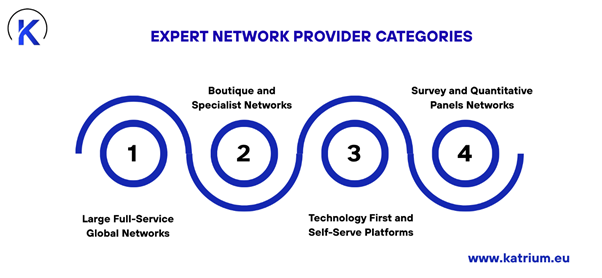
Below is a summary of what the provider ecosystem within the expert network space looks like.
Category 1: Large Full-Service Global Expert Networks
The biggest names in the expert networking field, having established huge expert pools globally, substantial internal recruiting teams, and coverage spanning all industries and functions.
Key characteristics:
- Expert pools with anywhere from hundreds of thousands to well over a million pre-screened experts
- Coverage including virtually all industries, functions, and geographies
- Specialized client support teams overseeing the engagement process end-to-end
- Comprehensive compliance architecture geared toward institutional clients
- Several modes of engagement, including phone conversations, surveys, face-to-face meetings, and written responses
What do they excel at delivering?
Large investment management firms, global consulting organizations, and corporate strategy teams at Fortune 500 companies that engage in extensive research in multiple industries and geographies.
Business model:
- Subscription pricing on an annual basis in addition to hourly consultation charges. Pricing for large enterprises negotiable according to projected consumption.
Important factor:
Size works to their advantage though size can become a weakness. With the largest networks, the caliber of the recruiter will vary substantially by team and geography. An experience of one client with good coverage in an established field such as information technology or health care may differ greatly from another doing work in a specialized or nascent area.
Category 2: Boutique and Specialist Expert Network
Specialized, narrow networks that have explicitly opted for depth over breadth – leveraging a concentrated pool of experts in an industry, function or geography.
Characteristics:
- Focused coverage in a particular vertical or geography
- Recruiters with actual subject matter expertise, beyond simply being able to source
- Higher average quality of experts within the niche
- Personalized and higher-touch client service model
- Strong compliance capabilities for regulated industries
Examples of specialties:
- Healthcare/life science – physicians, health care payers, pharmaceutical executives
- Financial services – traders, risk managers, regulators, fintech providers
- Tech/software – CTOs, product leads, cybersecurity experts
- Government/policy – former government regulators, policy experts
- Emerging markets – geographic specialists in Southeast Asia, Africa, Latin America
What do they specialize in?
Businesses and organizations with specialized, ongoing research requirements for one industry. Very useful for life science investors, healthcare strategy and financial services companies with a high degree of compliance complexity.
Business model:
- Subscription/per call fees
- Premium pricing given the superior depth of knowledge in their field
Important note:
Do not use a specialist network on anything other than their specialization.
Category 3: Technology First and Self-Serve Expert Network
A more recent crop of firms where technology platforms, including those utilizing AI, play a central role in their service delivery model, thus minimizing dependence on manual recruitment services.
Characteristics:
- Self-service interfaces for customers to search and engage with specialists
- AI-based matching algorithms that identify relevant specialists quicker than manual recruiting
- Library of transcripts and content repositories complementing live consultations
- Faster response times and reduced costs per interaction compared to conventional models
- API-based systems that integrate expert insights into customer research processes
Best suited for:
- Research teams performing high volumes of work, tech-savvy businesses, and customers preferring efficiency over luxury service offerings.
- Common business model:
- Monthly access fees for customers, sometimes tiered according to call volume or downloaded content.
Consideration:
Technology expedites the process yet does not eliminate the need for recruiting expertise. Complex briefs may not be sufficiently matched by AI algorithms compared to human recruiters.
Category 4: Survey and Quantitative Expert Networks
The emphasis was on gathering data through surveys from professional panels, not one-to-one consultations.
Key features include:
- Curated panels of professionals, categorized based on position, level of expertise, and sector
- Large-scale quantitative data gathering, involving several hundred participants per study
- Survey methodology, deployment, and analytics skills
- Commonly supplemented with qualitative interviews for more in-depth insights
Best suited for:
- Companies requiring robust statistical data from a broad spectrum of professionals for activities such as market sizing, sentiment studies, distribution channel reviews, and competitor assessments.
Revenue model:
- Charge per project, depending on survey parameters and number of participants.
How to Choose the Right Expert Network Provider
Choosing the appropriate provider type will ultimately be determined by the demands of your research. Where there is a demand for breadth of coverage within multiple sectors characterized by high consultation rates, the use of a global full-service network is necessary. In instances where the demands are focused on a specific industry, especially if it is a specialized and regulated industry, the superior expertise available in the boutique specialist networks will always be an advantage over the generalist providers.
Where speed, self-reliance, and technological capabilities matter, technology-based network providers are the way to go. And when quantitative validation among large samples is demanded, the survey and panel provider should be utilized. At Katrium, we help business access reliable research support and tailored expert network solutions that match their specific industry needs. With regard to expert networks, they have evolved such that each provider type cannot do everything effectively. It has therefore become standard practice for the most advanced research departments to have ties with more than one type of provider to utilize their strengths.