
Expert interviews in market research are becoming increasingly important as companies invest billions of dollars every year to understand market, customers, and competitors. In fact, the market research industry as a whole has seen revenues of $140 billion in 2024. This is up from $102 billion in revenue just three years ago. This is a tremendous amount of investment in understanding markets, customers, and competitors. However, most of this investment is going into understanding what is happening in the market. Very little of it is going into understanding why it is happening. This is precisely the space that expert interviews fill.
This is also precisely the space that makes them essential for any researcher who actually wants to understand the market and not just describe it. This article explores the significance of expert opinion in market research, what expert interviews can give you that no other research method can, and how to use them effectively.
What Expert Interviews in Market Research Are and What They Are Not
Expert interviews are a form of structured dialogue with people who have in-depth first-hand knowledge in a particular field. These people are beyond commentators or people who have read up about it. They are the people who have spent years living inside it.
What Expert Interviews Are:
- A direct line to tacit knowledge that never makes it into any report
- A way to understand the context behind the numbers that secondary research cannot deliver
- A means to validate or debunk your ideas before you act on them
What Expert Interviews Are Not:
- A substitute for hard numbers – they explain the why, not the what for which we need quantitative research
- Effective if you interview the wrong people or don’t do enough of them
- A shortcut for data collection – they require preparation and serious analysis
Why Expert Interviews in Market Research Matter
It’s extremely difficult to come across reliable first-hand information in market research because there is so much complexity to industry competitive environments and consumer behavior that is simply not picked up through other research methods. So much of that complexity resides within the minds of people who have been doing this for many years. This is where expert interviews come in because that’s where you can access that complexity.
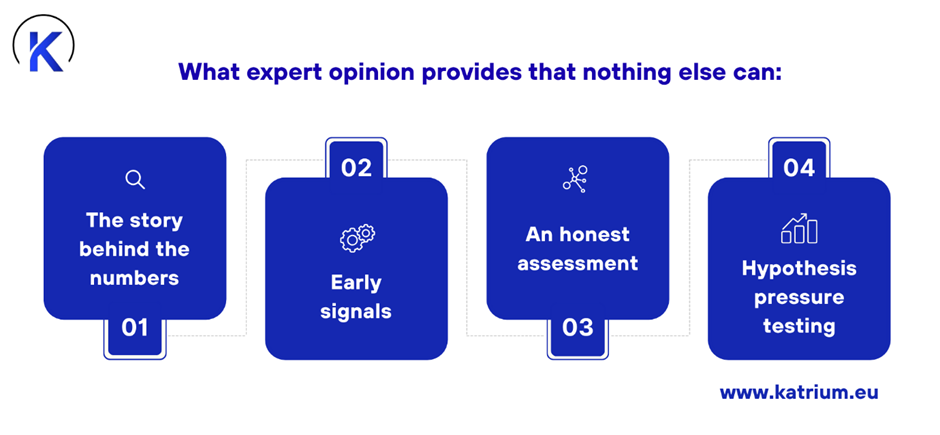
What Expert Interviews in Market Research provide that nothing else can:
- The story behind the numbers – i.e., why something is occurring and not just that it is
- Early signals – experts often know where a market is heading before that’s reflected in data
- An honest assessment – an expert who is well-informed will share information with you that is unavailable anywhere else
- Hypothesis pressure testing – an expert who can tell you when you’re wrong before you go ahead and do something.
By not utilizing both qualitative and quantitative research methods, organisations are making decisions based on incomplete information and ultimately end up fixing the wrong problem. IBISWorld Expert interviews are what completes that information.
The Limits of Market Research Without Expert Interviews
In most market research projects, you start off doing secondary research by looking at industry reports, analyst reports, competitor websites. There’s nothing wrong with this. The problem is when you stop here.
Public information about a market is generally positively skewed and biased. Reports are designed to be generally applicable, which is to say they smooth out all the nuances that matter for a particular decision. Analyst coverage is generally behind the curve. And none of this gives you a sense of what the actual people in a market think about what’s going on.
What You Miss Without Expert Interviews in Market Research:
- The actual competitive dynamics – not what’s officially said, but what’s said when people are being straight
- The why behind the numbers – what’s causing customer behavior to shift, what’s behind a segment growing, or a product not working
- The timing – experts will often have a much better sense than anyone else about where a market is in its lifecycle
- The landmines – things that are well known within a market or industry but never show up in external research
How Expert Interviews in Market Research Fit Into the Process
Expert interviews don’t exist in isolation. Instead, they’re most effective when you’re:
- At the beginning of your project: Before you even know what you’re looking for
- In the middle of your project: Validating your theories against those who’ve lived it
- At the end of your project: Helping you understand your results in context
- Throughout your project: Finding experts you never would’ve found otherwise

Common Mistakes When Using Expert Interviews in Market Research
- Talking to too few experts and assuming that is enough
- Selecting convenient experts rather than relevant ones
- Asking leading questions that support one’s current point of view
- Treat one expert’s response as if it is a finding rather than as a piece of data
- Omitting to make use of referrals – the experts they point you to are often the best leads for the project
Final Thoughts
Data will tell you what is happening. Expert interviews will tell you why. And in market research, it is almost always the case that you really need to know why. You need to know why in order to really understand your market.
Most market research projects don’t go much deeper than skin deep. They’ll give you an overview of your market; they’ll give you some numbers; and then they’ll stop. The projects that will really change how you go about making decisions are the ones that went deeper. They’re the ones that spoke to the right people before they ever started making conclusions. That is what an expert interview is for. And if you’d rather someone else handle all of this for you, Katrium’s market research services exist for just that reason.