Expert Interview Method in Market Research can help organizations identify costly risks before they turn into major business problems.
In 1994, when Intel first began hearing from consumers about the floating point bug in the Pentium processor, they dismissed the concerns. When they finally listened to the experts, the cost of the recall had been $475 million. Interviews with experts early on would have cost a fraction of the price.
Incidents like this are not isolated. Across different sectors and different types of decisions, organisations that incorporate a programme of expert interviews into their research process are able to make decisions more quickly, more knowledgeably, and more economically than those that depend solely on internal consensus and secondary data.
But like every research method, they have their own set of downsides. In the following article, we will discuss exactly what expert interviews are, what they are best at, and what they are worst at.
What is Expert Interview Method?
Expert interviews are a qualitative research method wherein a researcher talks to experts of a particular subject matter to gather first-hand knowledge about a particular topic, market, or question.
The main idea behind an expert interview is selectivity. In an expert interview, the researcher does not try to gather data from the general public. Instead, the researcher talks to experts of a particular subject matter whose opinions have evidential value.
Key Benefits of Expert Interviews
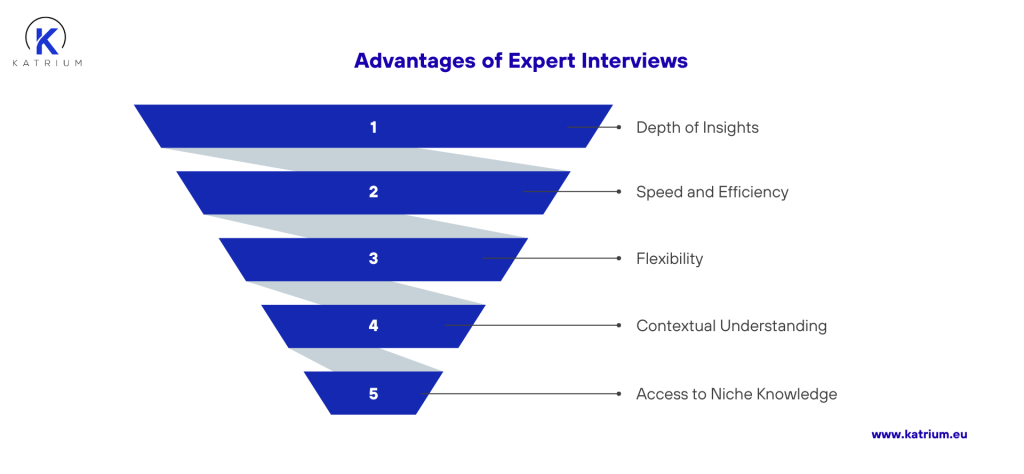
There are few research methodologies that can boast such a unique combination of depth, speed, precision, and flexibility as expert interviews. For organizations operating in complex and dynamic markets, such advantages cannot be overstated. The advantages of using expert interviews include:
- Depth of insights: Expert interviews allow for a deeper exploration of issues, as respondents share their experience and context, which is difficult to obtain using other research methods.
- Speed and efficiency: Expert interviews allow for quicker decision-making, as they can be conducted much more quickly compared to quantitative research methods.
- Flexibility: The research guide can be adapted according to the flow of the conversation. If a particular point is raised by the respondent, it can be explored accordingly.
- Contextual understanding: Expert interviews allow for a deeper exploration of issues, as they go beyond numbers and try to answer the question that every research project leaves unanswered: why?
- Access to niche knowledge: For industries where there is a lack of available research, expert interviews can be very helpful, as they allow for access to niche knowledge.
These benefits make the use of expert interviews an indispensable technique for both market research, competitive intelligence gathering, policy analysis, and academic research. When the objective is not merely to gather data but to comprehend a market, expert interviews have been shown to succeed where others fail.
Expert Interview Method In Market Research: Main Disadvantages
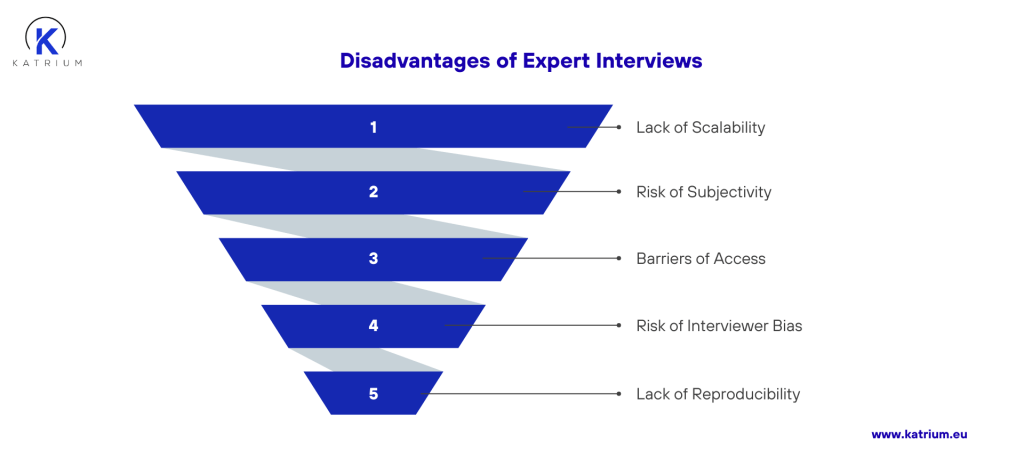
While conducting an expert interview is not an impossible dream, it is equally important to know the disadvantages of conducting an expert interview. These are:
- Lack of Scalability: Conducting an expert interview is a time-consuming and costly affair. Therefore, conducting a large number of expert interviews is not possible.
- Risk of Subjectivity: It is possible that the opinions of experts may not be representative of the overall sentiment of the market. A single expert may be misinformed or biased.
- Barriers of Access: Finding the right experts is often the toughest challenge of the process.
- Risk of Interviewer Bias: Unless the interviewer is careful, the outcome of the expert interview may be skewed.
- Lack of Reproducibility: The results of an expert interview are not easily replicable.
While these are certainly limitations, they are not arguments against the use of expert interviews as a research tool. They are arguments for the judicious use of the technique. In the hands of the judicious user, the disadvantages of the technique are limited and the quality of the intelligence is unparalleled.
Expert Interview Method: When to Use It
The expert interviews method is most effective when used for situations where the answer to the problem cannot be found through existing data alone. This method is best used for:
- Entering a new market – get an understanding of the market landscape and hidden dangers through people who are already immersed in it.
- Validation of a business hypothesis – test assumptions against expert opinions before investing time and money.
- Understanding new regulations – get ahead of the curve by talking to people who already know what is changing.
- Complementing existing quantitative research – when survey results leave you with more questions than answers, expert interviews provide the necessary background for proper understanding.
The key connection between these situations is that expert interviews are strongest when the cost of an incorrect business decision far outweighs the cost of proper research.
Expert Interview Method: Common Mistakes
Even the best-funded and best-designed research programs are not immune to undermining their own findings through basic avoidable mistakes. These are the mistakes that most often undermine the overall quality of expert interviews:
- Getting the wrong experts: Seniority and recognition are not necessarily related to expertise in a specific field or question under investigation.
- Leading questions: Questions designed around expected answers are not designed for gaining insight, they’re designed for gaining confirmation.
- Insufficient preparation: Experts get bored and tune out immediately if they sense that the interviewer has not bothered to get basic knowledge of their field.
- Overlooking contradictory findings: When an expert provides findings that contradict the majority of others, they are often dismissed as an outlier. In reality, they are often the most valuable experts.
- Treating transcripts as analysis: Interview transcripts are not a product of analysis, they’re just raw material for it.
- Over-relying on a single source: One expert, however senior and respected they may be, is not sufficient on their own to draw firm conclusions.
Avoiding these common mistakes is what distinguishes expert interviews that drive real decisions from those that merely pretend to do so.
Final Thoughts
Expert interviews hold a special place in the research methodology universe. There’s no other methodology that can match the combination of human judgment, sectoral depth, and flexibility in the same way. When done well, The Expert Interview Method in Market Research is not just a source of information – it is a way to reduce risk and make better-informed decisions.
At Katrium, we believe that rigorous research underpins everything we do. Our approach to market research solutions is based on the same set of principles that make expert interviews so effective: precision, depth, actionability, and a genuine commitment to making intelligence count.