
Most individuals dismiss emails that come from corporations. They do not open links to surveys. They quit filling out surveys midway. Response rates to telephone surveys have dropped to 6% owing to the rise in digital surveys. Nevertheless, there is a certain type of market research objective where there will always be a superior solution, especially when high-quality data, difficult questions, and niche audiences are concerned.
That type of market research is called CATI market research. It predates most types of digital research methods but continues to be one of the most potent market research methods when done properly. This article will tell you everything you need to know about CATI market research, including when it is useful and not.
What Is CATI Market Research?
CATI means Computer-Assisted Telephone Interviews. CATI market research is a quantitative research tool that involves conducting structured telephone surveys utilizing specialized software that helps interviewers navigate questions, implement complex logic, and enter responses.
This is an advanced version of the conventional telephone survey. Instead of following a written script, interviewers use an electronic questionnaire. The software does all the work from skipping questions depending on answers, validating results instantly to implementing various rules for quotas and other purposes.
The process of conducting a CATI market research interview:
- The interviewer calls a selected respondent from a predefined sample list
- An electronic questionnaire pops up on the screen with the initial script
- The interviewer verbally asks questions while entering answers manually
- The software navigates to the next question, depending on each individual answer
- All data is instantly validated as the software flags inconsistent responses and those exceeding specified limits
- All answers are collected centrally and ready to be analyzed straight away
What Makes CATI Market Research Unique in Comparison with Other Forms?
Market research via CATI falls into the unique category in terms of the method’s place between CAWI (online surveying) and face-to-face interviews. CATI brings the combination of high data quality features and remote access to a particular respondent.
Comparison with the key methods of market research:
- CAWI (Computer Assisted Web Interviewing) — CATI provides higher data quality and gives an opportunity to ask detailed questions while requiring higher costs per respondent and longer periods for large-scale testing
- Face-to-face interviews — CATI is less costly and faster compared to face-to-face interviews but lacks the possibility to show any pictures as stimulus material and to analyse nonverbal communication
- IVR (Interactive Voice Response) Surveys — CATI is better in case of complex surveying while being more expensive; IVR cannot perform any type of probing activities and requires simpler questionnaires
- CAPI (Computer Assisted Personal Interviewing) Surveys — CATI is not associated with the requirement to meet a person physically and thus is more convenient and cheaper than CAPI surveys
The critical advantage of CATI is the presence of a person who asks questions. Such a factor results in higher response rates among CATI respondents and makes it a perfect option to study consumers’ attitudes and behaviour.
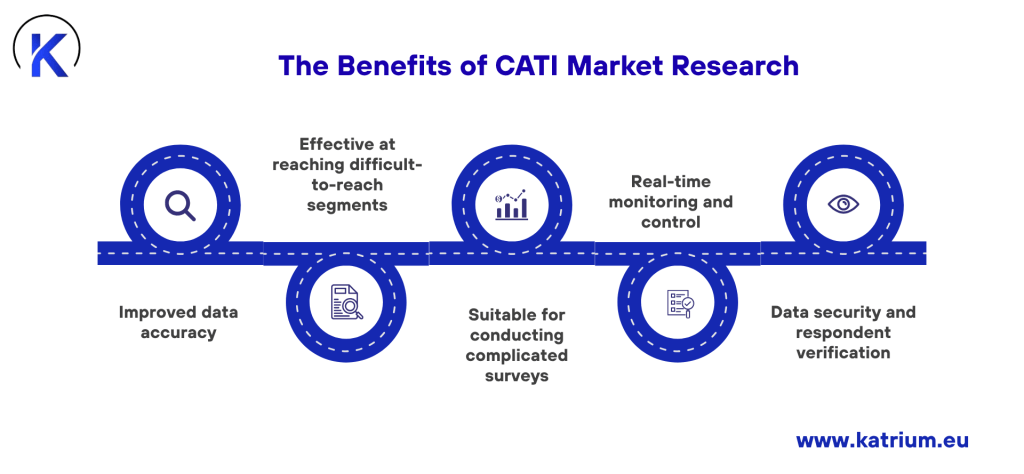
The Benefits of CATI Market Research
- Improved data accuracy
- The interviewer can explain any confusion about the question and avoid misinterpretations that might taint the data
- Validation checks provide instant alerts to mistakes, unlike identifying them only during the analysis stage
- Less non-response is observed using CATI compared to web surveys, indicating higher data accuracy
- The personal interaction minimizes social desirability bias when dealing with personal issues that respondents feel more comfortable discussing verbally
- Effective at reaching difficult-to-reach segments
- Perfect for elderly consumers, remote communities, and those with poor internet access and infrequently fill out online surveys
- Extremely useful for B2B market research, where targeting particular individuals demands repeated dialing and meticulous scheduling
- For many B2B audiences, telephone interviewing remains one of the most effective methods of drawing representative samples ResearchGate
- Functional in areas where the internet is not widely used but phones are abundant
- Suitable for conducting complicated surveys
- Automatic skip patterns, branching logic, and multi-component questions are managed by the software
- The interviewer can guide the respondent through detailed questions that require further explanation
- More appropriate than online surveys for lengthy and delicate surveys where dropout rates are high
- Real-time monitoring and control
- Supervisors have access to real-time call monitoring, recording playback, and interviewer productivity monitoring
- The response rate, completion rate, and quota are available for real-time tracking
- Survey wording or survey routing can be modified if issues are detected early during fieldwork
- Automatic quota management will ensure that a good mix of respondents is recruited
- Data security and respondent verification
- CATI provides a high level of confidence in terms of the respondent identity, important in B2B surveys when the role and level of the respondent are vital
- There is no possibility of receiving automatic robot replies, fake survey completion, or rushed completion by panel members for financial gain
- Data entry occurs automatically into the central database
When Is CATI Market Research the Best Option?
CATI market research should be considered when:
- You have to target a B2B audience of selected decision-makers who would rarely fill out web questionnaires
- Your population comprises older generations, rural areas, or individuals disinterested in digital technologies
- The questionnaire features intricate routing, difficult content, or questions requiring interviewer explanations
- Data accuracy and respondent validation are priorities over time and expense
- You require quota control and fieldwork supervision during data collection
- You conduct longitudinal studies, tracking projects, or follow-up interviews
CATI market research is better avoided when:
- A large sample size needs to be collected fast and economically
- Visual stimuli must be tested, such as advertising material, product design ideas, or branding
- The intended audience consists of younger people interested in technology and unlikely to respond to unknown numbers
- The questionnaire is straightforward, consisting of basic questions and prompts that do not require additional explanation
- Funding limitations preclude the per-response cost of CATI market research
Final Thoughts
CATI market research is not an outdated technology. It is an exact tool that provides significant benefits in terms of data quality, respondent identification, and survey management if applied correctly. The only flaw with CATI market research that many researchers fall victim to is the misapplication of this tool, considering it a universal approach, whereas CATI market research has its own niche.
It is worth applying where it is supposed to be applied, such as B2B studies, difficult-to-reach target audiences, complicated questionnaires, and confidential topics, CATI market research is likely to generate highly accurate data. In any other scenario, it will become costly and impractical.
Katrium operates across time zones with a carefully selected, multilingual team. Our agents bring diverse backgrounds, language expertise, and true versatility to every client interaction. If you’d rather not wander through the complexities of the CATI Market Research world alone, reach out to Katrium: we’re already here for you.