
C-suite interview process is rarely talked about, which is a shame. Very few people who reach the level of interviewing for a job at the C-suite level actually get the offer. This implies that even the best CEOs with decades-long experience, multi-billion dollar budgets, and impressive resumes do not qualify because they are being screened at the last stage. What distinguishes those who end up getting the position from those who do not rarely has anything to do with their qualifications.
A C-suite executive interview requires a different type of preparation from a standard management interview. Candidates for CEO, CFO, COO, CHRO, CMO and other executive roles are usually expected to discuss more than their previous responsibilities. The conversation may cover strategic judgment, leadership style, risk, organisational culture, financial priorities and the candidate’s view of the company’s future.
Preparation therefore means understanding both the organisation and your own leadership record in enough detail to discuss difficult decisions, measurable results and future priorities. For a broader look at executive interviews, Katrium also discusses the characteristics and preparation that can distinguish candidates in its guide to executive interviews.
Why C-Suite Interview Is Fundamentally Different
In most cases, people mistakenly consider a C-suite interview as a high-stake version of the usual senior management interview. This is an expensive mistake.
In the case of an executive-level interview, things become much more complicated and totally different:
- It’s not only about competence; you are considered competent simply because you are invited to the interview. In fact, you are being measured against other qualities: fit, vision, risk tolerance, and philosophy.
- This is a two-way selection process where you and your interviewers are being analyzed simultaneously. The most successful candidates make this clear.
- Subtle nuances such as politics and culture have a lot of importance at the C-suite level. After all, there is an environment full of relations within the board, investors, and team members waiting for you.
- People are buying the future you promise them. They are interested in what you are going to do with them at that very moment.
All these differences should be taken into account during preparation.
Step 1: Conduct Deep, Exhaustive Research Before a C-suite Interview
The obvious research starts at the surface level, but for an experienced board member or CEO, that’s all too easy to see through. You have to dig much deeper into the company beyond its website.
On the Organisation
- Annual report and presentations to investors – Look for revenue trends, margin pressure, strategy focus, and how the leadership frames the story to their stockholders
- Earnings call transcripts – They’re full of valuable insight. Pay attention to the verbiage used by the leadership team, questions from analysts, and how the executives react
- Newspaper articles – This isn’t about the good stuff. Seek out any controversies, missed forecasts, regulatory problems, or turnover among leaders
- Activity on LinkedIn – What posts is the board chairman making on the platform? How is the departing executive explaining his/her exit?
- Glassdoor and other employee review sites – Find out what it’s really like inside the company, how it’s managed, and any operational challenges
- Competitive environment – Understand what place this company holds in the marketplace and what the competitive threat is
- Customer and supply chain intelligence – Trade magazines, industry message boards, and customer forums can provide valuable insight
People Who Are Interviewing You
- Know every individual who is interviewing you – their background, their professional priorities, their public opinions on things
- Know what type of board this is – Founder-driven? Equity firm? Institution? Each of them have completely different expectations for an executive
- Know the connection each one of them has made in the past – Again, to see how they see other individuals working in the company
About The Role
- Why was this role vacant in the first place? – Retirement? Resignation? Promotion? Created anew?
- What have they tried in the past? – If this is a new role altogether, what has been the previous process?
- What should the outcome be in the next 90 days? 1 year? 3 years? – If you don’t know, make some guesses based on your hypothesis
Step 2: Build Your Executive Narrative
At the executive suite, you don’t rattle off your résumé but rather you articulate a leadership thesis. You paint a picture of what kind of leader you are, how you have succeeded at previous positions, and why this is a logical extension of your career.
Construct Your Leadership Thesis
Address the following questions without prompting:
- Who am I as a leader? — This is an introspective and reflective exercise; it explores your values, your leadership style, and the things people consistently comment on regarding their experiences working with you.
- What have I built or transformed? — Forget about having ‘managed’ or ‘maintained’; Boards look for people who create and change.
- Why should I be the person to lead this particular challenge? — Tie your story back to the organisational context.
Use the STAR-L Technique to Organise Your Key Accomplishments
Don’t settle for the standard STAR model (Situation, Task, Action, Results). Instead, use:
- S: Situation — Explain the situation and its implications.
- T: Task — What were your objectives?
- A: Action — What actions did YOU take? (not ‘we’)
- R: Results — Use quantitative measures. Dollars, savings, number of people, percentage of market share, compressed timeframes
- L: Learning — What did you learn from your stint?

Develop 8–10 Great Achievement Stories
Ensure a broad array of leadership competencies:
- When you generated major revenues or achieved transformation
- When you had to make a tough decision that others opposed, and you accepted the results
- When you reorganized or upgraded a team
- When you coped with crisis or handled risk
- When you used your influence without any official position to change people’s minds
- When you failed, what you learned from it
- When you disrupted the old system, whether you were right or wrong
- When you created or changed culture
Step 3: Master the C-Suite Interview Question Types
The C-suite interview consists of various types of questions. Being aware of them beforehand will allow you to prepare precisely for the interview.
Questions to Assess Strategic Vision
These check whether you can see beyond yourself:
- “Where will this industry be in five years, and how do we need to position ourselves?”
- “What would be your strategy in the first hundred days of work?”
- “How will you act differently from the previous manager?”
- “What is the main strategic risk that we’re not considering?”
To respond to such questions, you should be brave enough to voice your opinion. You should provide data and be ready to support your ideas.
Leadership and People Management Questions
- “Could you describe the process of developing the team of leaders?”
- “Tell me about the case when you needed to fire one of your top managers.”
- “How did you deal with a person who was skilled but culturally toxic to others?”
- “How did you interact with the board whose decisions you didn’t agree with?”
In answering such questions, you should be frank and detailed. It is clear that you cannot give sanitised answers.
Operational and Financial Questions
- “Take us through how you handle a stressed-out P&L.”
- “When did you have to make dramatic cuts but still keep everyone’s spirits up?”
- “Give an example of how you handled underperformance in a business unit.”
Answering these questions: Put numbers around everything you say. Show a solid understanding of the nuts and bolts of what makes your business tick.
Cultural and Values Questions
- “What culture have you built, and how?”
- “Describe a situation where there was a conflict between different values.”
- “How do you ensure psychological safety for your teams, but also drive performance?”
Answering these questions: Know what kind of culture you want to build. Culture becomes a strategy when you sit on the C-suite.
The “Adversity and Failure” Questions
- “Tell me about your biggest failure as a leader.”
- “What worries you about your own performance as a leader?”
- “When has a strategy failed you in the past?”
Answering these questions: Avoid deflection, minimisation, and placing blame. Your best self will give the best answers here.
Step 4: Prepare Your Questions — This Is As Important As Your Answers
Your questions convey your experience level, preparation, and insight. Weak questions end good interviews.
Questions Showing Executive Thinking
- “What does success look like in the first 18 months, and how would that be measured?”
- “What are the two or three mistakes you would be kicking yourself for making if you hired me?”
- “What are some of the key cultural or political dynamics I should know about?”
- “What kind of relationship do you expect the board to have with the executive team?”
- “What is the one thing this organization needs to figure out over the next year?”
- “What went wrong with the last occupant of this position, and what can you learn from that experience?”
- “Where is there healthy debate going on within the executive ranks right now?”
Questions Showing Your Homework
- “[Name], in the last earnings call, margin compression was an issue; where is the board looking strategically at that problem?”
- “[Industry competitor] has recently made several moves within [industry], how do you see this playing out competitively?”
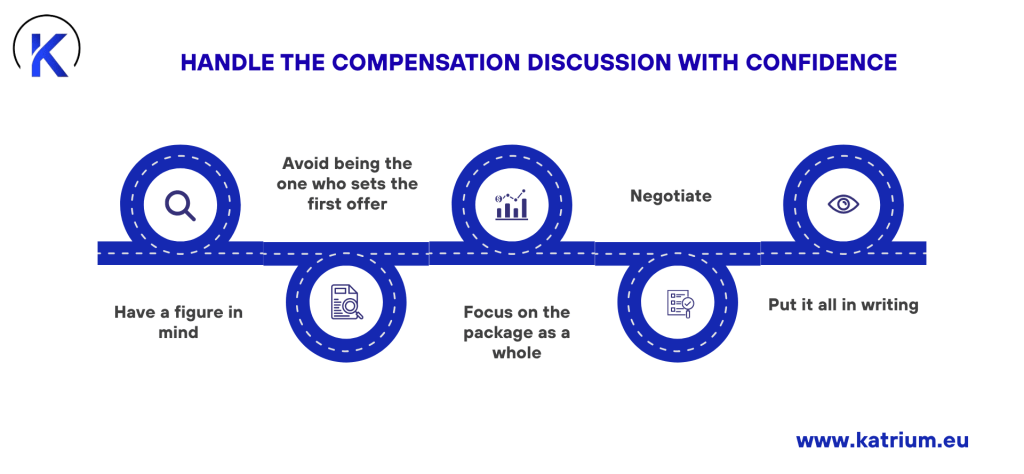
Step 5: Handle the Compensation Discussion With Confidence
Even highly qualified candidates can fail when it comes to negotiating comp. In the C-suite space,
- Have a figure in mind before entering negotiations. Get benchmark information on total comp from executive search firms for your area of expertise, industry, and organizational size.
- Avoid being the one who sets the first offer if possible — always let them do the offering first.
- Focus on the package as a whole; base salary will usually be the most insignificant portion. Think in terms of equity, bonus structures, long-term incentives, retirement, and severance terms.
- Negotiate! This is expected by the board. Candidates who accept their initial offer may seem like less qualified commercial players.
- Put it all in writing before you resign from your present position; oral agreements aren’t worth the paper they’re written on when talking about C-suite comp.
Step 6: The Practical Logistics Most Candidates Ignore
The logistics of your executive interview cannot be underestimated:
- Find out who will be there and in what order — Double check this from the search firm/HR in advance. This will ensure you are prepared.
- Bring hard copies of all materials that you may need during the meeting — Having leave-behind materials, a 30-60-90 day plan or a case study shows thoroughness.
- Dress properly for the culture and not just for the seniority level – An investment-backed logistics firm and a lifestyle brand will have totally different dress codes.
- Remember to pace yourself for the interview day – Executive interviews can last 4-8 hours. Plan accordingly and have food and water on hand.
- Send your thank you note that day — While uncommon today, sending a thank you note within 24 hours is still an executive-level differentiator. Make sure it’s relevant to your discussion.
Step 7: Preparing for the Board Interview Specifically
If your process involves a board interview (and if you’re going after the role of CEO, CFO, or any other top-tier C-suite executive position, chances are it will), the game plan changes yet again:
- Boards think in terms of governance, risk, and strategy — Not daily operations. Think big picture.
- Have a grasp on your fiduciary lexicon — This means speaking knowledgeably and convincingly about governance, risk management, stakeholder responsibility, and enterprise value.
- Many non-executive directors have wildly diverse experience — You might find yourself conversing with a former banker, a technology entrepreneur, and a university professor all at once. Adjust to that register while still maintaining your authority.
- Prove your awareness of the board/CEO relationship — The most impressive CEOs and CFOs always know where the line between the two should be drawn. Show that you do.
- Speak assertively, but never arrogantly — Executive boards have met every conceivable kind of business leader. Hubris sets off red flags at executive boards.
Step 8: The Mental and Psychological Game
Rarely spoken about, yet perhaps the most critical one.
- Be ready to manage your imposter syndrome — Most likely, all executives experience it at this level. Prepare to such an extent that your capability overrides all self-doubt.
- Treat this as a peer interaction, and not a performance — You lose everything once you switch gears and try to “perform” rather than connect.
- Understand that you cannot possibly be the best fit for every single role — It’s okay. If there’s a mis-hire at the C-suite level, nobody wins. Seek a connection.
- Make sure you do your homework on them — Be honest with yourself: Do I believe in this board? Am I impressed by this leadership team? Is the organisational vision aligned with mine? An offer from a wrong company is nothing to brag about.
- Create similar stress conditions for yourself — Conduct live mock interviews with your peers, a coach, or a recruiter. Video record yourself — the difference in how you perceive your answers compared to their actual delivery can be quite dramatic.
Closing Thoughts
A C-suite interview requires preparation across several areas: the organisation, the role, your leadership record, strategic priorities and the people making the hiring decision. The objective is not to memorise perfect answers. It is to enter the discussion knowing which experiences demonstrate your leadership, what evidence supports your claims and which questions you still need the organisation to answer.
Candidates can prepare by researching the business, developing concrete achievement examples and practising how they explain difficult decisions. Organisations conducting executive recruitment need the same level of clarity about the leader they are looking for.
For companies seeking senior or international professionals, Katrium’s recruitment services include international executive recruitment and executive talent sourcing.