
Thought leadership in B2B spaces faces a credibility issue. A recent survey regarding content marketing discovered that more than 70% of B2B consumers claim that most of the thought leadership content they come across lacks uniqueness and valuable insights and remains largely generic. Writing better isn’t the answer here. Rather, it’s all about better sources. One thing that successful companies have in common with regard to their B2B content is that they have interviews with actual experts.
The main challenge for B2B content creators is finding experts. Most often, their B2B content is sourced from internal experts and the same old industry sources and lacks a fresh perspective.
This guide offers practical advice about sourcing and conducting interviews with the right experts for B2B thought leadership.
The Importance of Expert Interviews in B2B Thought Leadership Content
Before getting into how you can find an expert, let’s first look at why expert interviews play such an important role in B2B thought leadership in the first place.
Today’s B2B buyer is a sophisticated individual. He’s read extensively on the subject matter; he’s consulted his colleagues on their opinions. He even has a finely-tuned ability to detect whether or not the insights he’s hearing are truly valuable or simply filler. In this context, it takes the following four qualities to cut through:
- A unique perspective: An insight that can’t simply be searched for online
- Practical experience: Insights based on real-world experience, not just theoretical knowledge
- Attestation of credibility: Findings supported by cited professionals with relevant experience mean more than anonymous claims
- Relevancy and concreteness: Specific examples, statistics, and other concrete data can help support otherwise intangible theories
Expert interviews provide all of these four elements at once. A good interview with the right expert can serve as the foundation of not only an article but also a webinar, a podcast episode, a LinkedIn series, and a sales enablement asset.
Now we come to the problem of finding the expert.
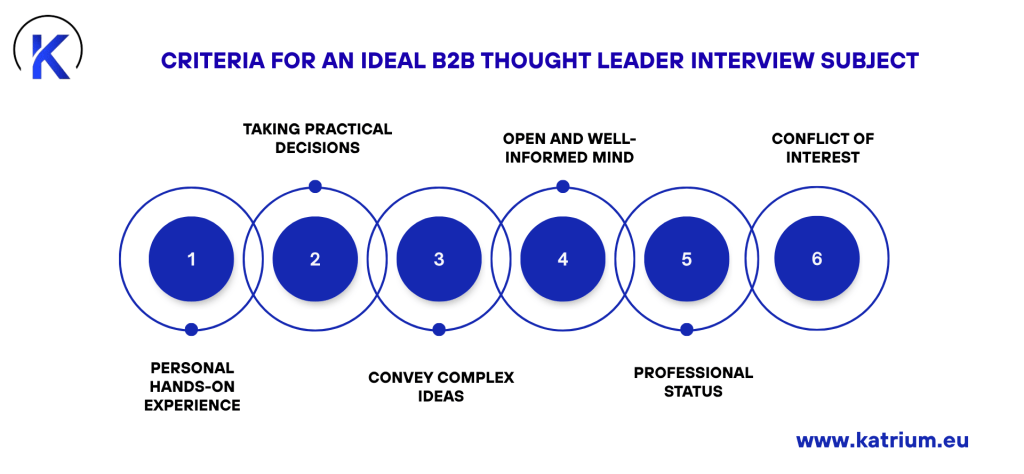
Criteria For An Ideal B2B Thought Leader Interview Subject
Not every expert is right for an interview. Before starting your research, think about the qualities you should be looking for.
An ideal B2B thought leader expert interviewee usually:
- Has personal hands-on experience in the particular function/industry/issue faced by your audience
- Is used to taking practical decisions rather than providing external advice on them
- Can convey complex ideas in an accessible way
- Has an open and well-informed mind but isn’t too cautious in their opinion
- Possesses enough professional status to make your readers realize their worth
- Doesn’t have any conflict of interest
Things to watch out for include:
- Experts that only express themselves in vague statements, refusing to get down to specifics
- So-called experts that aren’t recognized for actual experiences, but instead try to promote themselves
- Too exposed and overused voices in your field that wouldn’t bring anything new
- Personal circumstances that might make this person a competitor due to their role in the company they’re working for
- Interviewees who would prefer their comments to be approved or rewritten so that nothing of their real self is revealed
Considering all those criteria, here is how to reach such people.
- LinkedIn: The Ultimate B2B Sourcing Tool
When it comes to B2B thought leadership sourcing, there is still nothing that can compare to LinkedIn. No other platform offers such comprehensive professional profiles, as well as searchability and direct outreach capabilities.
Tips for effective thought leader sourcing via LinkedIn:
- Boolean searches: enter specific titles, industries, and keywords in the search bar for more precision: “VP Supply Chain” AND “manufacturing” AND “digital transformation”, for instance
- Current or previous companies: if you are interested in people’s experience working with certain companies, LinkedIn will allow you to conduct such searches
- Engagement: check out whose comments are featured in the discussions related to your niche – it’s always an indicator that you’ve found someone influential
- Similar professionals: look at the sidebar “People Also Viewed” next to the profiles of professionals you’ve found so far – there might be some new people who fit your requirements
- Creators’ mode: LinkedIn recently launched a special filter for finding influencers who marked their profiles as creators, meaning they are willing to become thought leaders
- Alumni networks: looking up alumni in your industry will help you uncover many talented and experienced specialists
Tips for reaching out via LinkedIn that work:
- Keep your initial outreach message no longer than 2-3 sentences long
- Open with why you have picked them specifically, by referencing their profile or some content they posted
- Clarify the format of the call, its length, and how their name would be mentioned
- Give a reason not to think twice — choose 2-3 time slots for the call
- Industry Conferences and Events
Speaker lineups at industry conferences remain one of the least tapped sources of experts in B2B content marketing. Every major industry conference hand-picks its line-up of experts who are not only experienced but also credible and capable of explaining their ideas effectively on a stage. Sounds like your exact match, right?
How to harvest expert leads from conferences:
- Go through the speaker list from the top 5-10 conferences within the industry – the list is usually publicly accessible on the website of the event
- Watch recorded sessions from YouTube channels to see if the speaker can explain complicated ideas
- Send a follow-up message right after a conference, while it’s still fresh – you’re more likely to get a response if you mention their last presentation
- Attend the virtual event with networking in mind – chat functions of B2B events might surprise you by their effectiveness
- Watch out for hashtags used in industry conferences on LinkedIn
Events worth watching to find B2B experts:
- Trade shows and annual summits in the industry
- Conferences run by Gartner and Forrester analysts
- Professional development programs run by associations within the industry
- Invitation-only executive roundtables – keep an eye for the post-event summary mentioning attendees
- Podcasts and B2B Media
The B2B podcasting world has seen exponential growth over the last five years, making it an incredibly rich source of pre-vetted experts available. The work of finding, vetting, and interviewing practitioners within your field has already been done by the podcast host. You can take advantage of this curatorial effort.
How to tap into B2B podcasts for expert sourcing:
- Find the ten to fifteen podcasts that your target market most frequently consumes – ask your sales team, review the Apple Podcasts rankings, or find industry-specific podcasts
- Find recent guests that gave exceptionally good interviews
- Look for experienced guests that aren’t yet overexposed – folks who were on a few podcasts, but not the circuit speakers
- Listen to the episodes in advance of contacting – if you are able to cite a particular interview during your outreach, it will make you much more effective
- Search B2B media sites such as the Harvard Business Review, MIT Sloan Management Review, and Fast Company for contributor profiles and sources cited in articles
- Professional Associations & Trade Groups
In every B2B vertical, there are associations dedicated solely to organizing and representing practitioners in that discipline. These groups are experts’ treasure troves, and yet they are largely ignored by many content teams.
How to source B2B experts through professional associations:
- Look up lists of association boards and committees — these tend to be made up of highly motivated, senior-level practitioners
- Look for mentioned practitioners within association publications and newsletters
- Look for Q&A sessions in association webinars and online events, as this will give you valuable insight into the identities of highly knowledgeable practitioners who pose good questions
- Connect with association communications teams directly; in many cases, they will help you reach relevant experts who may be eager to engage in collaboration
- Follow association awards programs, as award nominees/winners have already been vetted for their expertise
Important association types:
- Industry function-related associations — finance, HR, procurement, IT, marketing
- Industry vertical associations — manufacturing, healthcare, logistics, financial services
- Geographic Chambers of Commerce/business councils for region-specific B2B insights
- Standards bodies/regulatory working groups
- University Departments and Research Institutes
Where thought leadership requires a degree of analytic heft – in realms such as organizational behavior, technology diffusion, logistics and supply chain management, financial theory, and strategic decision-making – the academic voice adds value that cannot be delivered by practitioners alone.
Sources of academic thought leaders for B2B content:
- University business school faculties by department and area of research – typically freely searchable and highly specific
- Faculty members with active online profiles, article publications, and media experience – these academics make better interview subjects than their peers
- Google Scholar search for researchers who regularly write papers on your subject matter – high citation numbers reflect both validity and applicability to their discipline
- SSRN and other working paper archives for new studies on cutting-edge B2B topics – connecting with scholars before their papers are officially published gets you real first-mover content
- Business-oriented research institutes at universities – the heads and leading fellows at such institutions are prolific communicators actively looking to expand their reach
- Your Own Customer and Partner Network
The network of customer and partner relationships within your company is one of the underutilized expert sources for business-to-business (B2B) thought leadership. Your customers are dealing with the same problems as your target audience; furthermore, those that have successfully dealt with these problems are the very type of practitioners that you want to talk about.
How to transform your own network into a thought leadership source:
- Seek out customers who have demonstrated some success solving a problem — they have a story that you can leverage
- Find customers who have a presence on LinkedIn or have presented before at conferences — they are used to appearing publicly
- First approach through the customer success or account management department — this greatly raises acceptance chances
- Position the interview as a platform for the person to get recognized as opposed to merely a tool for content generation
- Create an official advisory council composed of hand-picked individuals with the necessary expertise and vested interest in working with you
Other potential sources include:
- Partners in technology and distribution channels with valuable industry knowledge
- Supply and distribution chain partners with insights that complement your own knowledge base
- Former customers who can speak openly about their experience with the problem
- Expert Network Platforms
When it comes to finding very particular experts for B2B content teams working on complex or challenging briefs that require extremely specific expertise, an expert network is likely the fastest way to get connected with precisely the right individual(s).
How expert networks work to help B2B thought leadership:
- Provide a comprehensive brief explaining the type of practitioner you are looking for (industry, role, seniority level, geographies, and type of experience required)
- Get back a pre-screened list of relevant experts in 24 to 72 hours
- Interviews with confidence that your expert(s) has been pre-vetted and pre-approved for relevance and validity
- Global reach of experts that cannot be achieved using any other approach
Popular options include:
- GLG – one of the biggest expert networks in the world and covering most industries
- Guidepoint – strong in finance, healthcare, and technology
- AlphaSights – good for strategic/consulting type projects
More costly than organic approaches but much faster and precise.
- Social Listening and Communities
While the most effective B2B practitioners might not be the most vocal, there is ample evidence left behind on various online platforms that a rigorous sourcing approach can identify.
Communities to listen to and platforms to check:
- Reddit – Subreddits dedicated to your vertical will likely have knowledgeable people posting their honest and unbiased opinions. Users who have consistently provided useful insights in those communities make good interview subjects
- Slack communities – In B2B industries, it’s common to find active Slack communities full of professionals in the vertical. Both moderators of such communities and regular participants may prove to be very good experts
- Quora – Look at what questions have been asked in your niche on Quora and see who offers insightful answers
- Substack – With an increasing number of B2B influencers creating personal newsletters, you can reach out to authors of well-followed publications
- X (formerly Twitter) – It remains a valuable platform for networking with technology, financial and political professionals. Simply browse through the lists created by credible industry accounts
How to Create a Repeatedly Successful Expert Identification Process
Identifying the right expert to be interviewed once may simply be a matter of luck, but being able to identify experts repeatedly requires an actual system for doing so. This process involves the following steps:
- Maintain an expert database — Make sure you keep a growing list of prospective experts in a particular subject or field of study based on the expertise level and industry.
- Assign a person or function to identify experts — You can assign a specific individual within your team or organization to handle this function.
- Get to know them before you need them — Before actually reaching out to a prospective expert, make sure you are familiar with them by attending their talk or leaving a comment on their content.
- Referrals work best — Always ask for referrals at the end of each interview session.
- Measure and track – Track the responses rate, acceptance rate, and performance of content based on the expertise category. Gradually, the numbers will reveal the sources that work well for your target group.
Build a strong community of experts – Share the completed content with interviewees, feature them when you post it, and update them on its performance. Valued experts become frequent contributors to and promoters of your content.
Bottom Line
When it comes to thought leadership in B2B marketing, concepts are as good as the individuals who generate them. It is the companies that continuously generate concepts that earn them true authority – something that earns them citation in business settings, because they know the importance of finding the right voices.
It is important to know where to look for the right experts, how to engage them, and how to develop an effective content sourcing structure that allows you to continuously conduct quality expert interviews. Your audience knows the difference between authentic experience and fabricated content, as does your sales pipeline.
If you want to strengthen your B2B thought leadership with credible expert insights, Katrium can support you with expert sourcing, interviews, and content creation. Contact Katrium to discuss your target audience, industry, and the type of expertise you need for your content.