
Before the report by any ordinary research firm is completed, an investment analyst working with an expert network will have talked to six former CEOs, refined the thesis through rigorous testing, and made their call. And that is no hyperbole, but rather the daily reality of life in a world run by cutting-edge companies. Expert networks have radically redefined the nature and speed of business intelligence, but very few other organizations apart from financial firms and consulting companies really understand them.
This is money down the drain. In this article, we cover all the aspects from definition, functionality, users, advantages to how to know whether your company needs an expert network.
Definition of an Expert Network
An expert network is defined as a platform that facilitates connections between firms, investors, consultants, and researchers to experts, which are individuals who have expertise in specific fields through firsthand experience.
Experts or advisory services are not scholars or general consultants. They are practitioners, meaning that they are people who have worked extensively within the sector, the company, and the job function that needs to be understood. C-level former executive staff. Insiders in the regulatory environment. Specialists with technical knowledge. Practitioners who have started, grown, and exited businesses precisely where you are conducting your analysis.
The basic concept is pretty clear. The quickest way to get answers to difficult questions in terms of industry, markets, or business challenges is simply speaking to somebody who has already got the answers based on real-world experience. They help by:
- They generate primary intelligence – you are creating original insight, rather than summarizing information already reported elsewhere by others
- They are demand-led – you identify the question and the network finds the exact expert capable of answering your question
- They move fast – reputable networks set up qualified expert interviews within 24 to 72 hours
- They are scalable – you can use them on a one-off basis to address a specific question or launch a thorough research program across multiple tracks and experts
- They are relationship-independent – due to the intermediary nature of access, experts will be more forthcoming compared to direct industry contacts with vested interest in your decision-making process
- They are compliance-based – reputable networks will have solid mechanisms in place to prevent any unethical behavior during the consultation process
A Short History of Expert Networks
The expert network concept arose during the late 1990s and early 2000s as a service for hedge funds and private equity groups looking to gain a competitive advantage in their research. At the time, the concept was fairly straightforward: put the buy-side analyst on the phone with former executives in private consultation.
The industry experienced rapid growth in the 2000s due to the clear realization that the value of primary human intelligence was undeniable. During the 2010s, the scope of expert networks has since moved well beyond finance and into management consulting, strategic advisory, biopharmaceuticals, and technology.
Presently, the global expert network market is worth $2 billion dollars per year and counting. However, while the models themselves have evolved to include things like transcripts, surveys, advisory, and artificial intelligence-driven matching, the essence of the value proposition has always been the same: putting the right question to the right human experience in short order.
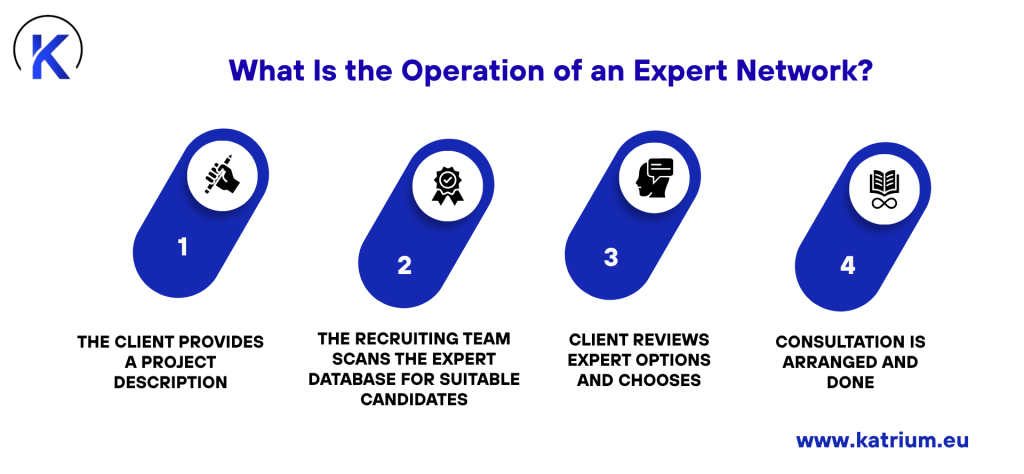
What Is the Operation of an Expert Network?
Learning how they work will allow you to better leverage their potential and choose service providers wisely.
Step One – The Client Provides a Project Description
It starts with the client, which is you, sending out a project description. It should include all of the following:
The main research question
- The ideal characteristics of the expert – field, functional expertise, seniority, company type, geographical location
- The urgency and deadlines of your work
- Other issues, such as compliance concerns
The better your project description, the higher the chance that you will receive relevant experts.
Step 2: The Recruiting Team Scans the Expert Database for Suitable Candidates
Upon receiving the briefing, the recruiting team begins working on identifying the experts from among the thousands of experts in their expert database, in case of large firms, it might involve scanning through their expert database containing hundreds of thousands of professionals from nearly all industries and geographies.
The recruiters scan through the database, analyze its relevance, and carry out screening discussions to ensure that the background of the expert really qualifies him/her for the research study. Screening is an extremely crucial yet undervalued aspect of the process; sometimes it may come down to a recruiter’s competence.
The experts are screened against any compliance issues – especially relevant when researching publicly held organizations.
Step 3: Client Reviews Expert Options and Chooses
The network provides a selection of experts, usually ranging from two to five options, each with their respective career histories, experiences, and reasons for their inclusion within the shortlist.
The client then chooses the expert whom they wish to consult with. In some cases, the client can access the entire database via self-service options.
Step 4: Consultation is Arranged and Done
After choosing an expert, the consultation process is arranged. Usually, consultations last anywhere between 30 minutes to an hour, but other durations are also available. The consultation comes in various formats:
- Individual telephone or video call – Most common type of consultation
- Panel discussion with multiple experts – When comparing opinions is necessary
- Question-and-answer written consultation – For when conducting an immediate consultation is impossible
- Face-to-face consultation – When the consultation requires a more personal setting
The consultation is done by the client following a discussion guide with carefully prepared questions.
Insight Extraction & Implementation
After the session, the customer gathers insights, surprises, and additional questions that have arisen from the consultation. This is often done by using transcription and artificial intelligence-powered summary services offered by most networks.
These insights are then used to enrich the larger research process through testing and refining existing hypotheses, conducting further research, and influencing the decision-making process.
Who Engages with Expert Networks?
Expert networks started in financial services but have spread widely beyond into all knowledge-based industries.
- Investment Management:
- Hedge fund managers employ expert interviews as a key part of fundamental equity analysis
- Private equity managers conduct expert phone calls during the due diligence phase when evaluating potential acquisitions
- Venture capital managers verify market and entrepreneur assumptions before investing their money
- Credit analysts monitor trends impacting the issuers of debt securities in their portfolios
- Management Consulting:
- Strategy consultants use expert networks to quickly develop industry expertise when beginning an engagement
- Engagement teams use expert networks to perform channel checks with customers, distributors, and competition
- Practice leaders use expert networks to monitor regulations, competitive threats, and market shifts across industries served by their clients
- Proposal teams use expert input to fine-tune their proposals and display industry expertise
- Corporate Strategy & Business Development:
- Corporate strategy teams test emerging market opportunities before allocating resources internally
- Mergers and acquisitions teams use expert interviews to evaluate potential acquisitions from within
- Business development departments use expert interviews to test out partnership and growth assumptions
- Product teams leverage expert networks for critical product development and launch decisions
- Life Sciences and Healthcare
- Pharmaceutical companies get insights from doctors, payers, and patient advocacy organizations regarding pipeline assets
- Medtech companies validate their clinical and commercial hypotheses via interviews with practicing specialists
- Healthcare investors monitor reimbursement developments and changes in regulation in real-time
- Hospital management seeks input from subject matter experts when developing new strategy
- Technology and Software
- Technology companies compare themselves against their competitors’ product offerings, pricing, and go-to market strategy
- Enterprise software buyers verify claims of vendors using practitioners from outside organizations
- CIOs evaluate new categories of technology before selecting platforms
- Information security managers get input from cybersecurity specialists on threats and security architecture
- Research and Policy Analysis
- Academics enrich their analytical work by incorporating practitioner perspectives
- Public policy think tanks bring together industry insiders to develop actionable policy recommendations
- Government agencies consult sector specialists while developing regulation
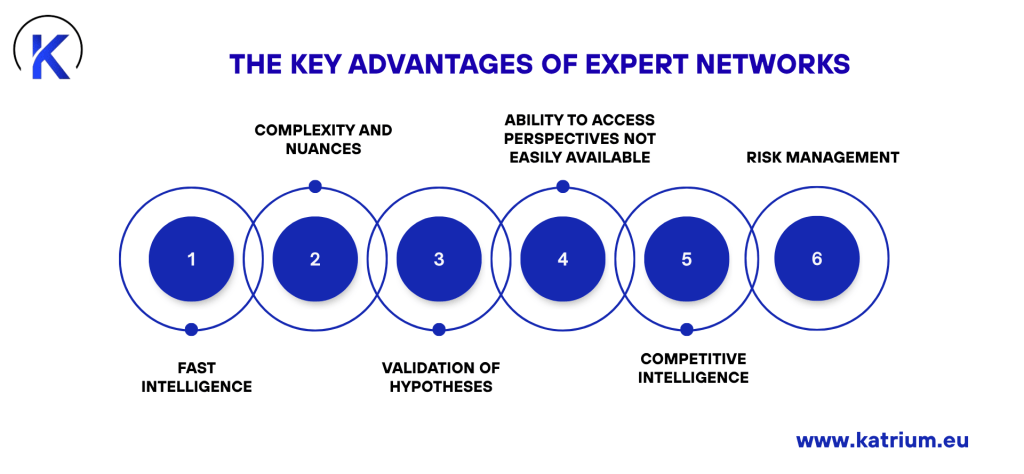
The Key Advantages of Expert Networks
- Fast Intelligence
Speed is the most clear and evident advantage of utilizing expert networks. Expert networks drastically reduce timeframes required for research.
- Where desk research could take days or weeks to produce an adequate response, a properly structured expert consultation could take just one day.
- Strategic deal cycles, strategy development cycles, and competitive cycles do not tolerate lengthy research processes
- Access to a relevant expert who could be consulted within 48 hours may be an advantage indeed
- Complexity and Nuances
Publications tell about events, while expert consultations give the real background, reasonings, and interpretation.
- Experts can supply nuances that cannot be derived from databases and reports
- They describe industry dynamics, which happen in the industry but do not appear in official publications
- They indicate where the information might have gaps or distortions
- They apply their judgment based on vast direct expertise
- Validation of Hypotheses
Before risking money, strategy, or resource investment in your conclusion, expert networks give you the ability to stress test your logic against experience.
- Market size assumptions can be validated by operators that know the real figures.
- Product or pricing hypotheses can be tested with consumers that make decisions modeled.
- Competitive assumptions can be challenged by executives that have competed with these companies.
- Investment thesis can be stress-tested by industry professionals that have weathered cycles.
- Ability to Access Perspectives Not Easily Available
Some of the most insightful perspectives within an industry belong to individuals that are inaccessible through regular means.
- Former executives that have left their positions and speak freely now.
- Operators working mid-level operations that are not visible from above.
- Specialists operating internationally that have intimate knowledge about markets other firms are oblivious to.
- Technical experts with expertise in niche subjects, for which the latest information is either non-existent or out-of-date.
Expert networks are specifically designed to unlock such perspectives systematically.
- Competitive Intelligence
It is difficult to think of a more valuable application for expert networks than learning what your competition is truly up to.
- Former employees from rival companies are an excellent source of competitive intelligence.
- Customers and distributors who work with several vendors are able to compare.
- Industry analysts who monitor the competitive environment can detect strategic moves before they’re officially announced.
- Experten can either substantiate or dispel information about the competition in market research studies.
- Risk Management
Ultimately, using experts to gather information boils down to risk mitigation.
- Detecting a faulty premise prior to making an important business decision could mean saving hundreds of thousands or even millions of dollars.
- Anticipating a regulatory issue prior to entering a new geographic market saves you from costly mistakes.
- Having a good handle on the true competitive dynamics of a business you are looking to acquire will avoid nasty surprises.
- Making sure a product idea has merit before investing in development is another way to reduce risk of failure.
The return on investment for just one expert consultation which prevents a poor decision easily outweighs the costs of consulting by orders of magnitude.
Criteria for Selecting a Provider for Your Expert Network Needs
Not all expert networks are created equal. Here’s what to consider:
Quality of Experts and Expert Vetting:
- How big is the network, and what kind of screening process do they use for their experts?
- What’s the average tenure and expertise level of the experts within the specific field you’re interested in?
- What process is in place for dealing with underperforming experts and those who misrepresent themselves?
Recruiter Experience:
- Are your recruiters industry specialists or just sourcing experts?
- How fast are they in delivering briefing documents?
- How many experts are recommended and how relevant are they to your needs?
Compliance and Security Structure:
- Does the network verify experts against restricted lists and employees working at publicly traded companies?
- Is each call recorded, archived, and securely managed?
- Are there strict guidelines regarding material non-public information?
Client Platform:
- Is the platform user-friendly?
- Does it support transcripts, keyword searching, and project management?
- Are there AI capabilities to assist in matching and discovering experts?
Transparent Pricing Model:
- Are rates clearly defined and easy to understand?
- Are there any hidden costs for scheduling, transcribing, and cancellation?
- Are rates structured on a per-call, subscription, or project basis?
Final Thoughts
In an age when information is commodified and maintaining an edge becomes increasingly difficult, one feature that the companies making better choices have in common is that they consult those who already know. Expert networks provide the infrastructure to implement such a practice in a sustainable and compliant manner. They are not something exclusively for the large players in investments or consulting but are rather a cost-effective research tool anyone can leverage.
It is not a question of whether your organization can benefit from using expert networks to improve its research and decision-making capabilities. Almost any company operating in an intricate and competitive environment can and certainly will. It is rather a matter of when.