More than 70% of leading consulting and financial companies use expert networks when making important decisions, but do you know the key differences between these services? Selecting a bad expert network will not only be a waste of budget but will cost you time, precision, and a competitive advantage. Below is an ultimate guide for selecting the right expert network service.
What Is an Expert Network Service?
An expert network is a service or company that connects organizations, investors, or consultancies with experts in the respective industry individuals who have firsthand knowledge about a particular sector, role, or geography.
They are not theorists; they are:
- Ex-CEOs who have run Fortune 500 business divisions
- Ex-regulators who have decades of experience with governmental bodies
- Entrepreneurs who have established a presence in regions you are eyeing
- Technical experts who know the ins and outs of operations in a region
Essentially, the premise of expert network services is to get your answers from those who already know them, saving you weeks of research.
The Importance of Expert Networks Today
Public information can be accessed by anyone. Yearly reports, analyst studies, database information as all of these are available for your competitor too. The difference lies in the context, the experience that only a person within the industry would have. It is one of the most efficient tools to gather qualitative data.
Expert networks provide you with:
- Fast turnarounds – Answers provided in a day’s time, not a week
- Targeted answers – Pose exact questions you need answers to
- Contextual insight – Understand the reasons behind the facts
- Validation – Stress test ideas before spending money on them
- Market signals – Identify trends in the markets even before data reflects them

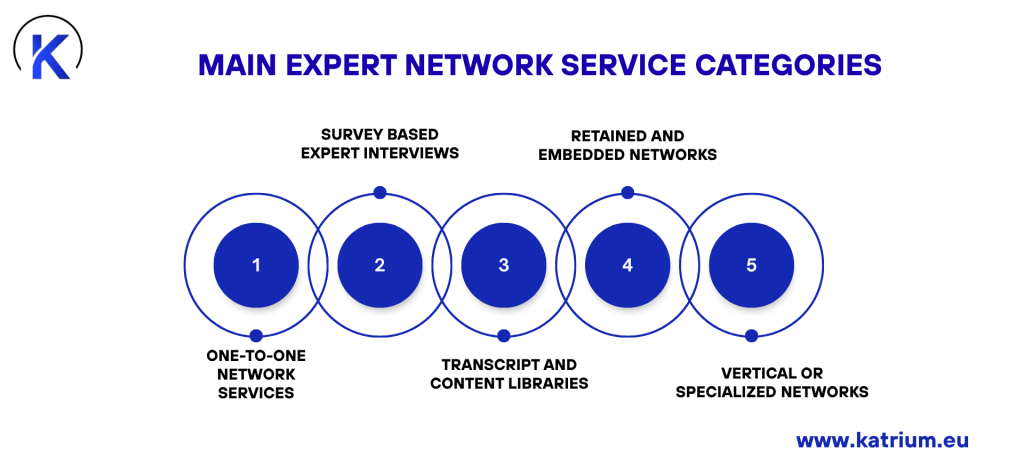
Main Expert Network Service Categories
Herein lies the mistake that most companies make which is assuming that all expert networks operate similarly. This is not true. There are several main categories of these services.
- One-to-One Network Services
This is the traditional approach. You pose your research query, and the network will pair you with an appropriate expert for an interview, which usually lasts for about 30 to 60 minutes.
Recommended for:
- Diligence in investments
- Consulting strategy projects
- Competitive intelligence gathering
- Market entry research
Benefits include:
- Rapid response time, usually 24 to 48 hours
- Insightful and focused discussions
- Flexible, using only what you require
- Potential pitfalls: Excessive use can increase costs rapidly, while quality depends on the recruitment capabilities of the recruiter.
- Survey Based Expert Interviews
Rather than a single dialogue, these networks promote structured surveys to carefully selected panels of experts in the field and produce data aggregations.
Useful for:
- Determining market sizes and validating findings
- Performing channel checks through distributors or consumers
- Capturing changes in sentiment over time
- Aggregating opinion data from a wide sample
Benefits:
- High scalability – you can target multiple experts simultaneously
- Data with statistical significance
- More economical than individual interviews
Caution: With structured surveys, there is less depth. They do not allow for nuances, follow-ups, or surprises that emerge from dialogues.
- Transcript and Content Libraries
Increasingly popular option where clients are able to use a database of previously recorded interviews with experts, instead of arranging fresh interviews.
Suitable for:
- Preliminary research prior to a live discussion
- Teams operating within tight budgets with many users
- Documenting changes in expert opinion regarding a business or industry
Primary benefits include:
- Immediate availability – no waiting time to arrange an interview
- More cost-efficient on a larger scale
- Artificial intelligence facilitates quick searches
Caveats:
- Information may be dated; you cannot ask any additional questions.
- Retained and Embedded Networks
An even more involved approach, which sees the expert working with you on a regular basis through meetings and consultations.
Ideal for:
- Sustained market entry strategies
- Private equity funds assessing their portfolio companies
- Complex product development projects that require significant technical expertise
Advantages:
- The expert gains a thorough understanding of your business context
- Deeper and more nuanced advice
- More cost-effective than multiple single consultations
Be aware: It may be more expensive, and a proper match between expert and client is essential.
- Vertical or Specialized Networks
Niche networks solely concentrate on one industry or specialization such as healthcare, finance, technology, public policy, or geographic specialization.
Good fit for:
- Companies with high and ongoing requirements within one industry
- Regulated industries requiring compliance knowledge
- Due diligence on technical or clinical assets
Advantages:
- Superior expert quality within that specialization on average
- Recruitment consultants who know your industry inside and out
- Better compliance systems in regulated verticals
Caution: Their usefulness is limited beyond their specialization. Don’t rely on a healthcare-specific network for manufacturing research.
Choosing the Right Service for You
Answer these four questions before choosing your service:
- How much depth do you require?
One-on-one networks will provide greater depth for exploring a complex question with a particular individual. Surveys will help you with broader validations among multiple respondents.
- How soon do you require it?
The transcript libraries give you instant results while live calling takes around 24-72 hours. The retained engagement services might be slower to get started with but are worth investing in.
- How specialized is your query?
Your query might not need a specialized network in case it’s more general in nature. However, if it’s complex and belongs to pharmaceuticals, fin-tech or regulation-related areas, a vertical expert will definitely deliver better results.
- How often do you expect to make use of the services?
Low-frequency individuals should pay for each call individually. High-frequency groups should make arrangements for subscriptions. Research facilities may want to explore transcript databases alongside live calls.
What to Expect from any Expert Network Provider
No matter what kind of service you opt for, all providers should be measured against the following standards:
- Expert quality and screening — How do they select their experts? How experienced are their experts typically?
- Recruiter knowledge — Do they have the ability to comprehend a complicated brief and find an expert rather than a near miss?
- Speed of delivery — How long does it take them to provide options for a standard request?
- Infrastructure for compliance — Do they check for blacklisted employees? Are phone conversations recorded and archived?
- Price transparency — Are they transparent about their costs? Do they hide charges such as scheduling or cancellations?
- Platform efficiency — Is their client portal user-friendly and effective?
Common Mistakes Made by Most Companies
Even the most seasoned groups overlook important considerations:
- Drafting broad scopes of work – General questions will yield general results. Be specific about your learning objectives and the experts needed.
- Interviewing just one expert – Just one point of view isn’t enough. Interviews with three to five experts on a particular topic uncover trends.
- Failing to prepare – Unplanned interviews waste valuable time. You should always go into an interview with a discussion guide.
- Neglecting compliance issues – The world of expert networks has received considerable regulatory attention for valid reasons. Never ask for any material non-public information, and always adhere to the compliance guidelines of your network.
- Dependence on a single network – Networks specialize in certain industries. Top research organizations cultivate a network portfolio.
Bottom Line
In such an environment, winning firms are those who have access to better information faster. In modern times, expert network services are not considered to be optional anymore; they constitute one of the essential pillars for any kind of strategic research activity. If you happen to be a hedge fund analyst testing some hypothesis, a consultant meeting a deadline, or just a corporate team exploring a new market – then having access to the right person at the right time can turn the tables around.
The most important part here would be selecting a proper service for your specific needs, using reputable expert networks, and establishing internal processes for getting the most out of every interaction. Katrium is here to assist in ensuring that your business functions more efficiently, quickly, and effectively.