
Executive interview roadmap may not seem important to you now, but that may change very soon. There will be fewer applications for senior positions but many more silent rejections. By the time executives get interviewed, 90%+ will be long gone from consideration. The small group that remains will be equally qualified. But only one gets the job offer. What makes the difference is not their experience. What makes the difference is not their credentials. Nor is it about performance in any conventional sense.
It is about something else altogether.
Why Executive Interviews Are Unlike Any Other Interview
But before going into the topic of preparation, it may be necessary to define what distinguishes executive interviews from all others that a candidate has ever experienced.
Interviews at junior and middle levels evaluate competence: Can you perform this task? Do you possess the necessary skills? Did you manage similar tasks previously?
Interviews at an executive level assume that these issues are resolved and no longer require discussion. You would never enter the room if the answer to all three questions was negative. The essence of an executive interview lies elsewhere and often requires special preparation.
What executive interviews assess:
- Your strategic sense beyond your experience
- If your leadership style corresponds to the organisational culture and the current business climate
- If you thought enough about the offered position to develop a vision of your work in it
- If you can be trusted to manage the development of the organisation
- If you are a leader who builds companies to last or only manages them in a seat-by-seat manner
A candidate aware of these differences enters the room differently. He does not come to answer questions but comes to discuss the future of the company with its leaders.
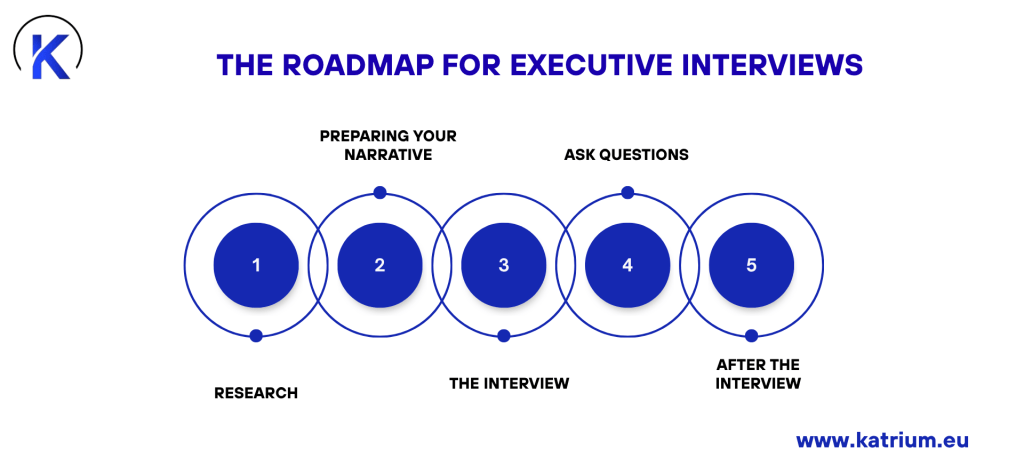
Executive Interview Roadmap Phase 1: Research — The Work Before the Work
In almost all cases, it’s neither nerves nor poor answers that lead to failure in an executive-level interview process. The most prevalent issue is lack of preparation. Interviewers on the executive hiring panel can quickly distinguish between those who have prepared thoroughly and those who did a quick read of the annual report last night.
Key elements of extensive executive-level interview research:
- Strategic context of the organisation – what are its current challenges? How have things developed in the past year to year-and-a-half? Where is the industry headed and where does this organisation sit in relation to it?
- Role definition – what challenge needs to be addressed? What does the organisation really need from a hire in this position rather than what it wants according to the job description?
- Leadership context – who will the candidate interact with? Who else leads the company and what do they bring to the table?
- Organisational culture – what does the organisation claim about itself compared to outside perceptions from employees, customers and analysts?
- Financials – for public organisations look back over the previous two or three fiscal years; for privately owned firms, any information available
Resources that candidates rarely consult but should:
- Glassdoor reviews, analyzed carefully
- Linkedin profiles of senior leadership currently at the organization, to get a sense of who they are
- Relevant press coverage that does not come from the PR department
- Industry analyst coverage
- Interviews with individuals who have had dealings with the organization
At this stage of the process, the research you conduct isn’t really meant to impress your interviewer with your knowledge. It’s meant to give you insight into how the organization works which is what makes you stand out.
Executive Interview Roadmap Phase 2: Preparing Your Narrative
The story of the executive candidate is not his/her professional resume. It is the rationale for being a leader in the given organization at the given stage of his/her career.
Usually, the candidates make this mistake. Instead of preparing to tell the story of their career as related to the job, they prepare to talk about their career history. The most successful candidates prepare to tell the story of how their career experience relates to the future of the organization.
Steps to develop an executive story:
- Determine what are the most significant experiences in your career which best fit the requirements of the role you are applying to; don’t dwell on the accomplishments but focus rather on your experience that is related to the current situation of the organization
- Develop the skill to tell your failures equally well as your successes; only those executives are worth considering who are able to admit mistakes and tell what have they done to prevent their recurrence in the future as it shows their emotional intelligence
- Develop a viewpoint on the role; determine the priorities you would consider in the first three months after taking the office
- Make sure you know your personal philosophy of leadership in practical terms: Don’t just say, “My leadership philosophy is I empower my employees,” but think of specific stories where you’ve led, made tough calls, or cultivated a culture that has lasted beyond you
Some stories to prepare for any executive-level interview:
- Something you’ve done when you’ve had to make a decision based on incomplete facts and information
- Something where you’ve been wrong about something important and how you handled it
- An experience where you had to lead an organization or a team through tough times (restructure, crisis, etc.)
- Something you had to go against the grain on, disagreeing with a board, CEO, or leadership team
- Your proudest accomplishment that isn’t about you
Executive Interview Roadmap Phase 3: The Interview Itself
Introduction
The introduction in the executive interviews sets the stage for the entire interaction. Most candidates will be managed by the interviewer during the first few minutes of the discussion. However, the best candidates will be confident enough in their ability to create a mutual conversation right from the onset.
Suggestions for introducing oneself in an executive interview:
- Start with enthusiasm and interest rather than with apprehension
- Provide a clear and concise explanation of who you are in relation to the position; avoid listing accomplishments
- Communicate clearly within the first few minutes that you have an opinion regarding the organization, rather than simply seeking a place in it
Responding to questions
During executive-level interviews, how candidates think is equally important to their achievements.
Tips for answering executive interview questions
- Provide a concrete example – generalities on philosophy of leadership will score poorly; something concrete and successful will score highly
- Take your time – don’t rush into an answer when asked a hard question; it’s better to wait a few seconds than to panic
- Answer honestly about things you do not know – executive candidates who pretend they know everything quickly show their lack of wisdom
- Stand your ground if you really feel differently – agreeing with everything shows that you are likely to be a yes-man
- Make your answers relevant to the context of the organization – not “this is how I managed it previously” but “here is how I would handle it here”
Examples of executive interview questions
- Please tell me what is your philosophy of leadership and provide a real example from your career
- Tell me about one occasion when your strategy did not pay off – describe the event and what you learned from it
- What information do you want to gather during your first week, month, and three months on board?
- Tell me about the toughest decision you had to make as a leader?
- What will my team members say are your strengths and weaknesses?
Executive Interview Roadmap Phase 4: The Questions You Ask
It’s just as critical for an executive job candidate to pose relevant questions as it is to provide thoughtful answers during an interview. A lack of substance in the questions an executive job candidate poses shows they aren’t truly considering this potential opportunity.
Relevant questions for an executive candidate to ask:
- What is your definition of success in the first 12 months for this role, and what metrics would indicate that the right hire was made?
- What are the two to three most important things that have to get done in the first year?
- What are the key issues the incumbent will need to deal with within the organisation?
- How does the board or executive management view risk?
- Is there something the organisation is doing well that few people outside the company understand or appreciate?
- What did the prior occupant of this role do well, and what were some of his or her challenges?
Question types to avoid asking:
- Questions that reveal the candidate hasn’t done their homework
- Questions focused on pay until a job offer has been extended
- Questions that show the candidate is an outsider to the organisation
Executive Interview Roadmap Phase 5: After the Interview
It is common for most people to regard the executive interview process as concluding once they exit the interview venue. The truly outstanding candidates consider the process to be continuous and continue engaging in it even after their departure.
The steps which truly outstanding executive candidates undertake following an interview include:
- Writing a specific follow-up message rather than the usual generic thank-you message that simply acknowledges having taken the interview. This should be a more personalized message that references some part of the discussion during the meeting.
- Reviewing the interview process objectively in order to understand areas that need improvement, as well as those areas where they succeeded.
- Conduct further research about areas where their lack of knowledge was discovered by the interviewer during the interview session.
- Maintaining regular contact with the executive recruiters.
Common Mistakes That Cost Executive Candidates the Offer
These mistakes can be made by any candidate, but identifying them is the key to avoiding them.
- Not having a point of view – The candidate who knows his stuff and really knows what he thinks about the problems facing the organization is much more impressive than the candidate who has merely prepared an answer
- Over preparing – The answer that is rehearsed sounds rehearsed, and no interviewer wants to hear thousands of the same
- Underestimating cultural fit – The candidate whose resume is not quite as good but who shows that he understands the culture wins out over the candidate whose resume is better but does not demonstrate understanding of the culture
- Lack of active listening – It is a conversation after all; candidates who just wait for their next opportunity to recite memorized material stand out
- Failure to close – Failure to show interest in the interview is always fatal because organizations want candidates who want to work there
Final Thoughts
A successful executive interview is built on more than experience alone. It requires thorough preparation, a clear understanding of the organisation, relevant leadership examples, and the ability to discuss both successes and failures openly. The strongest candidates also treat the interview as a two-way conversation, using it to assess the role, leadership team, culture, and expectations placed on the position.
Preparation should continue throughout the entire process, from researching the organisation and developing your leadership narrative to asking thoughtful questions and following up after the interview. Each stage gives the organisation insight into how you may approach decisions and responsibilities in an executive role.
If your organisation is looking for experienced professionals for senior or executive positions, Katrium can support the recruitment process through talent sourcing and international recruitment services. Contact Katrium to discuss your hiring needs and find candidates who match the requirements of the role and organisation.