
Executive interview process can be a bit of a mystery.The interview felt like a success. The dialogue was fluid, the interviewee was sharp, and by the end of the meeting, all parties involved felt satisfied. Months later, the person hired is underperforming. They aren’t buying into the company’s strategic vision. The organization feels unstable. The hiring manager is now left to wonder what went wrong.
The overall recruitment process fails in half of its attempts, regardless of job position. For higher-level positions such as senior executives, the consequences of failure go beyond monetary losses. An interviewee who appears to be highly competent but lacks strategic acumen may force the company to prioritize the wrong areas of focus, sacrifice sustainable development in favor of quick wins, and cause highly capable employees to leave. What went wrong wasn’t the selection of questions. It was the lack thereof.
Why Standard Interview Questions Fall Short at the Executive Level
Even today most interview questions making up the executive interview process resemble a guided tour of a resume. “Take me through your professional path.” “Please, describe what your last position entailed.” “Please, talk about your greatest accomplishment.” Such questions focus more on testing the candidate’s ability to retell information and less on evaluating their way of thinking in strategic terms.
It is quite possible for a well-prepared candidate to provide the perfect response to all these questions and disclose nothing about his/her approach towards decision-making, team-building, stress-management, etc. Standard interview questions help to put a candidate under the spotlight.
The limitations of standard questions include lack of knowledge on:
- What kind of decisions an executive would make when he/she lacks information/data and stakeholders hold different opinions
- If an executive’s instincts match the company’s strategy
- What his/her behavior is like when something goes wrong
- If an executive’s management style meets current organizational needs
It is the transition from discussing a candidate’s achievements to understanding his/her approach that distinguishes an effective interview from a performance.
What the Right Questions Really Reveal During the Executive Interview Process
It’s not about verifying an individual’s professional experience; you’ve got his or her CV for that purpose. Rather, it is to determine how this person is going to lead in the context of your organization, given its peculiarities and given the particular time in which your organization finds itself right now.
In order to design any one interview question, the recruiters need to be clear on the strategic context into which the executive will be coming: the critical issues he or she will be required to deal with during the next 18-36 months. And once you have clarity on that, all questions become a means by which to verify whether this person is capable of meeting these specific challenges.
Questions that repeatedly show up to yield the most insight into executive candidates:
- “How have you decided on striving for a short-term goal versus developing a long-term capability?” – This gives insight into how the individual makes decisions spanning different horizons, which is among the top traits required at the executive level.
- “What have you developed during past jobs that has survived your departure?” – Structures, processes, culture, or people. The response highlights whether this individual has the mindset of an owner or just a tenant in the position.
- “Please share an example of a decision that you made confidently, but which was ultimately incorrect.” – It demonstrates self-awareness, intellectual humility, and the willingness to learn which are traits that distinguish executives who create organizations from mere managers of them.
- “What persistent challenge did you attempt to address in your last position but could not?” – It uncovers genuine limitations, personal blindspots, emotional intelligence, and how the individual deals with scenarios where he does not receive the needed resources

According to studies, employees with a cultural fit tend to be more productive and are more satisfied with their jobs. When it comes to an executive, the lack of a cultural fit is no longer a problem for him alone but for all his subordinates and co-workers around him. Cultural fit interview questions are anything but soft if used effectively.
What Executive Candidates Should Be Asking
The executive interview process takes place on both ends. Either the interviewee does not pose difficult questions because he or she simply is not interested in the position or lacks the preparation. In either case, the outcome will be poor for the candidate.
Asking intelligent questions shows a true interest from the interviewee towards the organization – and the lack of any questions implies that the applicant is not quite bothered whether he or she gets hired. In the context of the executive level hiring, this difference means a lot.
Examples of smart questions to demonstrate your professionalism include:
- “How will you know that you have made the right hire at 30, 60 and 90 days?” — A better question than “what qualifications do we need?” It reveals an emphasis on results and accountability from day one
- “What was the last person doing well in this position and what were their challenges?” — A good indicator that you are ready to learn from your surroundings, not just come in and rewrite everything
- “What is the greatest challenge facing the management team today?” — It tells us that you understand the company, not just yourself
- “What would success look like in two years in this position?” — It tells you how much the organization knows what it really wants and needs, and gives you the information to decide if the position is a good fit
The Questions That Define Great Executive Interview Process vs Just Good Ones
Regardless of whether you are conducting or being interviewed in an executive interview, there are certain qualities all of the questions that can lead you to insight have in common.
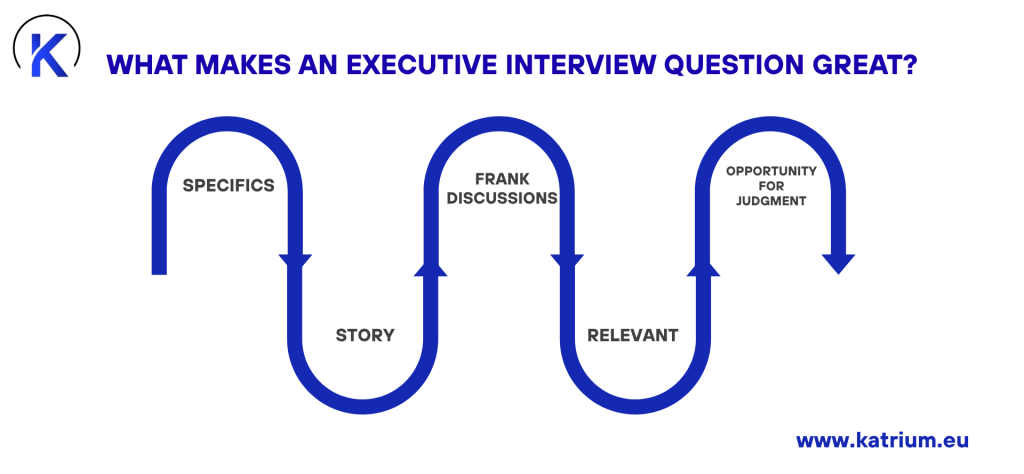
What makes an executive interview question great?
- It seeks specifics — concrete stories with concrete details, not just principles or statements regarding personal style or approach
- It seeks the story of what happened next, not just what the decision that was made was
- It encourages frank discussion of struggle, mistakes, and ambiguity instead of praising confidence
- It is relevant to the actual situation in which the person is expected to function
- It provides an opportunity for judgment to be revealed, rather than simply recollection
One of the most revealing questions that might be asked in any executive interview process could be a very simple one: What do you feel most uncertain about when considering taking on such a role?
Final Thoughts
The executive interview is probably one of the most crucial talks within a company. Getting this interview right results in acquiring the person that will set up the path for the whole company, push everyone else up their game and build the legacy. And failing at it comes with an exceptionally high price that is paid in lost time, momentum, culture, and even money.
The factor that determines whether the outcome of such interviews will be positive or negative rarely has anything to do with the quality of communication or appearance of a potential hire. It is all about whether the necessary questions were asked and answered. An executive interview is not just a formality. An executive interview is where the fate of a very important decision is decided. And the questions you ask determine its result.
If your organization needs support in identifying and reaching the right senior-level candidates, Katrium’s recruitment and talent sourcing services can help you build a more focused executive search process. Contact Katrium to discuss your recruitment needs and the type of leadership expertise your organization is looking for.