





Target group research is the first and most essential step in understanding your customers and building a marketing strategy that truly delivers. Without knowing who your audience is, even the most creative campaigns can fall short.
Every product or service has an ideal user. When you know exactly who that is, you can focus your energy, budget, and creativity on reaching and serving them well. Whether you are a small startup or a multinational corporation, knowing your audience is not optional; it is crucial.
What Is Target Group Research?
Target group research is the process of identifying, analyzing, and understanding the specific audience that a product, service, or campaign is meant to reach. This research allows businesses to focus on the right segment of the market by studying customer behavior, preferences, needs, demographics, and pain points. Learn more about this core marketing concept through this Investopedia guide on market segmentation.
It is more than just knowing who your customers are; it is about learning how they think, feel, and behave. By using target group research, businesses reduce guesswork and make informed, data-driven decisions that lead to more sales and stronger customer loyalty.
We at Katrium believe that the success of any project begins with the right research. That’s why our expert teams conduct detailed and precise audience analysis for each of our clients, helping them stay competitive in global and local markets.
Why Target Group Research Matters
Understanding your target group brings countless advantages. You get to:
- Develop more relevant and useful products
- Launch highly targeted advertising campaigns
- Write engaging and personalized content
- Improve customer experience and satisfaction
- Reduce marketing costs by avoiding trial-and-error strategies
Let’s suppose a company is trying to sell luxury watches to college students on a tight budget. Without target group research, businesses might waste thousands on marketing to the wrong people. But with the right data in hand, you can reach high-income professionals who are actually in the market for luxury timepieces.
This strategic clarity is what makes target group research so powerful. According to Statista, businesses that base their strategies on customer data achieve up to 3 times higher returns.
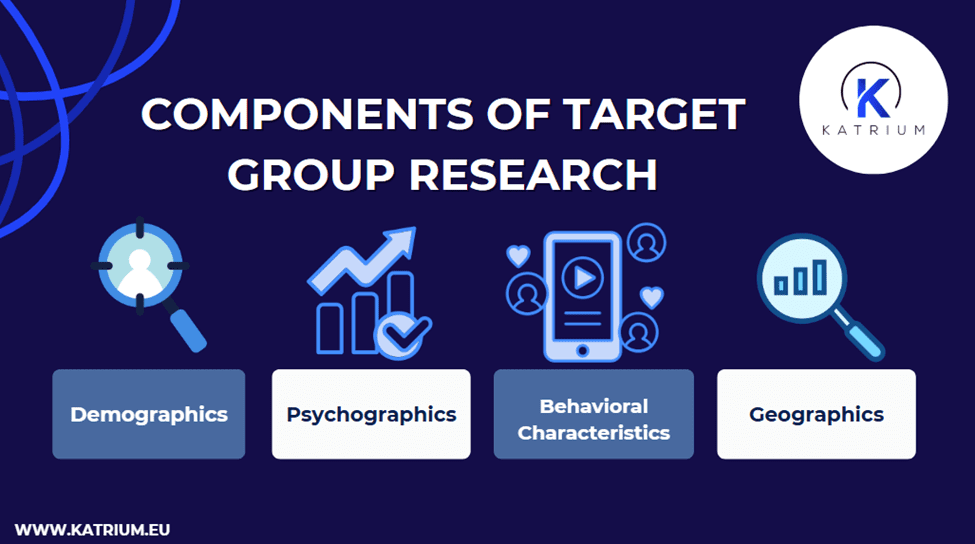
Main Components of Target Group Research
To conduct target group research effectively, you need to understand several key elements:
1. Demographics
Demographic data includes age, gender, income level, education, occupation, and family size. These basic details help form the first layer of your target audience profile.
2. Psychographics
Psychographic data focuses on lifestyle, interests, values, personality, and social status. It helps you understand why people buy, not just who buys. Explore more about psychographic segmentation in this comprehensive article.
At Katrium, we combine demographic and psychographic insights to create customer personas that represent real segments of your audience.
3. Geographics
Geographic data covers the location of your customers. Knowing where they live affects product delivery, marketing language, seasonal promotions, and more.
4. Behavioral Characteristics
This involves purchase history, product usage, brand loyalty, and online activity. By examining these patterns, you can refine your offers and messaging to better align with their behavior.
Katrium’s market research methods use advanced tools and real-world interviews to collect and verify such information. We know how important it is to build a full picture of the customer.
Methods Used in Target Group Research
There are two main types of research methods in target group research:
1. Quantitative Research
Involves numerical data gathered through:
- Online surveys
- Polls
- Web analytics
- CRM tools
Quantitative data helps you understand trends and volumes; for example, 80% of your buyers are women aged 25–34.
2. Qualitative Research
Involves an in-depth understanding through:
- Focus groups
- In-person interviews
- Open-ended survey questions
Qualitative research reveals emotional triggers, motivations, and opinions that drive customer decisions. These insights are crucial in developing marketing strategies that connect on a deeper level.
Katrium offers flexible data collection & research services to help you reach your business goals with accuracy and confidence.
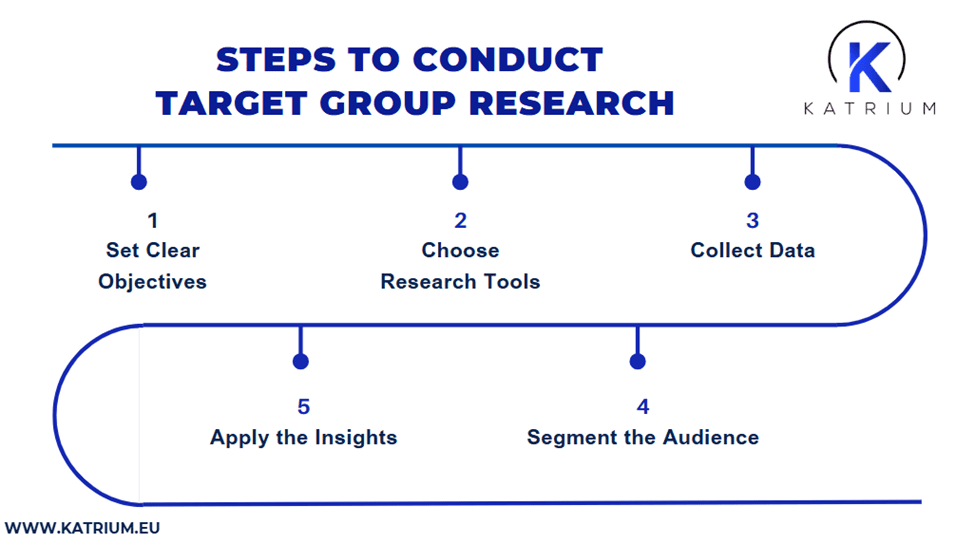
Steps to Conduct Effective Target Group Research
Conducting target group research involves the following structured steps:
Step 1: Set Clear Objectives
Know why you are doing the research. Are you planning to launch a new product? Improve an old one? Expand into a new market?
Step 2: Choose Research Tools
Choose tools that match your goals. For digital products, the elements of web analytics may work appropriately. Additionally, the surveys and the interviews may be authentic.
Step 3: Collect Data
You can use surveys, forms, interviews, and other social media analytics. On the other hand, you can also purchase the third-party data for deeper insights.
Step 4: Segment the Audience
Based on similarity, it is better to divide your customers into simpler & smaller groups. For example, you can have a segment for first-time buyers and another for loyal customers.
Check out Katrium services on Market Research for businesses to learn how this step has helped small businesses flourish.
Step 5: Apply the Insights
Tailor your messaging, product features, pricing, and campaigns to suit the preferences of each segment.
Popular Tools for Target Group Research
Using the right tools can make target group research easier and more effective:
- Google Analytics – for visitor demographics and behavior
- Typeform / SurveyMonkey – for online surveys
- Facebook Audience Insights – for social media audience profiling
- SEMrush / Ahrefs – for search behavior analysis
- CRM Software – like HubSpot, Zoho, or Salesforce
Customer Relationship Management (CRM) tools are widely used to store, track, and segment customer data. You can explore more about CRM benefits here.
Katrium uses a combination of these tools alongside direct customer interactions to gather highly actionable insights.
Examples of Target Group Research in Action
Let’s look at a few industries where target group research plays a vital role:
1. E-commerce
Understanding shopping behavior helps businesses recommend the right products at the right time.
2. Healthcare
In public health campaigns, knowing which demographic group is at risk allows for tailored messaging and timely interventions.
3. Education
Schools and universities research to reach students through preferred channels and offer programs that meet their needs.
Common Challenges in Target Group Research
Incomplete or Inaccurate Data
Old or low-quality data leads to poor decision-making. Always validate data from reliable sources.
Research Bias
Avoid asking leading questions or making assumptions in your research design.
Overgeneralization
Avoid grouping too broadly. Targeting “all millennials” is too vague. Instead, be specific; like “millennial freelancers in tech startups.”
At Katrium, we help our clients avoid these common pitfalls by offering tailored, transparent, and high-quality research services.
How Katrium Supports Target Group Research
At Katrium, we understand that target group research is the backbone of all successful marketing, sales, and business development. Our multilingual and multicultural team provides:
- Survey design and analysis
- Telephone and online interviews
- Market segmentation reports
- Focus group planning
- On-site and remote research coordination
We work with clients from various industries—B2B and B2C—and provide tailored research solutions. These are the values that Katrium upholds: accuracy, professionalism, and a deep understanding of local and international markets.
Conclusion
Every successful campaign, product launch, or branding effort starts with understanding your audience. Target group research equips businesses with the tools they need to speak directly to the right people.
With a combination of demographic, psychographic, geographic, and behavioral data, companies can build campaigns that resonate, products that solve real problems, and services that meet true needs. Whether you are a small local business or an international corporation, this research lays the foundation for sustainable growth.
We at Katrium believe in empowering businesses through smart research. Target research is not just a task; it’s a continuous journey of learning, adapting, and improving.
Contact us today to learn how our expert team at Katrium can support your business with reliable, multilingual, and results-driven target group research.