
Industry expert consultation is an often overlooked side of research. Organizations invest billions each year into conducting market research that results in incorrect decisions, not due to poor data, but because no one in the room comprehended what it all meant.
It’s not a question of whether industry experts add value to research efforts; that is an unequivocal fact. Instead, it’s a matter of deciding when to leverage expert consultations, how to go about using those consultants effectively, and determining whether the cost-benefit analysis warrants the expense.
That’s the truth.
What Does It Mean to Use Industry Expert Consultation in Research?
Industry expert consultation means getting advice from qualified and experienced individuals within your research area. These may include former industry leaders or experts with significant experience in your topic.
It doesn’t involve employing an external research company, requesting reports or surveys. All these activities will result in the accumulation of information and raw data. The purpose of expert consultation is different as you want to get a comprehensive view on your research problem.
Here are several examples how it looks in practice:
- A team responsible for the development of a strategy speaks with former regional managers before making any assumptions regarding the company’s position in the market
- A product development team seeks assistance of procurement experts to confirm its pricing assumptions
- An investor performs expert consultation to make sure he or she has all necessary information regarding the acquisition process
- A policy analyst employs practitioner insights to better understand results obtained by using quantitative survey data
In every instance, the procedure is always the same because gathering information helps one to answer the “what” question, while expert consultation provides insight into the “why” question.
The Central Argument for Engaging Market Research Specialists
It Helps Fill the Interpretation Void
The most costly error when conducting research occurs due to faulty interpretation of sound data. There are numerous companies out there that knew the correct numbers but did not understand what those numbers meant due to the absence of contextual knowledge.
Industry expert consultation addresses the situation by providing:
- Historical background for existing market trends
- Unofficial factors that shape the behavior reflected in the figures
- Insider knowledge as to what is driving the changes in numbers
- Specific recommendations based on data to support decisions being made
It Reveals Information That Secondary Research Lacks
Secondary market research is, by definition, lagging. It talks about past developments in the markets that are already in motion. The truly valuable insights, such as what is currently going on, what will happen next, and why, cannot be found anywhere else except inside the minds of experienced individuals who work in their fields.
Industry expert consultation allows you to get:
- Early warning signs of emerging market trends before anyone else knows about them
- Competitive information that has not been published anywhere
- Insider knowledge regarding regulatory and policy changes that take place
- Realities behind the face that industries show publicly
Validation Comes First
By far the most valuable reason for an industry expert consultation is hypothesis validation; that is, validating your assumptions via the experience of those in the know, prior to committing significant resources to a big project.
Have market size estimates validated by operators with actual numbers
- Get product concepts challenged by customers, who understand what your decisions are based on
- Have competitive assumptions tested by experienced executives who have dealt with these parties before
- Ensure that strategic conclusions are sound before presenting them to anyone at all
- One expert consultation preventing a bad assumption from becoming a costly mistake can pay itself back many times over.
It Speeds Up Your Research
When done right, an industry expert consultation can replace months or even years worth of research with a single meeting. Experts who really know their business will know how to point out things that your desk research missed, and will help you focus on what really matters.
This speed becomes particularly important when time is of the essence.
When Is It Best to Have Expert Consultations in Industry Research?
Consultation with industry experts cannot be the method used for all research. The following cases require using industry expert consultation the most:
- You enter into an unknown market area
If you and your team do not have experience of working in the particular market you are researching, then consultation with industry experts will help you obtain the necessary contextual knowledge.
- Your research requires answering qualitative questions
The questions related to customer behavior, competition factors, regulatory risks, etc., need human judgment rather than data evaluation only.
- You are trying to verify some hypotheses
In order not to make costly mistakes, before investing money or efforts in any assumptions, you should prove them by consulting industry experts first.
- Your secondary research is sending mixed messages
Wherein your sources disagree or do not make sense of the evidence before you, the interpretation of experts gives you the necessary layer of analysis to make sense of things.
- Time is against you
Whereas a couple of expert interviews may accomplish in days what months of desk research cannot, lack of time allows you no other option.
- Due diligence demands it
Where the numbers and the documentation fall short of telling you everything, an expert consultation in M&A, investment, and partnership deals may be your only recourse.
When Caution Is Advised
Expert consultation is valuable, yet it has its constraints and risks, which are better understood than ignored.
- In situations where statistical significance matters
Expert consultations provide quality data at the expense of quantity. When a quantitative dataset is needed in large numbers, supplement expert consultations with surveys.
- In situations where expert accessibility is an issue
Finding experts in very specialized fields is not always easy and might be time-consuming. Plan for this in advance.
- In situations where compliance is important
When dealing with public companies, the risk of getting into legal trouble due to material non-public information is possible. Only use networks with sound compliance measures and instruct your team properly.
- In situations where bias masquerades as consensus
Just because there is only one perspective does not mean it’s a finding. Always consult more than one expert on the same question, particularly if the stakes are high. The rule of thumb is three to five expert consultations on any topic under discussion.
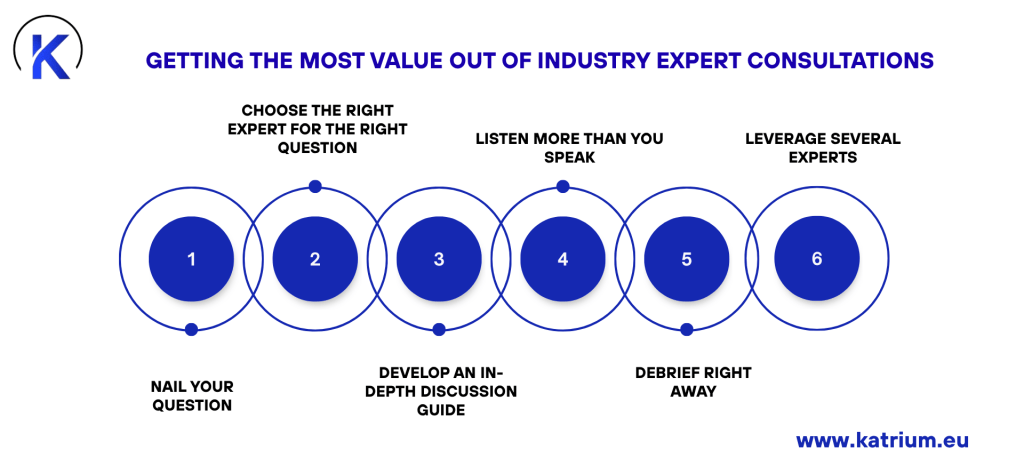
Getting the Most Value out of Industry Expert Consultations
Once this decision has been made, what distinguishes the expert consultation that changes your life from the one that yields no results is planning and process.
- Nail your question
Unclear questions beget unclear answers. Identify in advance exactly what one thing you need to learn, and make the rest of your plan serve that goal.
- Choose the right expert for the right question
While it is helpful to have a well-rounded veteran of an industry, it does not necessarily equate with having an expert with direct, current expertise related to your question. Plan ahead to define your expert needs in detail prior to recruiting.
- Develop an in-depth discussion guide
Never wing this conversation. Develop 6 to 8 core questions and organize them from general to specific in advance, with probing follow-ups ready for each.
- Listen more than you speak
Your mission in expert consulting should be to listen, learn, and probe, rather than present your work for affirmation. Challenging assumptions may prove to be more valuable than confirming them.
- Debrief right away
Record themes, surprises, and additional questions within 30 minutes after each session. Some of the best discoveries are the surprises, but they won’t stick around for long.
- Leverage several experts
One session might just scratch the surface, while three to five sessions about the same topic start to show trends, agreement, and differences. Adjust your use of experts based on the significance of the decision.
Final Thoughts
If your work requires a difficult market, an important decision, a new field of inquiry, or a question that even your data can’t help you answer, then yes, you need industry expert consultation.
Industry expert consultation is not meant to replace your quantitative research, second hand sources, or in-house expertise. It is the icing on the cake that allows all of these resources to become more effective because it gives meaning and value to the information.
The companies that are able to make better decisions in tough environments aren’t necessarily the ones who have more data at their disposal. It’s the ones that know how to interpret their data.
This is exactly what industry expert consultation does.