



Segmentation research is the systematic process of dividing a broad market into meaningful subgroups that share common characteristics such as needs, preferences, or behavior patterns. This allows businesses to tailor products, pricing, communication, and distribution to resonate uniquely with each audience. It is a strategy that often leads to increased conversion rates, higher customer loyalty, and improved ROI.
Why Segmentation Research Is Essential in Modern Marketing
Segmentation research transforms generic marketing into precise targeting. The purpose of segmentation is to help a firm identify segments in a market, with the end goal of developing different strategies and tactics for the different segments. With insights from segmentation, businesses can avoid wasting money and reach customers more effectively.
At Katrium, we believe that strong segmentation research lays the groundwork for personalized customer experiences that drive measurable business growth.
Core Types of Segmentation Research and Their Applications
1. Quantitative Segmentation
This involves collecting large-scale survey data and applying statistical techniques like RFM analysis or k-means clustering to discover distinct customer groups. For instance, an e-commerce brand might segment customers based on purchase frequency, order size, and product preferences.
2. Qualitative Segmentation
Through focus groups and one-on-one interviews, qualitative segmentation reveals emotional motivations, lifestyle factors, and deeper connections that numbers alone can’t uncover.
3. Secondary Segmentation
This leverages readily available data like census statistics, CRM records, and industry reports to identify consumer clusters. It’s a cost-effective starting point before investing in primary research.
4. Hybrid Segmentation
Combining multiple data types—demographic, behavioral, psychographic, and technographic creates more dynamic and actionable segments. This holistic view supports more effective targeting and messaging strategies.
Key Bases for Segmentation Research
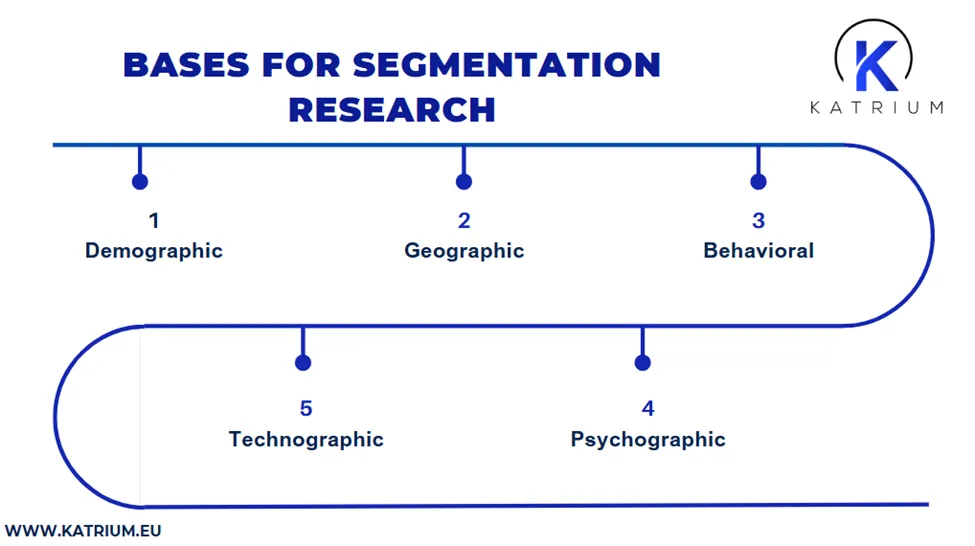
- Demographic – Variables such as age, gender, income level, and education.
- Geographic – Geographic segmentation by country, city, or climate zone—critical for regional marketing.
- Behavioral – Segmentation based on purchase frequency, brand loyalty, or usage patterns.
- Psychographic – Lifestyle values, interests, and personality traits—are essential for appeal-based marketing.
- Technographic – Understanding customers’ tech adoption and platform usage—a growing trend in segmentation research.
Step-by-Step Guide: Conducting Segmentation Research
- Define Research Objectives
Identify the business question or problem, e.g., “Which customer groups offer the highest growth potential?” - Choose Data Sources
Decide between primary data (surveys, interviews) or secondary data (reports, CRM analytics). - Gather Data
Use well-designed questionnaires, in-depth interviews, and analytics dashboards. - Apply Analytical Techniques
Implement RFM, k-means clustering, decision trees, or neural networks to reveal segment structures. - Build Segment Profiles
Create personas summarizing motivations, common traits, media consumption, and buying barriers. - Validate Through Testing
Pilot test messaging, channels, or product offers to evaluate segment responsiveness. - Activate Tailored Strategies
Implement customized marketing campaigns, email, social media, and ads that speak to each segment. - Monitor and Update Segments
Reassess segments regularly to reflect evolving consumer behavior and market changes.
Business Benefits of Segmentation Research
- Precision Targeting – Deliver personalized communication to segments with high conversion potential.
- Improved ROI – Allocate budget more efficiently by focusing on receptive audiences.
- Enhanced Product Relevance – Adjust product features and positioning based on segment insights.
- Stronger Brand Loyalty – Personalize the customer journeys so that they can match the segment needs to precisely build the emotional connections.
Info-Tech particularly focuses on the fact that segmentation helps companies to identify the lucrative market segments for targeting efforts. This is the ultimate key to strategic growth.
Overcoming Common Challenges in Segmentation Research
- Data Inaccuracy – It ensures that your samples are accurate and reflect the population by the proper use of sampling techniques.
- Excessive Segmentation – It avoids the overly fragmented groups that have been maintained by the 4–6 actionable segments.
- Combining Methods – This pairs the quantitative data with qualitative insights. It has mainly been one to uncover the true customer motivations.
- Regulatory Compliance – It manages the personally identifiable information along with the adherence to GDPR and other similar laws.
- Validation Requirement – This continuously tests the segment assumptions with the help of small-scale campaigns and user testing.
Katrium is the platform that handles all these challenges to perfectly combine the strong data controls with the help of expert analysis.
Global Perspective: Navigating Market Differences
Expanding into new regions—like Southeast Asia or Latin America—requires segmented insights that consider cultural norms, language differences, and local behaviors.
Explore more about the International Expansion Services for detailed support.
Advanced Tools & Frameworks
- RFM Analysis: Segment based on purchase value and frequency.
- Cluster Methods: k-means, hierarchical clustering, and Gaussian mixture models reveal hidden groupings.
- Personas: Use visual and narrative attributes to make segments relatable across teams.
- Social Listening: Platforms like Brandwatch gather sentiment and unmet needs.
- A/B Testing: Evaluate messaging and creatives against segment criteria.
These tools support Katrium’s goal of creating segments that are accurate, reachable, and measurable.
Case Study Spotlight
A beverage client wanted to increase market share. Segmentation research identified three prime audiences:
- Health-Conscious Professionals: Prioritize nutritional transparency and organic ingredients.
- On-the-Go Convenience Seekers: Value single-serve options and convenient availability.
- Flavor Adventurers: Seek new, adventurous tastes and flavor varieties.
Using this insight, Katrium recommended segment-based packaging, messaging, and in-store displays, leading to a 25% increase in sales and improved brand recognition among target segments.
Technographic Segmentation: The Next Frontier
Research indicates that including technographic data, such as device usage, app preferences, and tech savviness, can:
- Increase brand awareness by 40%
- Reduce cart abandonment by 50%
- Improve repeat purchase rates by 33%
Given consumers’ growing digital engagement, technographic segmentation offers rich opportunities for targeted campaigns
Best Practices to Ensure Success
- Start with Clear Objectives: Align segmentation goals with business needs.
- Use a Hybrid Approach: Combine hard data and emotional insights.
- Make Segments Memorable: Develop personas with symbolic names and images.
- Test Before Scale: Use ads or product pilots to validate segment assumptions.
- Track Progress: Use dashboards and KPIs to monitor segment-specific metrics.
Conclusion
Segmentation research is far more than an academic exercise; it is a dynamic, business-critical process that informs every aspect of marketing and product strategy. Companies that segment effectively can lower acquisition costs, enhance brand loyalty, and accelerate growth.
At Katrium, we design Segmentation research projects that are data-driven, culturally aware, and strategically focused on helping you to unlock the full value of your customer base.Ready to transform your approach? Learn more about our Market Research Services or contact us to begin your journey with expert-led segmentation research.