




The basis of pioneering achievements in the modern, product-driven business world is product development research, which involves gathering data, thorough analysis, and data interpretation to enhance products. It aims to create products that fully meet customer needs and market demands. This research enables companies to reduce risk and increase the probability of market success at every stage, from product testing to post-launch evaluation.
Why Product Development Research Matters
While introducing new products, companies no longer depend on assumptions thanks to product development research, which enables businesses to scrutinize competitive dynamics, customer preferences, and recently emerged market trends. This research bridges the gap rooted in companies’ lack of awareness of customers’ preferences and requirements. Additionally, according to Clayton Christensen, a professor at Harvard Business School, 95% of new products fail, mainly because of this particular reason.
At Katrium, we believe that research-driven innovation holds the key to creating products that align with what users need and prefer. Our market research services are tailored for businesses, supporting them from idea generation through fine-tuning to the market launch of a product.
Stages of Product Development Research
Product development research is not a discrete process; it’s a sustained activity that provides information about every step of a product’s life cycle, including:
1. Idea Generation and Screening
This is the initial stage, involving the exploration and analysis of new ideas using proven tools such as customer reviews, social listening, and focus groups.
For example, concept testing helps businesses assess how customers respond to a new product idea before investing, and Katrium carries out preliminary feasibility studies at this stage to evaluate which ideas have the strongest potential.
2. Concept Development and Testing
Once a compelling proposal is identified, product development research helps companies fine-tune it. Through surveys and behavioral analysis, it provides insight into benefits, features, branding, pricing, and everything important to the target demographics. This allows businesses to estimate the likelihood of a consumer purchase.
This is where Katrium surpasses expectations: customer segmentation becomes crucial for understanding which customer groups prefer specific product features. This approach can significantly improve the product-market fit.
Key Methods Used in Product Development Research
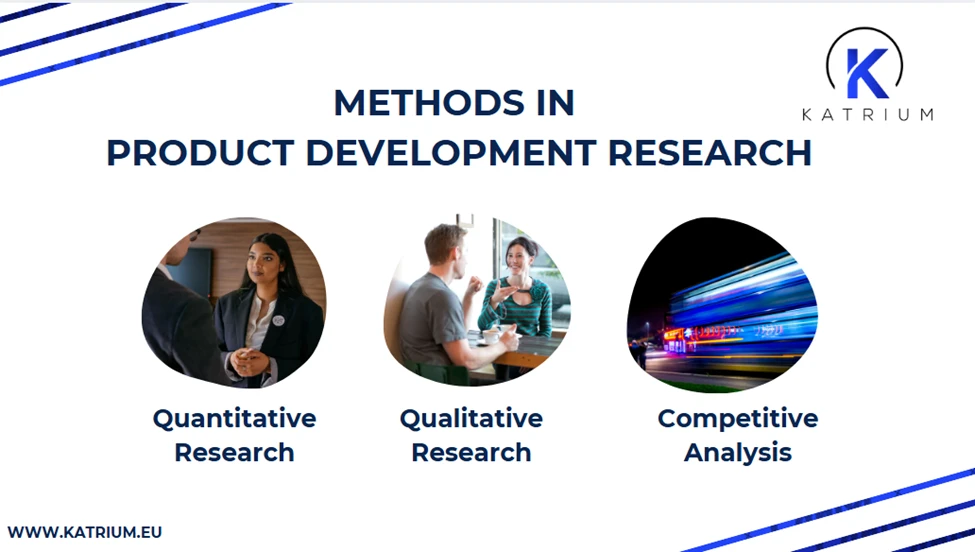
Quantitative Research
Quantitative techniques include A/B testing, online surveys, as well as keen analytics. These methods offer quantifiable data about customer preferences and requirements by using tools like Google Trends and SurveyMonkey.
Qualitative Research
Qualitative methods like ethnographic studies, interviews, and focus groups provide thorough insights into the outlooks of customers along with their needs. This is essential for refining the product’s competitive edge.
Competitive Analysis
Understanding the competitive landscape and comparing market trends can help shape strategies and make smarter decisions. Product development research often includes a detailed analysis of opportunities and challenges from competitors.
Integrating Customer Feedback into Product Design
When designing or refining products, customers are the most important data source. Understanding and accepting customer feedback can lead to smarter development strategies, whether it’s through post-purchase surveys or users identifying their pain points.
A study by McKinsey & Company shows that companies that use client-oriented product development see 32% more revenue growth than their competitors.
At Katrium, we use tools like Net Promoter Score (NPS), product satisfaction surveys, and in-app feedback to support our clients in developing products that reflect customer expectations.
A European fintech company wanted to redesign its mobile banking app. Initial user analytics showed poor engagement on key features. Katrium performed product development research by running usability tests and interviewing users, allowing for accurate development plans to be made.
Key findings included:
- Users found the navigation confusing.
- Many could not locate advanced budgeting tools.
Based on this, the company introduced a new interface, simplified navigation, and an onboarding tutorial. Within 3 months, user retention improved by 18%, and NPS increased by 22 points.
Read more about how usability testing can improve digital product experiences.
Challenges in Product Development Research
1. Biased Feedback
Sometimes, customers may say what they think companies want to hear. Using anonymous surveys and third-party research providers like Katrium helps reduce this risk.
2. Resource Intensity
Conducting robust product development research can be time-consuming and expensive. However, the cost of failed products is often higher.
3. Fast-Changing Markets
What customers want today may change tomorrow. That’s why we at Katrium focus on continuous research cycles that adapt to evolving customer needs and trends.
Role of Product Development Research in Innovation Strategy
Innovation is not just about creativity—it’s about making the right choices based on evidence.
Katrium supports businesses by providing actionable insights at every innovation touchpoint. Our team works closely with clients to tailor research frameworks that align with their strategic goals.
Explore Katrium’s service categories to see how we integrate product research into a broader market research strategy.
Internal Collaboration for Stronger Research Outcomes
Cross-functional teams, including engineering, marketing, and customer service, must work in tandem during the research process. Fusing data and insights from multiple departments results in more balanced and achievable product outcomes.
For example, feedback from support teams may highlight recurring product issues, while input from sales teams can guide research on pricing.
Katrium is convinced that collaborative problem-solving can often enhance joint research sessions with multiple stakeholder groups to enhance unification across business functions.
Ethical Considerations in Product Development Research
Ethical research practices are crucial, especially when collecting personal or behavioral data. Businesses must ensure:
- Informed consent from participants
- Anonymity and privacy
- Transparency in how data will be used
At Katrium, we strictly follow GDPR and ethical guidelines in all research activities. For more on ethical market research, refer to this resource from ESOMAR.
Summary
The difference between a successful and a failed product in a competitive marketplace is often a matter related to the quality of its development research. Product development research enables businesses to revolutionize with confidence, outperform competitors, and fulfill customer expectations.
Katrium is your trusted associate in driving impact through insights, whether you are launching a new product or upgrading an existing one. Contact us to learn how we support innovation through targeted research strategies.


One Response