
One in five candidates who make it to the executive interview stage ends up getting the job offer. You have successfully navigated the screening process, impressed the recruiter, made it through the competency tests and there is still an 80 percent chance that you will leave without a job.
What separates the candidates who secure executive positions from those who fail rarely has anything to do with their qualifications. The deciding factor is their performance in the interview. The selection committee is not merely judging your professional background. They are judging your ability to possess the executive presence, strategic thinking, emotional intelligence, and interpersonal leadership required of the position.
How Your Candidacy is Evaluated
- Your ability to speak and think like an executive
- Your ability to exude executive presence immediately upon entering the room
- Your ability to recognize and respond to organizational challenges with equal insight
- The kinds of questions that you ask, which are reflective of an executive’s perspective
Failing to prepare yourself specifically for this type of interview will not be excused by your extensive experience. This guide will provide you with everything you need to know to lead the room instead of merely surviving it.
6 Practical Tips to Perform in Executive Interviews
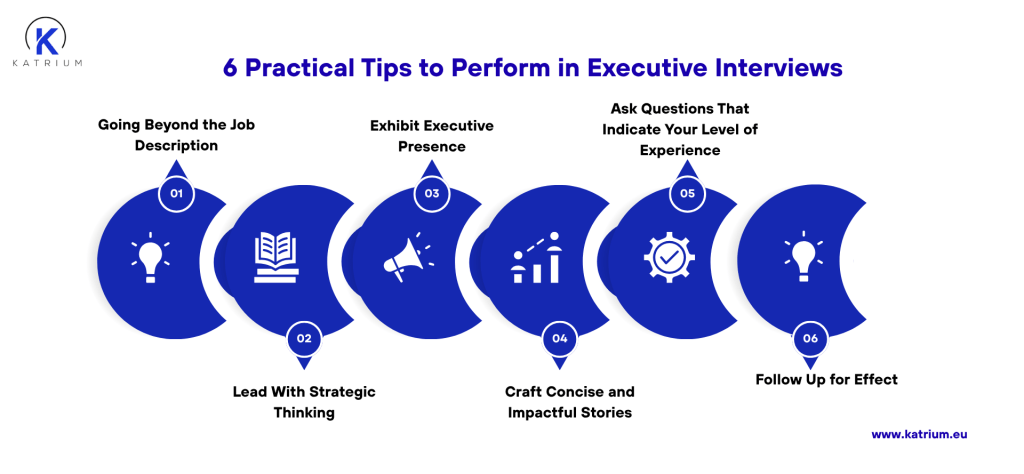
- Going Beyond the Job Description
Looking at the job description is only the starting point. Before the executive interview:
- Look at the annual report, recent news articles, and press releases
- Understand the company’s board members, its leadership structure, and its competitors
- Pinpoint what issues the new executive needs to tackle during the first 90 days
- Be familiar with all the people who’ll be present in the interview
When you demonstrate that you’ve done your homework, you show that you have what it takes to be an executive right off the bat.
- Lead With Strategic Thinking
Junior candidates succeed by knowing “what” to do. Executive candidates succeed by explaining “why” and “what next.” In answering interview questions:
- Discuss the strategic rationale for the actions you took, not the results themselves
- Explain how you balanced conflicting priorities when making tough decisions
- Relate your decision-making process to business and organisational objectives
- Show that you were always thinking one step ahead, regardless of your position
- Exhibit Executive Presence
Executive presence is among the most talked about attributes during executive-level recruitment but one of the least known. In essence, it entails the following:
- Speaking slowly and utilizing silence effectively
- Active listening, which the panel can tell if you are engaged
- Calmly responding to challenging questions without becoming defensive
- Avoiding the temptation to say something at every pause
- Preparing for the interview with the assistance of a coach or colleague
- Craft Concise and Impactful Stories
At an executive level, the panel has conducted thousands of interviews. The use of long-winded language suggests a lack of clear thinking. As such, answering effectively requires:
- Using the STAR technique – Situation, Task, Action, Results
- Limiting your stories to a maximum of three minutes and concluding with results
- Crafting five to seven stories applicable to all types of questions
- Selecting stories that show executive-level magnitude
- Ask Questions That Indicate Your Level of Experience
Your questions will be just as closely examined as your answers. Effective questions are:
- What are the strategic priorities for the new executive to deliver within the first year?
- What would constitute success after twelve months and after three years?
- What is the organization’s biggest commercial risk currently?
Never mention salary or benefits until an offer has been made, and don’t ask anything that should be obvious with a little bit of research.
- Follow Up for Effect
Effective follow-up emails:
- Arrive within 24 hours after the interview
- Mention something discussed during the interview
- Make it clear you are genuinely interested in the position without being too eager
- Provide a succinct and relevant observation based on what you learned about the organization’s problems
Executive search is very relationship-driven so every interaction counts.
Final Thoughts
In executive interviews, there is nothing left to prove about your resume. The interview itself becomes a real-life example of the kind of leader you are. Every single word you say, pause you take, or question you pose affects how the committee judges your readiness to work at this level. The difference between success and failure might be small, but it lies in the ability to think clearly, strategically, and influence the situation without coercion.
The bottom line is that executive hiring boils down to a simple principle of trust. The selection committee must have faith in you and your ability to represent the company, address the issues at hand, and steer its future course. By preparing for the interview to fulfill this goal, you will stop being a candidate and start becoming a contender. For more guidance, reach out to Katrium.