Online content development involves strategising, crafting, disseminating, and evaluating various materials (like blog articles and videos) tailored to a specific audience and intent. It stands as a pivotal element within content marketing strategies, extending its impact to sales, customer service, and broader communication objectives.
Digital content development combines the following aspects:
- SEO
- Content planning
- Target audience analysis
- Content creation
- Visuals creation
- Content promotion
- Content performance tracking
In this Katrium blog post, we will discuss essential tips to help you create content that resonates with your audience and drives traffic to your website.
Why is Online Content Development Important for Your Business?
In today’s landscape, many individuals heavily lean on online information to guide their purchasing choices. Content development involves crafting informative material by researching, writing, and collating data, incorporating elements like infographics, audio, and video content. The distribution of this content hinges on employing strategic approaches tailored to either existing or potential customers, aligning with their positions within the sales funnel.
The benefits of online content development are the following:
- Increasing audience engagement
- Generating new leads
- Extending customer base
- Promoting brand
- Increasing brand loyalty
- And much more!
The Basics of Online Content Development
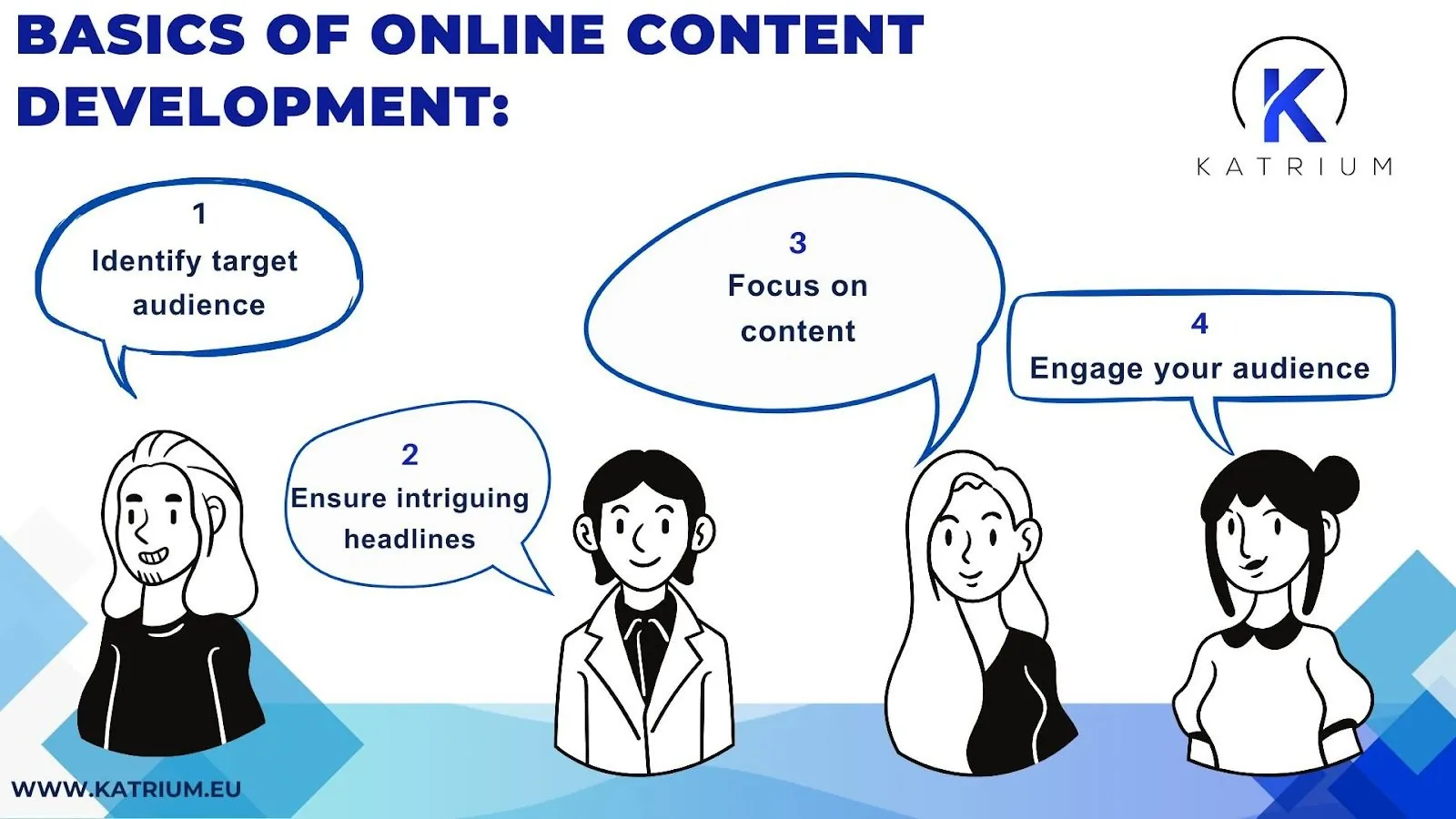
The first step of any content creation process is always to identify your target audience. Analyze your website’s analytics, conduct surveys, or research your competitors’ audience to understand your audience’s needs and interests.
Next, the focus falls on the headlines: your headline is the first thing your readers see. Use concise, intriguing headlines to catch their attention. Powerful words or numbers can also make your headlines more appealing.
Content itself should also be high-quality, informative, and easy to understand. Avoid technical jargon and use simple language. Remember to use images, videos, or infographics to make your content visually appealing.
After content creation, it is equally important to use social media channels such as Facebook, Twitter, and LinkedIn to promote your content and increase your website traffic. Engaging with your audience on these platforms is key. Build a relationship with your audience by responding to their comments and questions on your website and social media channels. Creating a community around your brand will help you develop a loyal audience.
After outlining the basics of online content development, it is time to share several advanced tips for improving your content.
1. Decide on Your Business Goals, Metrics and KPIs
Solely concentrating on content creation and publication often falls short in delivering desired outcomes. Creating a content strategy involves aligning both long-term and short-term goals while defining metrics, identifying target audiences, selecting platforms, and determining content style. All these factors are interrelated: a certain target audience favours specific online content platforms. These platforms, in turn, suggest various content types and styles.
By diversifying the metrics and granularity for each content marketing campaign goal, it becomes possible to assess and optimise strategies effectively for broader objectives beyond direct payments. Here is a list of the most important online content development KPIs:
Customer Engagement:
- Time Spent on Content: Evaluate the average time users spend engaging with the content.
- Interaction Rate: Track comments, shares, likes, and other interactions to gauge engagement.
- Click-Through Rate (CTR): Measure how many users click through from the content to other pages or calls to action.
- Social Mentions: Monitor the frequency of mentions or discussions around the content on social media platforms.
Lead Generation:
- Conversion Rate: Analyse the percentage of visitors who take the desired action (filling out a form, subscribing) after engaging with the content.
- Form Submissions: Count the number of forms completed or leads generated directly from the content.
- Email Sign-ups: Track the number of new email subscribers acquired through content engagement.
Brand Mentions:
- Brand Reach: Measure the visibility of the brand through content across various channels.
- Sentiment Analysis: Assess the overall sentiment of mentions to understand brand perception.
- Influencer Shares: Monitor influential individuals sharing or discussing the content.
Referral Traffic:
- Referral Site Traffic: Measure the volume of traffic driven from external sites or referrals due to content.
- Backlinks: Track the number of quality backlinks generated from the content, indicating credibility and referral traffic.
2. Seek for Relevant Information Regularly
By regularly updating your knowledge about the competitive landscape, audience preferences, and trending topics, you’ll remain agile, ensuring your content stays relevant and resonates with your audience amidst evolving market dynamics.
Competitive Landscape Analysis:
- Regularly assess competitors’ content strategies, their engagement tactics, and the type of content resonating with their audience.
- Analyse their strengths and weaknesses to identify potential gaps or opportunities in your own strategy.
Target Audience Research:
- Continuously gather insights into your audience’s evolving demographics, psychographics, preferences, purchasing behaviours, and pain points.
- Engage with the audience through surveys, polls, social media interactions, and feedback to understand their changing needs.
Trending Topics and Keywords:
- Monitor industry trends, emerging themes, and hot topics relevant to your niche.
- Utilise tools for keyword research to identify high-impact keywords and phrases in your online content development.
3. Not Only Create but Optimise Your Online Content
Create engaging content by staying committed to your identity, being honest, and focusing on value creation rather than selling. This advice emphasises the importance of leveraging your brand’s unique story and message to differentiate yourself from others in the content landscape. Integrating these distinctive elements into your content can be a powerful way to stand out amidst the noise.
Regardless of how captivating and distinctive your content may be, it won’t reach your intended audience if it lacks optimization. Search engine optimization (SEO) acts as the binding force that consolidates all your endeavours during online content development and refinement. Employing precise and relevant vocabulary has the potential to significantly amplify your business’s visibility. Wouldn’t it be valuable for your written content to prominently feature in search results? The factors you should consider here are:
- Relevant keywords
- Optimal length of content pieces
- Readability
- Correct formatting tags
- Short URLs
- Appropriate visuals
- Interesting headings
- Well-designed meta descriptions
4. Promote Your Online Content
There are numerous strategies to promote online content effectively. You are supposed to select the ones best working for you and combine them into a content distribution strategy.
- Social Media Sharing: Share content across platforms where your audience is active. Utilize engaging visuals and concise, compelling captions.
- Email Marketing: Send newsletters or updates to your subscribers, showcasing new content and encouraging engagement.
- Collaborations and Partnerships: Collaborate with influencers, other content creators, or businesses to expand your reach and audience.
- Content Syndication: Share content on platforms or websites with a broader audience that aligns with your niche or industry.
- Paid Advertising: Invest in paid ads on social media or search engines to target specific demographics and increase visibility.
- Community Engagement: Participate in online forums, groups, or communities relevant to your content to share insights and build relationships.
- Guest Posting: Contribute content to other reputable websites or blogs in your industry to reach new audiences and build authority.
- Repurposing Content: Transform existing content into different formats (videos, infographics, podcasts) to cater to diverse audience preferences.
- Analytics and Optimisation: Continuously monitor the performance of your content using analytics tools and adapt strategies based on insights gained.
5. Track Your Online Content Performance
Continuously monitoring and auditing your content is crucial in the ever-changing landscape of digital marketing. Rankings can fluctuate, and search volumes for key keywords may shift unexpectedly. Embrace advanced content analytics tools to stay ahead and adapt to these changes effectively.
Effectively tracking your content’s performance involves more than just reaping the rewards of achieved goals and reassessing those that remain unmet. It should revolve around two intertwined cycles:
- Auditing and Updating Existing Content: Regularly assess and refresh your current content to ensure relevance and alignment with evolving trends and audience needs.
- Performance Analytics and Forecasting: Continuously analyze the metrics and trends to anticipate future outcomes, allowing for informed adjustments and strategic planning.
Benefits of Outsourcing Online Content Development
- Time efficiency: Outsourcing content creation tasks can liberate precious time that would otherwise be spent on training internal staff.
- Cost efficiency: Opting for services often demonstrates greater cost-effectiveness compared to the expenditures linked to hiring full-time employees.
- Flexibility in workload: Outsourcing grants the flexibility to scale your online content development without the constraints of long-term contracts, empowering you to quickly adapt to evolving business requirements.
- Access to expertise: Leveraging service providers armed with specialised expertise, customised to your content development needs, can provide more benefits than assembling an entire in-house team. Accessing these targeted skill sets ensures top-notch work for both your business and clients.
- Increased productivity and focus: Outsourcing enables you to concentrate on core business functions, strategic planning, and high-impact tasks that require your expertise and focused attention.
- Time zone advantage: Outsourcing content development to professionals in different time zones provides distinct advantages. Their flexibility allows them to handle tasks overnight or during their work hours, complementing your team’s schedule while they are offline.
- Access to technology and tools: Professional content developers generally bring a wealth of proficiency in diverse tools and software to the table. They stay abreast of the latest technologies, platforms, and analytics tools, ensuring they remain current in their field.
Online Content Development at Katrium
Online content development is an essential aspect of any digital marketing strategy. However, the ongoing process of content development can swiftly become overwhelming, affecting overall productivity. Outsourcing this process to a service provider can substantially alleviate this burden at a minimal cost. Their assistance in handling various content types can streamline operations, enabling the business to concentrate on core activities and ultimately enhance productivity.
Drawing upon years of specialised experience, Katrium offers a diverse range of services, notably excelling in online content development. Explore our comprehensive suite of offerings, and don’t hesitate to contact us! – we’re here to assist you with your social media administrative needs!

One Response