
Business owners have a strong belief in the quality of service their teams are offering to their customers daily. Mystery shopping market research could reveal if this holds true. Owners create guidelines and manuals, organize onboarding meetings and track sales. Yet, executive teams usually do not know about customers’ experience while shopping at the store, or contacting service departments. Until sales figures begin to decline, managers are usually not aware of a team breaking the rules. Mystery shopping market research is a structured method of measuring store processes, customer experiences, and digital services without making assumptions.
Why Customer Surveys Miss the Big Picture
One source for customer feedback is customer satisfaction forms, and standard customer surveys can provide several useful answers. Yet, their outcomes are often one-dimensional. In general, only the customers who had a spectacularly bad or an undeniably good experience in a shop fill in the forms. Thus, the everyday experiences, which silently lead to a lower or higher sales rate, go unnoticed. Customers’ moods often influence their feedback more than the actual facts of the store process. This is not the case with mystery shoppers. They come with a predetermined checklist, they measure exact waiting times and rate employees’ activities. They always gather specific information, without their personal opinion. According to Quirk’s glossary of market research terms, mystery shoppers are individuals who act like a regular customer and follow specific instructions. They provide a company with an outsider perspective of their business.
Auditing Daily In-Store Operations
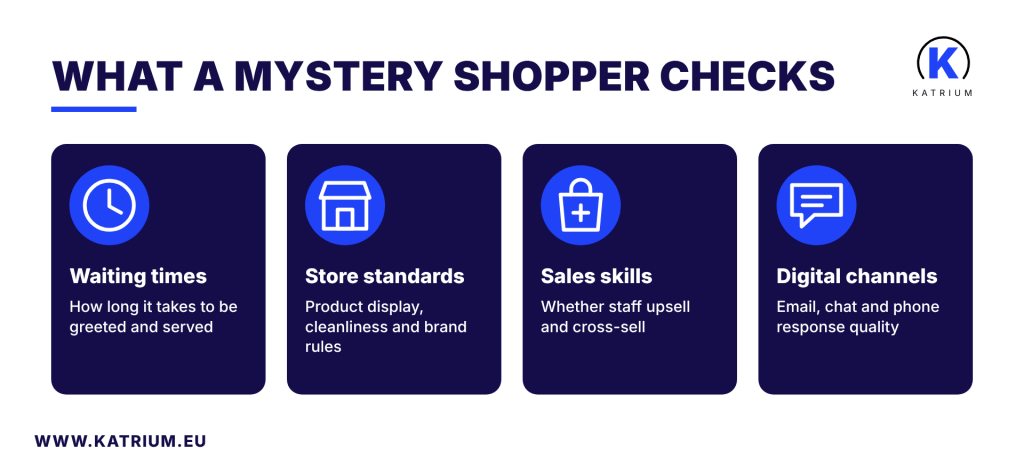
The best brand and shop concept means nothing if employees do not apply it in the shop. Local store managers cannot see all the holes in their processes that appear every single day. This is because the employees behave better while being observed by the manager. That’s why mystery shopping market research uncovers these everyday mistakes by organizing unannounced and real visits. Auditors take note if the products are correctly sorted, the sales shelves conform to the agreed brand criteria and if the checkout counters are clean. Then, they check the customer service while the store manager is absent.
Testing Sales Skills: Upselling and Cross-Selling
Cross-selling and upselling have a direct impact on your average transaction value. But during busy hours, these are often neglected by the employees. The employee might be insecure when it comes to suggesting an additional product, or forget to ask about any accessories. A mystery shopping market research visit may reveal whether employees follow the usual sales script that trainers taught them. The mystery shopper asks to purchase a phone case and checks if the employee has also mentioned a screen protector. Or the shopper books a hotel room and sees if the receptionist offers to upgrade to a higher room, or offers a free breakfast. Such results help managers understand which shops have the capability to turn a standard transaction into a bigger one. They also show which ones are missing out on the profits.
The findings can be used in a truly useful way when the exact same situation is repeated a few times. It should happen at different hours in different stores, as well. A single mystery shopping visit only describes what there was in that situation. Only when managers evaluate dozens of visits can they identify whether an employee at one of the checkouts causes the problem. It can also show if the wrong people are on duty during rush hours, or if the employee’s training is just not enough.
Mystery Shopping Market Research for Digital Channels
Customers do not consider the store, the website, the chat window and the phone line as different. Plenty of customers order online and pick their purchases up in the store, or vice-versa. If a shop only audits the real-world locations, there is a part of the customer’s journey missing. Evaluators can examine digital touchpoints using the same structured checks as above. An evaluator mails a product query to the customer service department, initiates a chat or calls the company number. Then, the evaluator writes down the response time, the quality of the reply, and the tone the customer service agent uses.
These checks determine if a company provides the same service to its customers in every channel. Someone may receive a friendly and immediate answer in the store, yet wait three days to get a customer service reply by e-mail. Then their impressions about the brand are going to be about the slow customer service channel. Companies that invest in multi-channel customer service can use these results to improve the least performing channel first.
Planning a Mystery Shopping Market Research Project
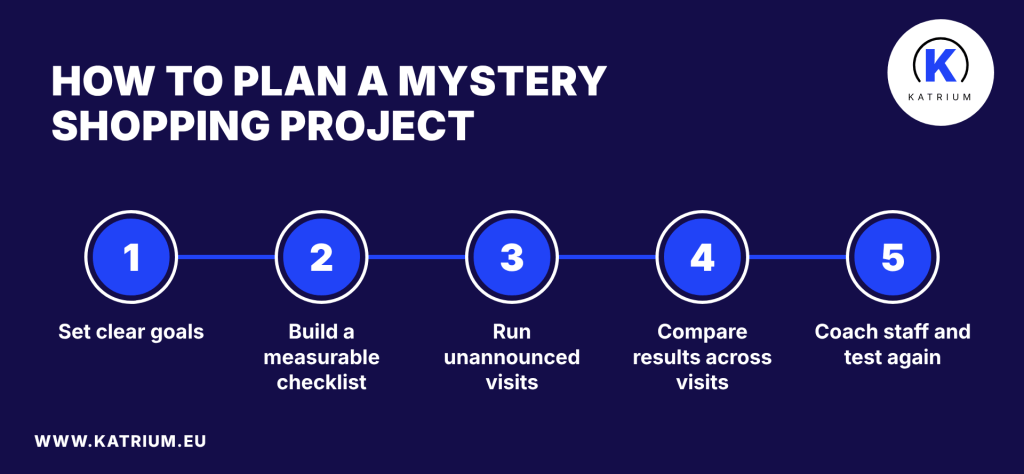
A mystery shopping market research project only provides reliable results if the examined points are defined before the first visit occurs. First decide for which purposes the project is conducted. For example, what are the waiting times, are the employees following the agreed brand criteria, or how do they deal with a customer who is grumbling about his order? Then establish a checklist of points that are to be examined. Companies need to define specific and measurable points, so “greeted within 30 seconds” or “offered an additional product” would be good examples. “Friendly service” is not, as it is too abstract. This way the stores are easily comparable and results can be tracked over a longer period.
The project also needs to focus on ethics and privacy. In the EU, every note and recording that contains the identifying information of a certain employee is considered personal data. The information that is collected must be treated carefully and only be held for as long as it is needed. Many companies inform their staff that mystery shopping market research takes place regularly. Usually, managers don’t tell employees which days the visits will take place. This way these mystery visits remain realistic. At the same time, the staff develops more trust in their managers. They know it is not some kind of a sanction but a plan for improving the business process. Katrium’s multilingual team can conduct visits, calls and chats in the local language. This way, companies with international operations in several European markets are able to compare customer service by country.
Turning Results into Better Service
A results report is only the beginning of mystery shopping market research. The manager should present it to the store team and show them the good things that are going right. Then they should focus their coaching on those mistakes that happen most frequently. Mystery shoppers might repeatedly write that staff members skip the product recommendation part. This might be solved with short role-play sessions and focused customer service training. A second mystery shopping visit, after a few months, shows if the improvements really helped.
Final Thoughts on Mystery Shopping Market Research
Surveys tell a company how a handful of customers have felt about their experience. But mystery shopping market research will reveal what has happened during a visit, a call or a chat to a store. By making mystery shopping visits regularly, a company will keep their brand standards consistent and the sales routine polished. It will also discover the holes in customer service before they can cost the business revenue. The consumer research services from Katrium can show companies how to create the checklist, conduct the evaluation and report the findings in a clear way. Contact Katrium to discuss how a mystery shopping market research program could support your business.