In the past few years, multilingual telemarketing has become a powerful tool for all those businesses that want to reach on a global level. The global marketplace has revolutionized a lot, and customers expect personalized communication in their native language. All the companies that adopt multilingual strategies in telemarketing can improve customer satisfaction and conversion rates. It also critically focuses on brand loyalty for long-term profitability.
What Is Multilingual Telemarketing?
Multilingual telemarketing is the process of conducting telemarketing campaigns in multiple languages to reach diverse customer segments across different regions. Translation is not only the required task, but the main responsibility of the agents is to have an idea about the cultural understanding, the required time, and the overall preferences of the target audience, so that they can build trust easily.
According to Harvard Business Review, over 72.4% of customers are more likely to purchase when information is presented in their own language. This actually explains why multilingual telemarketing is so important in the current global marketplace.
Why Multilingual Telemarketing Matters in a Global Economy
Businesses are no longer restricted to local markets. E-commerce and other digital platforms have made cross-border interactions the norm. Multilingual telemarketing bridges cultural and linguistic gaps, allowing businesses to:
- Build customer trust by speaking in familiar languages.
- Boost sales through targeted and personalized campaigns.
- Enhance brand image by demonstrating inclusivity and global presence.
- Ensure compliance with regional communication norms and data privacy laws.
We at Katrium have seen how multilingual telemarketing helps clients strengthen their global footprint. By connecting with customers in more than 50 languages, Katrium enables businesses to develop meaningful international relationships.
Key Benefits
1. Increased Conversion Rates
Speaking to customers in their preferred language makes communication smoother and more persuasive. This increases the chances of converting prospects into loyal customers.
2. Improved Customer Retention
When clients feel understood and valued, they are more likely to stay loyal. Multilingual telemarketing plays a major role in fostering long-term relationships.
3. Global Market Expansion
Businesses can enter new markets more effectively when they communicate in the local language. This reduces entry barriers and speeds up growth.
4. Cultural Sensitivity
Beyond language, telemarketers must respect cultural norms. For example, communication styles in Japan differ from those in Brazil. Successful multilingual telemarketing incorporates cultural intelligence.
For deeper insights, you can explore the importance of cultural intelligence in global marketing.
Challenges

Despite the benefits, companies may face challenges such as:
- Recruiting skilled agents who are fluent in multiple languages.
- Maintaining consistent brand messaging across different regions.
- Managing data security while handling international customer information.
- Training staff to handle cultural nuances effectively.
At Katrium, we address these challenges with professional training and strict compliance protocols. Furthermore, some cultural awareness programs are used to ensure seamless telemarketing experiences.
Multilingual Telemarketing vs. Traditional Telemarketing
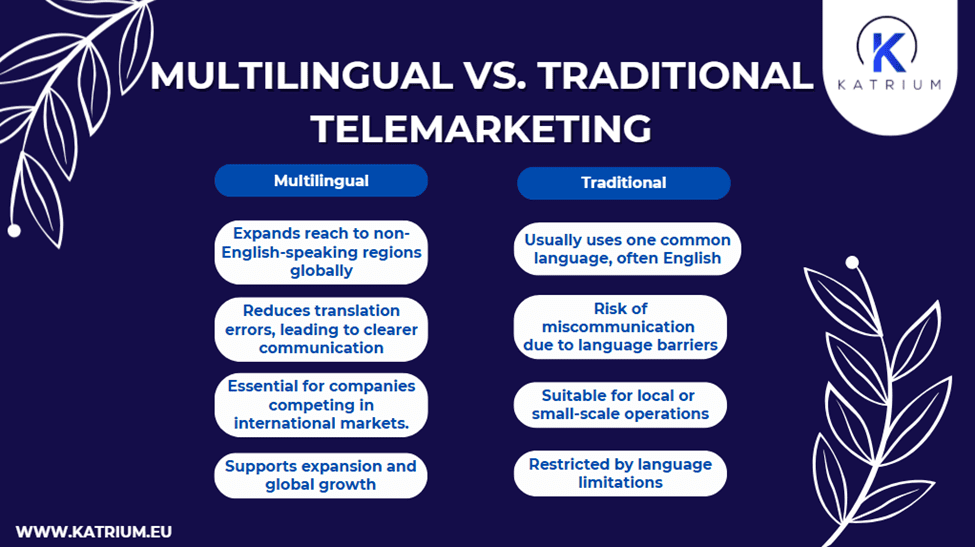
Traditional telemarketing focuses on reaching customers with one common language, usually English. While effective in limited contexts, it often excludes large segments of the international market.
Other than this, the Multilingual telemarketing;
- Expands reach to non-English speaking regions.
- Delivers higher engagement because customers feel valued.
- Reduces miscommunication caused by translation errors.
Katrium believes that multilingual strategies are the main entity for the overall survival and growth of the business in competitive markets. Check Katrium’s blog on multilingual call center benefits to see how global communication impacts businesses.
The Role of Technology in Multilingual Telemarketing
Technology plays a crucial role in managing large-scale multilingual operations. Some key innovations include:
- CRM Integration – Customer data is stored and accessed across languages.
- AI Translation Tools – Real-time assistance for agents handling multilingual calls.
- VoIP Systems – Lower communication costs for international telemarketing.
- Data Analytics – Tracking performance across markets to improve campaigns.
A report by Gartner shows that companies using advanced communication technologies in telemarketing achieve 30% higher efficiency compared to traditional methods.
Industries That Benefit Most from Telemarketing
While every business can benefit from multilingual communication, some industries rely heavily on it:
- E-commerce – For global product sales.
- Travel and Tourism – To serve customers worldwide.
- Healthcare and Pharmaceuticals – For patient outreach and product education.
- Finance and Banking – To handle international clients with precision.
- Technology – For global software and hardware support.
For example, Katrium’s market insight shows that businesses in these industries report higher ROI when using multilingual strategies in customer outreach.
Best Practices for Effective Multilingual Telemarketing
- Hire Native Speakers – Native agents bring authenticity and cultural understanding.
- Invest in Training – Continuous training ensures agents adapt to market trends.
- Use Standardized Scripts – Maintain consistency while allowing flexibility for cultural adjustments.
- Leverage Data – Use analytics to understand customer behavior in each region.
- Partner with Experts – Outsourcing to experienced companies like Katrium ensures quality and efficiency.
Future of Multilingual Telemarketing
As globalization increases, multilingual telemarketing will continue to grow. Some trends to watch include:
- AI-driven personalization – Real-time tailoring of conversations.
- Integration with digital channels – Combining phone calls with social media and chatbots.
- Sustainability in telemarketing – Eco-friendly communication technologies.
- Greater focus on inclusivity – Ensuring that even smaller language groups are represented.
Read Katrium’s market insights to explore more about the future of international communication strategies.
Conclusion
Multilingual telemarketing most critically refers to building trust, increasing customer relationships, and driving global growth. By combining language skills with cultural awareness and advanced technologies, businesses can engage customers on a deeper level.
In the current scenario of an interconnected world, Katrium believes that multilingual telemarketing is the future of customer engagement. Companies that embrace it today will lead tomorrow’s global markets. To take your business further, get in touch with Katrium and discover how our multilingual solutions can transform your communication strategy.