





Marketing research is the foundation of any successful marketing strategy. It helps businesses to properly understand the needs of their customers, explore market trends, know about their competitors, and further minimize business risk. With appropriate marketing research, companies can make data-driven decisions that lead towards sustainable growth along with product innovation.
At Katrium, marketing research is not only a business function but also a mindset that promotes curiosity and learning. No matter if you are about to launch a new product, entering into a foreign market, or trying to improve customer experience, marketing research is the entity that ensures your decisions are based on real data.
What Is Marketing Research?
Marketing research is the systematic process of gathering, analyzing, and interpreting information about a market, including potential customers and competitors. This information helps organizations identify opportunities, develop effective strategies, and monitor business performance.
Effective marketing research is both quantitative (e.g., statistical analysis, metrics) and qualitative (e.g., focus groups, in-depth interviews). This combination provides a full picture of consumer behavior, needs, and perceptions.
You can explore useful data from the American Marketing Association to better understand the scope of this field.
Types of Marketing Research
There are four main types of marketing research, each used for different goals:
- Exploratory Research: This is used at the beginning of a project when the problem is not clearly defined. Techniques include informal interviews, literature reviews, or brainstorming groups.
- Descriptive Research: Helps businesses understand “who, what, when, where, and how” of customer behavior. For example, who are your most loyal customers? What products do they prefer?
- Causal Research: This focuses on understanding cause-and-effect relationships, such as whether a specific promotion increases sales.
- Predictive Research: Uses historical data and forecasting techniques to predict future trends. Katrium regularly applies this to help clients anticipate customer needs and industry shifts.
We at Katrium combine these types of marketing research to create comprehensive projects that support well-informed business decisions.
Why Is Marketing Research Important?
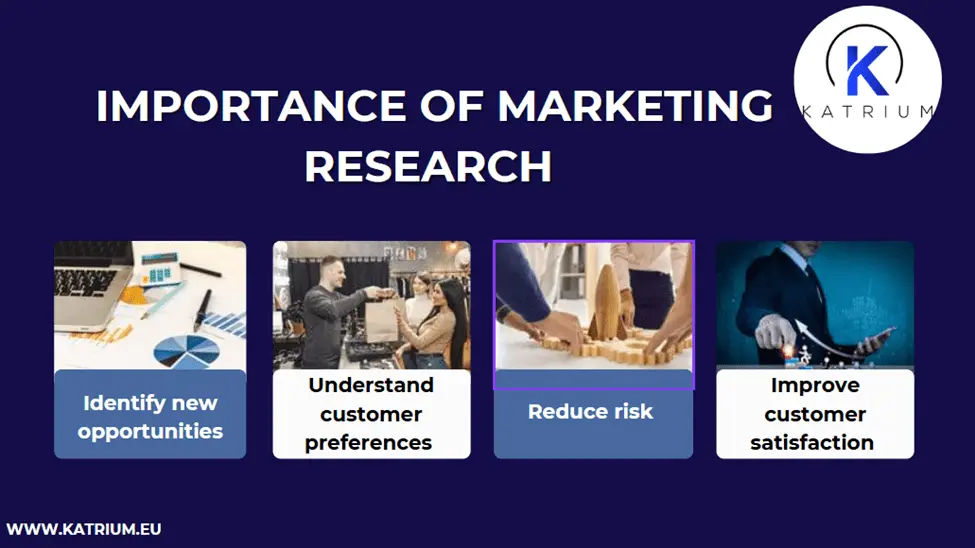
Marketing research plays a critical role in:
- Identifying new opportunities, such as untapped markets or underserved customer segments.
- Understanding customer preferences allows businesses to customize products, services, and campaigns.
- Reducing risk by testing concepts and forecasting demand before making investments.
- Improving customer satisfaction through better service, pricing, and communication.
- Tracking performance, measuring how well your marketing efforts are working.
For example, companies that use marketing research often outperform competitors who rely solely on instinct. Learn more about the importance of market analysis and how it supports strategic planning.
The Marketing Research Process
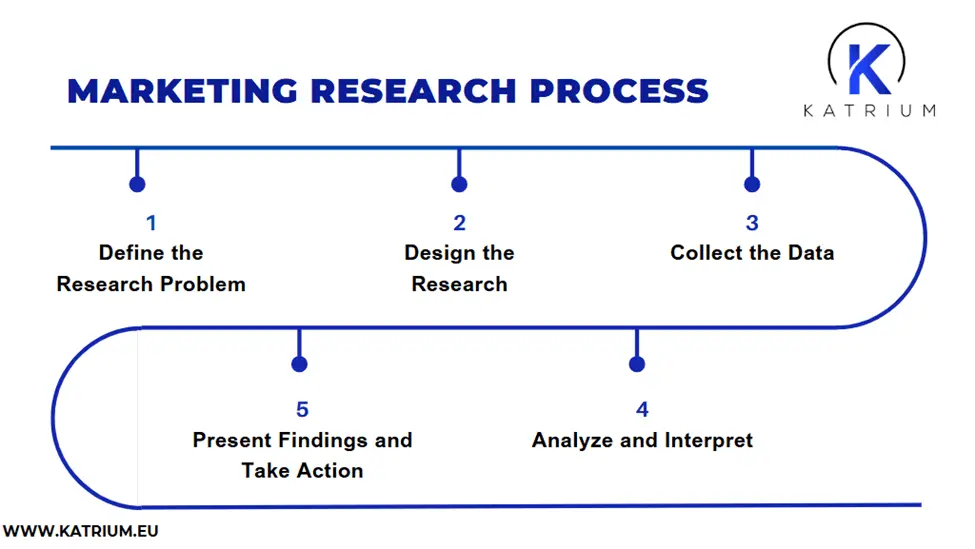
A solid marketing research plan involves these steps:
1. Define the Research Problem
What are you trying to solve? A poorly defined problem leads to wasted effort. For instance, “Why are online sales declining in Q2?” is a clearer starting point than “How’s business going?”
2. Design the Research
Decide on the data collection method, sample size, target audience, and timeframe. This stage may include writing questionnaires or structuring interviews.
3. Collect the Data
Use digital tools like Google Forms, phone interviews, or field observation. Katrium’s multilingual teams often help international clients gather local data efficiently.
4. Analyze and Interpret
Use statistical software (Excel, SPSS, Power BI) to spot trends, correlations, and anomalies. Data interpretation is key—without it, numbers are just numbers.
5. Present Findings and Take Action
Results are shared through reports, charts, and strategic recommendations. We at Katrium turn findings into practical solutions that align with your goals.
Digital Tools and Platforms for Marketing Research
Modern marketing research depends heavily on technology. Some of the most effective tools include:
- SurveyMonkey & Typeform – for customizable online surveys
- Google Trends – to monitor what users are searching for
- Google Analytics – to study website behavior and performance
- CRM platforms like Salesforce – to track customer interaction data
- Social listening tools like Hootsuite or Brandwatch – to analyze public opinion on social media
Katrium uses a combination of digital platforms and human expertise to deliver timely and accurate results, no matter the industry.
How Marketing Research Supports Global Business
Marketing research is particularly valuable for international businesses. Entering a new market without understanding local behavior, language, or regulations is risky. At Katrium, we help businesses collect and interpret data across regions through:
- Local-language surveys
- Competitor benchmarking
- Cultural analysis
- Economic and political risk assessment
Read more about how Katrium supports international clients in terms of their business strategy, work management, and localized research models.
Common Mistakes
Even experienced teams make these common mistakes:
- Biased questions that push respondents toward certain answers
- Unrepresentative samples that distort findings
- Ignoring the competition
- Under-analyzing results or rushing to conclusions
- Failing to act on research insights
These pitfalls can lead to wasted time and poor business decisions. Katrium’s commitment to thorough, unbiased research avoids these errors and ensures our clients receive actionable results.
Integrating Marketing Research into Your Strategy
For marketing research to be valuable, it must be part of your overall strategy, not an afterthought. Consider these integrations:
- Product development: Test ideas before launch
- Pricing: Evaluate what customers are willing to pay
- Promotions: Measure campaign effectiveness
- Customer service: Identify service gaps and expectations
Katrium’s customer experience services help turn insights into improvements across all customer touchpoints.
Future Trends in Marketing Research
Technology is shaping the future of marketing research. Here are some innovations:
- Artificial Intelligence (AI) – for automating data analysis and prediction
- Natural Language Processing (NLP) – for analyzing open-ended responses
- Mobile ethnography – using smartphone apps to observe customer behavior
- Voice and video feedback – providing richer qualitative insight
- Augmented reality testing – simulating customer interaction with products
We at Katrium stay ahead of these trends to ensure our clients benefit from the latest innovations in research.
How Katrium Supports Your Marketing Research Needs
Katrium offers a full range of marketing research services customized to your needs. These include:
- International market entry studies
- Customer satisfaction surveys
- Brand awareness tracking
- Competitor analysis
- Remote interviews and multilingual research
Our clients include SMEs, corporations, NGOs, and public-sector organizations—all seeking evidence-based guidance.
If you need to get deep-dive insights or quick-turn surveys, the service portfolio of Katrium provides accurate tools and experience that can deal with every stage of your business growth.
Conclusion
Marketing research promotes businesses so that they can make better, faster, and smarter decisions. From properly identifying customer needs to authentically optimizing marketing strategies, research provides the real competitive advantage.
We at Katrium ensure that businesses get the most reliable, ethical, and global marketing research services. These are the core values that Katrium upholds: accuracy, clarity, cultural competence, and customer success. Contact us for more insights, and explore how our services can take your research to the next level.