
A market research report turns a set of partial responses to a survey questionnaire, random notes taken during interviews or some sales numbers into action steps for a manager. There are lots of companies who conduct market research but do not properly order the results of the research. So conclusions remain in their spreadsheets and people make decisions just as they always do: with gut instincts. In this post, we are going to define what a market research report is and what it should contain. We will also show how to compose a market research report which results in action steps.
What is a market research report?
A market research report is a document which summarizes the outcome of a market research project and what it means for business. Raw data itself shows what’s found. But a market research report goes one step further and answers the so what question by making numbers relevant for price, product development or marketing decisions.
What’s inside your report will depend on how you did your data collection. An interview-based research project will differ from one that uses a large-scale online survey. So it can be a good idea to know the key methods of market research before planning your report.
What’s included in a market research report
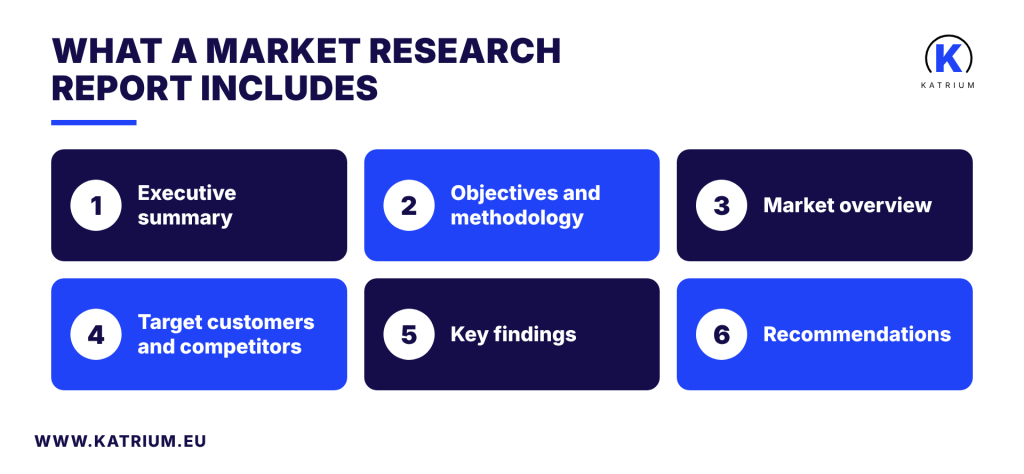
Although the length of a report may vary from a few pages to a full presentation, most reports tend to have a similar structure. First, your report will probably contain the executive summary. These are a few sentences with the main results. They help the reader of your market research report to make sense of it in a couple of minutes. The next section after that can be a summary of what the research tried to find out. It can also include the methods you used and the number of participants.
The core of the report will be the actual market. This includes the market size and key trends, the researched target customer segments and their buying patterns, the key competitors, their pricing structure and their pros and cons. As you can see, governments advise small businesses on many of the same subtopics, like demand, size, pricing and competition. See, for example, the U.S. Small Business Administration advice for small businesses.
At the end of the report you showcase the key findings. You show your charts and tables as evidence. You have your recommendations. This is likely where most managers will look first, so the recommendations should be easy to implement and plan.
How to write a market research report step by step
First, be aware of the reader. The CEO will want a short executive summary and clear recommendations. A product team may want detailed numbers for individual product features. This helps you decide what goes into the main text and what goes into the appendix.
Next, clean and structure the data. Duplicate answers, missing data or different names for the same product can all lead to wrong conclusions. Well-structured data makes the analysis of the market research data much easier, and trends start to emerge.
List your findings by importance, not in the order of the survey questions. Every chart should carry one message. The chart title should state the takeaway (e.g. not Question 7 results, but Younger customers compare prices more often). Add a sentence or two at the end of each section to explain what the finding means for the business.
Finally, make your recommendations specific. A recommendation to simply improve customer service is not useful enough for action. Instead, you could recommend offering chat in German at weekends, because many German customers call in with complaints on Saturday afternoons. This gives the team specific steps they can plan and measure.
What are the common mistakes in a market research report?
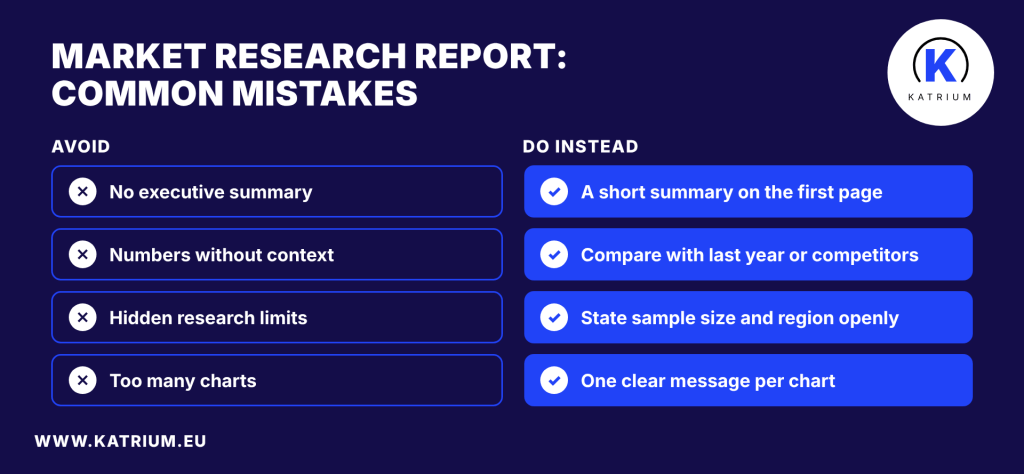
Even the best market research project loses its value if the report is hard to use. Decision-makers rarely have time to read a long report without an executive summary. Also, numbers without context mean little to people. A 7.2 satisfaction score means nothing unless you compare it to last year’s score or to competitors.
Hiding the limits of the research is also a common mistake. If you used a small sample or researched only one region, say so clearly in the report. This stops readers from drawing conclusions the data doesn’t support. Too many charts also hurt the report. Every chart needs a message, and decorative charts only make the key message harder to find.
How Katrium helps market research projects
Busy internal teams often don’t have time to collect valuable data and turn it into a readable market research report. Katrium can run surveys and interviews in many European languages. We then clean and process the data and give you a structured report for decision-making. You can learn more about Katrium’s market research services and how projects work.
Final thoughts on writing a market research report
Data only helps if we can understand it and act on it. A good report tells you clearly what you found, shows the evidence and gives clear next steps. Whether it is a few pages or a presentation, the same rule applies: write for the reader, not the data. You can contact Katrium to talk about how we can help you plan your next study. Together, we can turn it into a report your team will actually use.