
The worldwide market research sector is the one sector that brings in $75 billion yearly, and it is operating on quicksand. According to audits from the industry, collected survey data is corrupted by “professional” individuals, automated software programs, or uninterested respondents who do nothing but click for reward. When you take into account the statistic that 90% of new products are discontinued in their first year of release, then it makes perfect sense.
If you get recruiting right, all of the subsequent steps of methodology and analysis can be meaningful. However, if you fail at recruiting, the other parts don’t matter. This guide will walk you through the key elements of market research recruitment success.
Why Market Research Recruitment Is So Often Underestimated
Most research groups spend a lot of effort on developing questionnaires, choosing a methodology, and defining frameworks for analysis; participant recruitment takes up all the remaining time. That should not be the case.
The value of any piece of market research will depend solely on its inputs, i.e., the participants themselves. In other words, a perfect questionnaire applied to the wrong people will lead to completely flawed results no matter how advanced the process of data analysis may be.
Most typical outcomes of ineffective market research recruitment:
- Confirmation of preexisting beliefs rather than proving anything new
- Research findings that do not generalize to the population in question
- Need for a duplicate study leading to extra spending of time and money
- Decreased trust from stakeholders in the research department
- Decisions being made according to participants’ opinions rather than the market’s opinion
Key 1: Define Who You Actually Need Over Who Is Easiest to Find
To understand the mechanisms behind successful market research recruitment is half the battle.
The most costly error in market research recruiting occurs prior to making contact with any potential participant. This occurs when the ideal participant profile is either vague or defined according to convenience rather than necessity.
While demographics may describe a respondent’s characteristics, such as age, gender, or geographic region, they do little to determine whether that individual will provide you with the necessary insight. Behavioral, experiential, attitudinal, and role factors are generally more important.
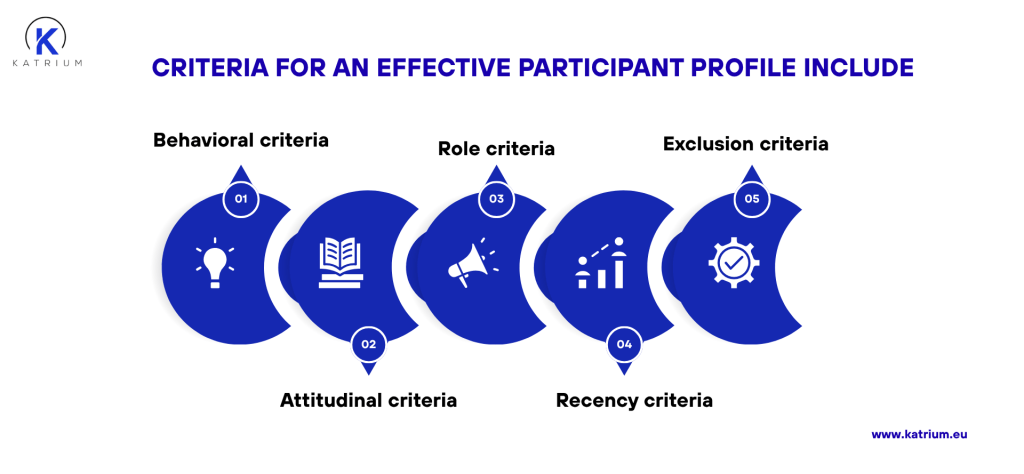
Criteria for an effective participant profile include:
- Behavioral criteria – describes the behavior of the respondent, e.g., what the respondent consumes, uses, experiences, etc. related to your topic of interest.
- Attitudinal criteria – describes what the respondent thinks or feels about the topic of interest.
- Role criteria – for B2B research, it includes level, decision-making authority, and responsibilities.
- Recency criteria – time since the relevant experience occurred.
- Exclusion criteria – describes who to screen out, such as professional respondents, competitors, and those with conflicts of interest.
Screeners ensure that we select those that truly represent the target demographic group, as well as help us achieve our quota requirements, ensuring a proper age distribution, gender distribution, geographical spread, and other relevant demographic factors.
While under deadline constraints, the urge is always to widen the net to meet the quotas. Don’t give in to the temptation.
Key 2: Design a Screener that Screens
A screener is the tool through which the participant will be matched to the research. An efficient screener is arguably the most important recruiting tool for market research. However, an ineffective screener is worse than not having one at all, as the former generates a false sense of security regarding the quality of the participants recruited.
Screeners often fail. Long, irrelevant, intrusive and difficult to complete screeners may result in high abandonment rates, annoyed participants, and wrong recruits.
Criteria for an efficient screener:
- It should be brief – no more than ten questions; a longer screener means higher risk of dropout and haste
- It should be behavior-related – “How often do you use product X?” is always a better question than “Do you like product X?”
- It shouldn’t reveal the correct answer – if participants understand the way into participating, the screener is inefficient
- It should be specific – vague criteria yield vague participants; the closer to the brief, the better results
- It should include at least one disqualifying question
Avoid the following when creating screeners:
- Questions about private personal information not contextualized appropriately
- Leading questions which steer participants towards an answer
- Screener too long for no reason other than trying to prove something
- Self-reporting of demographic information without validating through behavior
A good screener does more than eliminate those participants unsuitable for your study. It helps begin profiling them as a respondent.
Key 3: Use Multiple Recruitment Channels
One way to quickly add bias to your market research recruitment process is to recruit from a single source. Single-source recruitment, whether through a single research panel, a single social media site, or a single database you control internally, results in a sample that is more reflective of the source than the target audience.
Popular Market Research Recruitment Channels and Their Best Uses:
- Research Panels – quick and efficient method for recruiting consumers, but you will need to screen out professional survey takers who have learned how to beat the screener questions
- Targeting on Social Media Sites – powerful for recruiting very specific demographic or behavioural groups, especially younger and more internet savvy populations
- Outreach – a laborious process, but will get you the best quality respondents for specialist audiences
- Professional Groups and Associations – a valuable resource for recruiting B2B or specialist studies, provided you know the right people to approach
- Databases You Control – useful for customer research but biased; should only be used when you need an independent perspective
CATI and direct recruiting continue to be some of the most efficient approaches for conducting B2B research, as they ensure representative sampling from particular decision-makers.
Some of the best approaches for recruiting market research participants involve using multiple recruitment channels, which help eliminate source biases while ensuring there is always a backup in case one approach does not work well.
Key 4: Manage the Process
Participant acquisition may well be half the battle won. However, retaining their commitment, confirming them and ensuring they show up on the day is the other. Market research recruitment is particularly apparent here in its effectiveness or failure.
Active participant recruitment can yield show rates of more than 90%. Such levels of reliability require active, structured participant engagement throughout the process, including screening, confirmation by email, calling reminders and even live support.
What active participant recruitment entails:
- Confirmation through multiple touchpoints – an email confirmation following screening, a reminder call or calendar invitation 48 hours before and another 24 hours before
- Over-recruitment by default – over-recruit by design, and always exceed the expected number of participants; 20% over-recruitment should be considered a bare minimum for focus groups
- Effective incentives – provide incentives which reflect the participant’s time and skills, but not those so generous as to attract people whose motivations are solely financial
- Single contact – participants are unlikely to back out when they have established an ongoing relationship with a single contact person
- Contingencies – what happens in case of a cancellation 24 hours before the session? You need contingency plans and participants waiting in the wings
Indicators of Recruitment Process Management Failure:
- Large number of no-shows on the day
- Obvious mismatch between participants and brief in terms of attendance for sessions
- Late withdrawals resulting in insufficient numbers
- Participants who are enthusiastic but obviously driven by incentives rather than interest
Final Thoughts
Market research recruitment should not be noticeable when done well. People who fit the criteria attend the sessions, everything goes well during the sessions, and the results seem instantly valid. But if anything goes wrong with market research recruitment, such as having to repeat the study, disputing the results, or even when the data fails, then recruitment will become noticeable.
But investing in proper market research recruitment will always be less expensive than poor recruitment. For your company to be able to recruit people for your market research session properly, Katrium can help out.