
Line charts are a type of graph used across numerous industries and fields of science. In market research, line charts can help with tracking the price changes in currencies, stocks and more. In this blogpost we will explain how they work and how you can use them to the fullest.
What are line charts?
Line charts are simple graphs with two axes, horizontal X and vertical Y. A lot of the time you will see the X axis representing time, it is usually months or years in equal increments. The Y axis is your data, for example number of customers, weekly revenue, daily price changes and so on. It is called a “line chart” (or a line graph, rarer line plot) because it connects data points with a line. The points are your initial data, and the lines are the changes in that data.
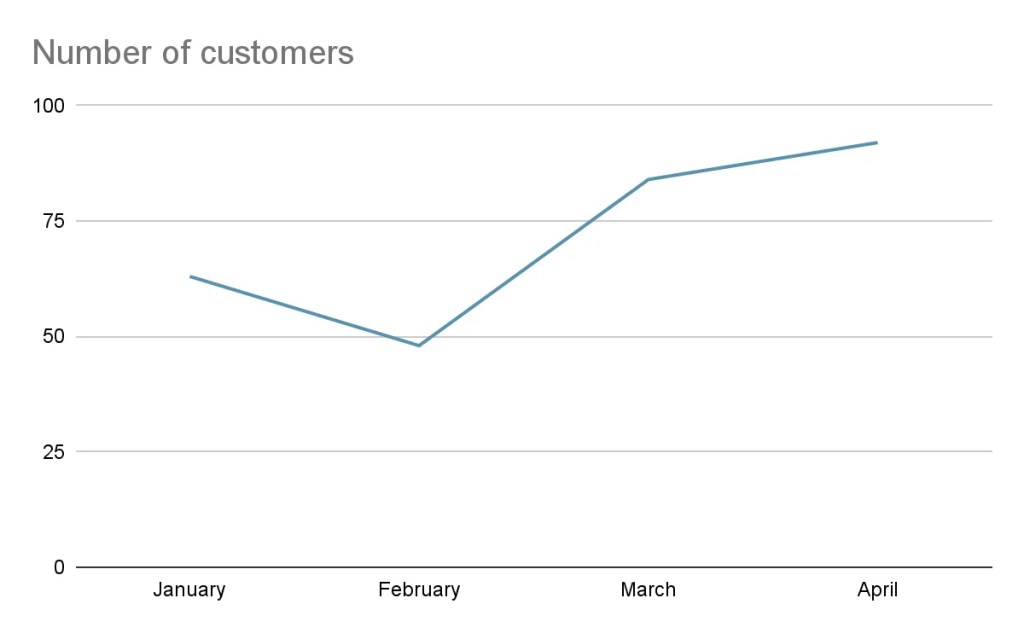
Here is a simple example of a line chart. On the X axis are months of the year, on the Y axis is a fictional company’s website throughput. As you can see, the number of customers dipped from January to February and then rose significantly. If the company applied a new strategy during that period, then the line chart can help them visualise if that strategy worked and how effective it was.
You can, of course, plot multiple lines instead of just one. Multiple line charts are a great comparison tool. That way you can compare, for example, multiple markets and identify their strengths and weaknesses in a simple manner. There are also compound line charts, they are multiple lines stacked on top of each other in a cumulative manner, meaning you can see how each dataset affects the whole.
Make better use of your toolbox
Since line charts are so simple to make and use, they are going to be one of your most basic tools when it comes to market research. It is a good idea to learn how to work with them. Most software used for office work such as Microsoft Office or the Google Drive has the tools to plot line charts automatically with your data, so you do not actually have to draw anything or connect the dots yourself. If you are struggling with those tools, there are many helpful tutorials on the internet.
The weaknesses of line charts
Even though line charts are simple, sometimes they can be too simple. Its rigid format might not always be suitable for your needs. When you are analysing prices, you usually want to do it thoroughly. However, line charts simply do not have that level of detail.
For example, if you want to compare multiple batches of different data, line charts will not be helpful, since they work best when your data is of the same kind. Line charts only show you a straight line from point A to point B, so you cannot visualise anything in between without adding more and more data points, and by then you might as well use another type of chart. The lack of in-betweens also makes it easy to misinterpret the reality of the trends, so you should keep that in mind.
Conclusion
Line charts are a popular tool used in market research. It allows us to visualise changes in data and trends in a simple and effective manner. However, due to their simplicity, line charts may not be suitable for all purposes, so you should consider other types of charts.
At Katrium, we specialize in diverse market research services. Contact us today! We provide further insights and support to meet your specific needs.