Industry expert consultation may be what makes or breaks your study. Research that does not take into account the proper human element becomes nothing more than facts with a story attached. According to various studies, firms who engage industry experts during the research stage are able to make decisions faster, and do so with considerably more certainty, than those firms who rely on only secondary information.
The following are some ways to maximize the benefits of industry expert consultation during the research process.
What Is an Industry Expert Consultation?
An industry expert consultation is when you talk directly to a highly experienced person with expertise in a particular issue you want to investigate. These people include former CEOs, operators, regulators, and technical experts.
It’s not a literature review. It’s not a survey. It’s talking to a person who has worked on the problem you’re analyzing.
- It’s primary research — You’re gathering intelligence, not rehashing existing data
- It’s specific — Designed exclusively for your research problem, not for anything else a report covered
- It’s quick — One well-run industry expert consultation saves you from many hours of desk research
- It’s human — It picks up information, context, and subtleties you won’t find in any database
- It’s actionable — Insights are pre-interpreted by a subject matter expert
Why Industry Expert Consultation Improves Research
The primary limitation of nearly all research initiatives is that they can tell you about events but not the reasoning behind them. They can show you a market structure but won’t be able to explain the forces underlying it. You’ll get metrics, but there will be no way to know if what you’re seeing is a structural trend or a transient one.
Industry expert consultation addresses each and every one of these deficiencies:
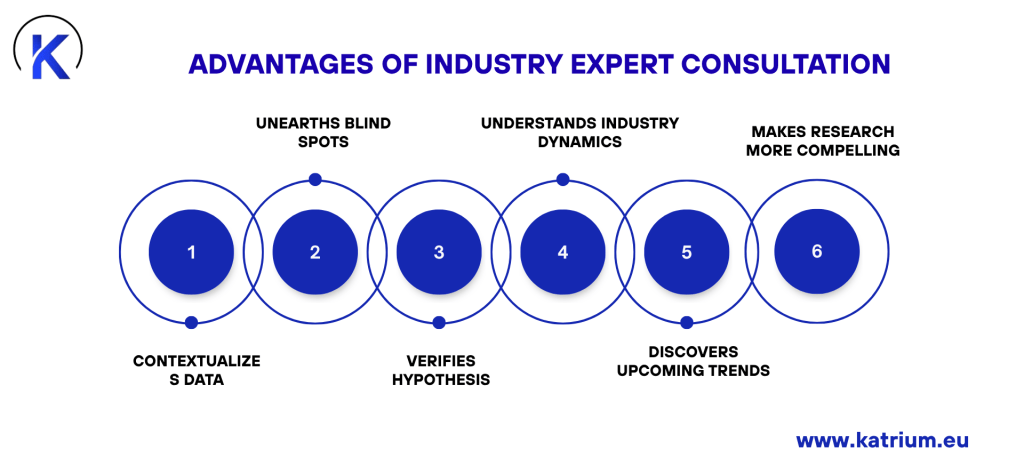
- Contextualizes data – The expert will tell you why the metric shifted rather than just that it did
- Unearths blind spots – The expert brings any holes in the analysis from secondary research to light
- Verifies hypothesis – Test the assumption before putting too much weight on a result
- Understands industry dynamics – The way things really happen vs. how they seem from afar
- Discovers upcoming trends – Industry experts often spot changes in the market up to 12-18 months before it appears in academic research
- Makes research more compelling – Stakeholders will appreciate findings derived from expert insight
Who Uses Industry Expert Consultation and How
The solicitation of expert opinions among industry professionals is not exclusive to the investment management and consulting sectors. This practice extends to nearly all industries where strategic decision-making is involved.
- Investments and Finance
- Hedge funds and private equity firms vet thesis ideas before investing money.
- Analysts perform channel checks by interviewing suppliers, distributors, and end-users.
- Mergers and acquisitions deal teams hold expert consultations during due diligence processes.
- Management Consulting
- Project teams quickly acquire expertise in their domain before engaging with clients.
- Consultants leverage expert calls to grasp competitive and regulatory landscapes.
- Practicing partners monitor industry changes to anticipate their clients’ needs.
- Corporate Strategy
- Strategy groups vet new market opportunities before allocating resources.
- Business development units assess mergers and acquisition targets using industry insights.
- Product development teams confer with technical experts before making key product decisions.
- Life Sciences and Healthcare
- Pharmaceutical companies obtain expert perspectives from physicians and payers for new drugs.
- Medical device companies vet clinical assumptions from practicing specialists.
- Healthcare investors monitor reimbursement trends and policy changes.
- Academic and Policy Research
- Researchers complement quantitative analyses with expert qualitative insights.
- Policymakers consult with industry practitioners when formulating actionable advice.
- Think tanks solicit expert perspectives to lend authority to their publications.
Four Key Ingredients for Effective Expert Consultation
Not all expert consultations are created equal. What sets apart the conversation that inspires a breakthrough from one that yields no results at all? It’s four things:
- The right expert
The first key to an expert consultation is having the right expert. A seasoned veteran with decades of experience does not necessarily have the expertise you require for a narrow niche.
- Specify expert qualifications upfront – by industry, role, level, firm type, region, and timeframe of expertise
- Relevance trumps reputation – an operator with hands-on expertise beats a high-profile executive who’s only indirectly exposed
- Consider perspective – speak to individuals from various angles within the market and across all levels of seniority
- The right question
Wandering questions yield meandering answers. Your expert consultation’s effectiveness correlates directly with the specificity of your research question.
- Pinpoint your main research question – what’s the one most crucial piece of information you must know?
- Structure your consultation guide based on the anchor question – everything else must support this one question
- Anticipate answers ahead of time – prepare a series of questions that probe into partial responses
- The Right Structure
Expert interviews can range from being fully structured to completely unstructured. Pick the format based on what you want to achieve:
- Structure – Pre-defined set of questions that are asked in a fixed sequence. Good choice for comparisons across several experts.
- Semistructured – Predefined flow with room to explore valuable insights as the conversation unfolds. Good fit for most applications.
- Unstructured – Open-ended conversations without predetermined goals or agenda. Good choice when starting off on new topics.
- The Right Analysis
It is critical to analyze the consultation in such a way as to turn the insight into value.
- Debriefing right away – Make sure that key themes, insights and follow-up questions are identified within 30 minutes after every interview.
- Identifying patterns between interviews – One expert’s opinion is an insight, opinions of five experts are a trend.
- Applying the importance factor – Insights should be analyzed for relevance and timeliness. Older insights may have become outdated.
- Incorporating the research into a larger picture – Expert opinion complements quantitative analysis, it doesn’t replace it.

Evaluating the Effectiveness of Consulting Experts for Research
What are some ways that you can measure if your program for consulting experts is effective?
- Degree of decision confidence — Are decisions based on research which involved consulting an expert more assured compared to decisions without this process?
- Percentage of hypothesis revisions due to expert feedback — Do experts play a role in revising your hypotheses significantly? The more revisions made, the greater the amount of learning achieved.
- Time to obtain insights — Does consulting an expert speed up the process of conducting your research studies?
Final Thoughts
Data tells us what happened. Analysis explains why it happened. But industry expert consultation is when research turns into intelligence that’s actionable, relevant, and based on the real-world experiences of those who understand the lay of the land. The scientists and companies that always create groundbreaking research aren’t necessarily working any harder. They’re consulting the right people. They’re asking the right questions. They’re incorporating industry expert consultation into every major research project as an absolute necessity, not a luxury.