No doctor ever examines a patient without asking questions first, and no lawyer ever goes to trial without knowing the facts of the case. Yet, 80% of companies make their most important business decisions, decisions that are worth millions of dollars and years of their lives, without ever speaking to anyone who really knows the market. Expert interviews are the due diligence that most businesses skip, and almost all of them regret it.
One of the most powerful research tools available to researchers is expert interviews, and they’re incredibly useful whether you’re conducting market research, academic research, or business research. Expert interviews put you in direct contact with valuable domain knowledge that no other research technique can match. This guide covers everything you need to know about expert interviews, from finding experts to analyzing what they tell you, so you have a clear and repeatable process that actually works.
What are Expert Interviews
Expert interviews are a form of structured or semi-structured interviews with individuals possessing specific knowledge, expertise, or authority in a given domain. Expert interviews differ from general interviews in that the information gathered in expert interviews is not generally available. In other words, instead of asking people what a product did to them, expert interviews aim to gather information from people who have spent a decade working in the domain itself.
Some of the most common use cases for expert interviews include:
- Academic and policy research
- Competitive intelligence and research
- Product development and validation
- Journalism and investigative research
- Consulting and advisory services
Why Expert Interviews in Market Research Matter
Tacit knowledge comprises 80% of everything that an organization knows. Only 20% ever gets documented. Your competitors are reading that same 20%. Expert interviews get you into the 80% that they can’t touch as they have this type of knowledge, and this information cannot be obtained by relying only on secondary research. Expert interviews provide this information. There are many unique insights are they provide including:
- Context behind the numbers — understanding why trends are happening, not just that they are
- Forward thinking — experts may be able to see where a space is going before it shows up in the numbers
- Uncovering blind spots — expert interviews can help identify risks and opportunities that may have been overlooked
- Hypothesis validation — expert interviews can validate your ideas before investing
- Access to secondary referrals — people you would never have found any other way
91% of companies report that market research provided a competitive advantage. The ones who didn’t do it? They’re the ones the 91% beat.
How to Identify the Right Experts for Your Expert Interviews
The quality of expert interviews is entirely dependent on who you talk to. It is a waste of time and leads to wrong conclusions if you talk to the wrong experts.
Here are a few criteria for evaluating potential experts:
- Relevance: Do they have direct experience with your research question, or just adjacent experience?
- Recency: Is their knowledge current, or do they base their answers on a version of the world that no longer exists?
- Independence: Do they have a vested interest in a particular answer?
- Depth: Are they an active expert, or just a commentator?
- Accessibility: Can they be bothered to talk to you?
Where You Can Find Experts for Your Expert Interviews
- LinkedIn, searching by job title, company, and years of experience
- Academic databases, searching for published researchers in your field
- Industry association websites, as well as conference speaker lists
- Expert networks, such as Tegus, and AlphaSights
- Referrals from current interviewees, as it’s essential to ask who else you should talk to
Names that come up repeatedly across multiple expert interviews are worth prioritizing, even if you didn’t find the name through your research efforts.
How to Structure Expert Interview Questions
The quality of the answers you receive is determined by the quality of the questions you ask. Inexpertly designed questions lead to answers such as “yes/no” or “tell me what you think I want to hear.”
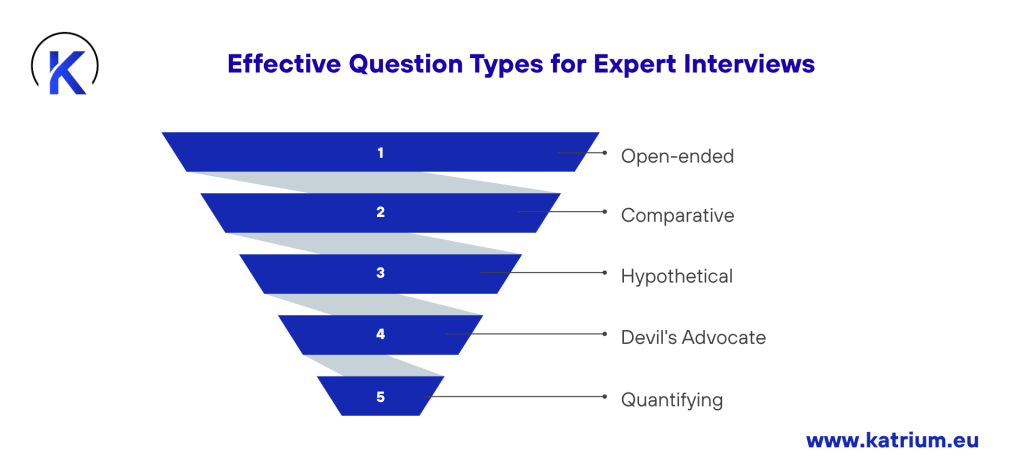
Effective Question Types for Expert Interviews:
- Open-ended – “Walk me through how X works”
- Comparative – “How does approach A differ from approach B?”
- Hypothetical – “If you were starting from scratch, what would you do differently?”
- Devil’s Advocate – “Some people argue Y – what’s your reaction to that?”
- Quantifying – “How common is this problem – what percentage of cases does it affect?”
Questions to Avoid When Conducting Expert Interviews
- Leading questions that embed the hypothesis in the question
- Double-barreled questions that attempt to ask two things at once
- Jargon-heavy questions that limit the scope before the expert has a chance to define it
- Closed-ended questions too early in the conversation before establishing a relationship with the expert
How to Conduct Expert Interviews: Step-by-Step
- Send brief outreach, including who you are, why you’ve chosen this person specifically, and what the interview will entail. You have about 8 seconds in which you can make a first impression in a cold email. Keep it under 150 words. Long emails are a sign of disrespect before you’ve even started.
- Send a reminder of logistics, including sending the discussion guide if appropriate for your research design, 24 hours before.
- Start with framing. It’s helpful for people to understand the purpose of the interview and how you plan on using their information. They are more likely to open up.
- Ask your first question, and listen. Don’t fill silences. Silences are actually helpful in expert interviews.
- Follow their lead. If they want to go deep on something, even if it’s not on your discussion guide, follow it. Your guide is a minimum, not a maximum.
- Ask each answer at least once: “Can you give me a concrete example?” is the most useful question in any expert interview. The particular example is where the actual information is.
- Record with permission: Paraphrasing from memory before you have a chance to analyze the data introduces your interpretation into the data.
- Ask for referrals: “Who else should I speak with?” is one of the most valuable questions you can ask in any expert interview.

Common Mistakes to Avoid in Expert Interviews
- Too much preparation of questions, not enough listening. You can always tell when an interviewer is just waiting for their next question, and so can the expert
- Taking the expert’s first response. Most experts have a “surface” response, and then something more insightful. It’s worth probing once before moving on
- Lack of triangulation. One expert’s response is just a hypothesis, not a fact. It’s not until you’ve done several expert interviews that a pattern begins to emerge
- Lack of recording. Even good listeners can miss the subtle nuances and contradictions
- Too few interviews. 5 – 8 expert interviews is the bare minimum for a qualitative perspective. Most researchers do two or three.
- Too much deference to the expert’s agenda. The experts have their own agenda, and their own favorite topics. Try to uncover insights beyond that.
How to Analyze Findings from Expert Interviews in Market Research
Raw notes and recordings from expert interviews are not insights in themselves. The actual true value is created when you analyse it.
Here’s the Step-by-Step Analysis Process:
- Transcribe the interviews within 24 hours
- Create a memo immediately after capturing your top three to five takeaways from the interview, while context is still fresh
- Transcript coding: Identify common themes in the interview, i.e., labeling sections of the transcript where different expert interviews relate to the same concept
- Identify consensus: Where are multiple expert interviews in agreement without prior coordination?
- Identify divergence: Where are expert interviews in disagreement, and, more importantly, why?
- Identify surprises: Insights that no secondary research prepared you for are often the most valuable
- Identify repeated referrals: When a person’s name comes up in multiple expert interviews, they are likely a person of interest
What to discount from your consideration:
- Opinions stated as fact without supporting evidence
- Opinions stated as fact where the expert’s interest is obvious
- Unusual opinions without corroboration from other sources
How Many Expert Interviews Do You Need?
- Exploratory Research: 5-8 expert interviews to explore a landscape you don’t understand
- Hypothesis Validation: 8-15 expert interviews to validate a specific hypothesis
- Deep Dive Research: 15+ expert interviews for a narrow topic
The practical answer for this question is: saturation. Saturation is reached when new conversations do not produce new themes. For example, finishing sentences and predicting answers of the expert is a sign of saturation.
Expert Interview Best Practices: Quick Reference
- Before Your Expert Interviews:
- Clearly define your research question before you begin
- Research each expert thoroughly
- Develop a discussion guide, not a list of all possible questions
- During Your Expert Interviews:
- Make sure you are actively listening
- Probe each surface-level response at least once
- Always ask for referrals before concluding
- After Your Expert Interviews:
- Transcribe within 24 hours
- Write an immediate takeaway memo
- revise your research question based on expert interviews, if they change your understanding
Final Thoughts
Expert interviews are not a shortcut. They are a process that demands preparation, attention, and critical thinking. Yet, when done well, expert interviews allow you to compress months of desk research into a handful of expert interviews with people who have lived the very experience you are trying to understand.
Researchers who get the most from expert interviews are those who see each expert interview as a dialogue, not an interrogation. They come prepared, they talk less, they listen more, and they allow the expert to take them somewhere they did not expect. It is where the real insights lie. If you want a team that will handle all the heavy lifting for you, our market research services at Katrium will handle all the work for you, from expert interviews to analysis.