
executive interviews are important because of this: Out of every 100 new hires, only 43 will be successful in the long run. That’s a costly problem for regular positions, and a potentially company-defining problem for executives. Executives cost an average of $28,329 just to make, before even considering the cost of getting them wrong.
Most first time interviewees go into executive interviews unprepared for what the interview for executive positions actually require, simply because an interview for an executive position is nothing like an interview for any other position they’ve ever had. What makes the successful interviewees different from the ones who just didn’t make it?
What Makes Executive Interviews Different?
The interviews one’ll be doing most often will be assessing what they know, and what they’ve done. Executive interviews are slightly more challenging, as they’re trying to determine how you think, how you lead, and whether or not they’d follow you in a tough decision.
To be a leader at any level, you’ll require a different skill set than for any other role. You’ll require visioning skills, thinking skills, team-building skills, decision-making skills, conflict resolution skills, flexibility, and a strong ethical base.
What the executive interviews are actually evaluating:
- How you talk about failure – a defensive attitude about failure is a red flag right off the bat
- Your leadership style in relation to the culture and where that organisation is at in terms of their journey
- Your ability to simplify complex concepts – people who can’t simplify concepts aren’t ready for a role
- If you’ve already thought about the biggest challenges in that role before you’re even asked
- If you’re thinking at a level that’s commensurative with the role, not just capable of thinking about it, but thinking about it in a strategic way
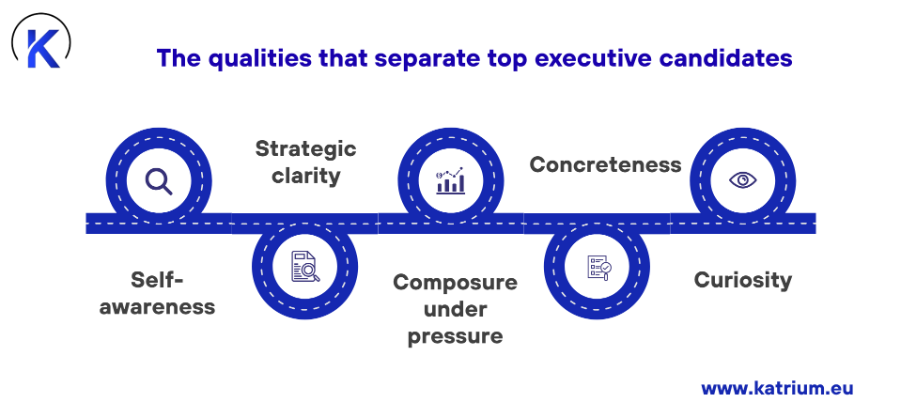
The qualities that consistently set top executive candidates apart
Boards and executive recruiters now focus more on hiring leaders with emotional intelligence, flexibility, and purpose alignment rather than qualifications such as tenure. Emotional intelligence is the number one factor in the equation for leadership success among more than 500 hiring managers surveyed in executive interviews.
The shift is enormous in terms of how you should think about your approach to executive interviews. While your qualifications are certainly important, they are no longer enough. What gets you hired is something far less tangible and far more important.
- Self-awareness – knowing your strengths and weaknesses precisely. Executives that can’t tell you their weaknesses can’t get anyone’s trust
- Strategic clarity – knowing not only what you’d do in a role but also why you’d do it and what you’d do first
- Composure under pressure – executive interviews are designed to make you uncomfortable. Can you handle it?
- Concreteness – vague answers about “driving growth” and “building teams” will always lose to concrete examples with real numbers and outcomes
- Curiosity – top executive candidates ask tough questions. Executives that ask no questions at all signal that they’ve stopped listening
How to prepare for executive interviews
The companies that are currently winning aren’t interested in people who can follow a playbook. They’re interested in people who can create a new playbook on the fly. Your preparation for executive interviews should be that kind of preparation.
Before the executive interview:
- Do research on what’s currently challenging for this organization. Executive interviewers will know in a second whether you’ve done real research or simply browsed
- Develop a point of view on this role, including what the first 90 days should accomplish, what you would change, and what you would leave the same
- Develop three to five stories that demonstrate your best leadership experiences, each including a challenge, a decision, and a resulting outcome
- Know your numbers, including revenue you’ve driven, teams you’ve built, and outcomes you’ve achieved. Vague answers don’t fly in executive interviews
During the interview, you should:
- Listen before you answer – the best executive candidates treat interviews as a conversation, not a performance
- Be direct – executives who hedge every answer signal that they won’t make tough calls
- Acknowledge complexity honestly – a question about a past failure is a chance, not a trap
- Match your energy to the room – different organizations want different kinds of leaders; reading that room and adapting accordingly is a leadership skill

The Mistakes in executive interviews that cost candidates the offer
44% of job applicants admit to dishonesty in the hiring process. In executive interviews, this will not take long to become apparent. They are experienced interviewers and will not miss a candidate’s dishonesty.
What eliminates a strong executive candidate in the interview process:
- Talking about organisational issues even if they are identified
- Overestimating yourself and undervaluing your team – executives who cannot share the win are a red flag for organisational culture
- Coming unprepared with questions – this is a big red flag for a candidate who is not engaged in the interview process
- Giving generic answers to very specific interview questions – “I am a good communicator” is meaningless; “I had a good experience overcoming a poor communicator” is a different story altogether
- Underestimating the importance of culture fit – 84% of recruiters rate this a critical factor in making a hiring decision. This is particularly true for executive candidates since they are at the top and will create a culture that permeates through all levels in the company.
Final Thoughts
These are high-stakes interviews for all involved. For the organisations, this is one of their most critical interviews. For the candidate, this is a role that will write the next chapter in their career.
The executives who excel at these interviews are coming at it with a strong perspective, a true interest in the organisation, and a confidence to be open and honest about their own achievements, their own learnings, and their own regrets.
It’s not as common a combination as most interview teams assume. When we at Katrium find it, though, the decision is almost always a slam dunk.