Customer data analysis is an increasingly common method in modern business decision-making. It allows companies to understand customer behavior, measure satisfaction, forecast needs, and create targeted marketing strategies. With the rise of digital tools and platforms, customer data is now readily available, from online purchases to feedback forms. But raw data alone is not enough. Structured and ethical customer data analysis helps businesses develop strategies that improve customer loyalty and profitability.
At Katrium, we help businesses across Europe and globally gather, analyze, and apply customer data effectively, ensuring that every decision is backed by insight, not intuition.
Why Customer Data Analysis Matters
These days, customer expectations are higher than ever. A generic approach to marketing or service delivery no longer works. Customer data analysis provides the insights needed to personalize experiences, optimize products, and predict future behaviors. It allows you to:
- Identify your most profitable customer segments.
- Understand buying patterns and seasonal trends.
- Uncover pain points in the customer journey.
- Track satisfaction and loyalty over time.
- Make strategic decisions supported by factual evidence.
Research indicates data-driven businesses are significantly more likely to acquire and retain customers and achieve higher profitability, compared to those that do not prioritize analytics. For instance, they are 23 times more likely to acquire customers, 6 times as likely to retain them, and 19 times more likely to be profitable
Customer Surveys – A Key Source of Data
One of the most powerful ways to collect customer data is through surveys. Whether it’s a simple feedback form after a purchase or a detailed Net Promoter Score (NPS) survey, these tools allow businesses to hear directly from their customers.
Types of customer surveys include:
- Customer Satisfaction Surveys (CSAT) – Measure how happy customers are with your service or product.
- Net Promoter Score (NPS) – Gauge the likelihood that a customer will recommend your business.
- Customer Effort Score (CES) – Understand how easy it is for customers to complete an action with your brand.
- Market Research Surveys – Explore customer preferences and unmet needs.
- Product Feedback Surveys – Collect suggestions for product improvements or features.
At Katrium, we design multilingual, culturally sensitive customer research to ensure authentic and actionable feedback.
What Kind of Data is Collected?
Effective customer data analysis utilizes a combination of quantitative and qualitative data collected through surveys and other channels. Key data types include:
| Data Type | Description | Source |
| Demographic | Age, gender, location, and income | Registration forms, surveys |
| Transactional | Purchase history, value, frequency | Sales systems, POS, CRM |
| Behavioral | Clicks, time spent, navigation paths | Web analytics, heatmaps |
| Psychographic | Values, lifestyle, opinions | In-depth interviews, open-ended surveys |
| Feedback | Compliments, complaints, suggestions | Online forms, social media, and support |
By combining structured and unstructured data, customer data analysis becomes more robust and insightful.
Step-by-Step Customer Data Analysis Process
Here’s how customer data analysis unfolds in practice:
1. Define Your Goals
What do you want to discover? For example, are you trying to reduce churn, increase repeat sales, or improve your onboarding process?
2. Collect Relevant Data
Use surveys, CRMs, Google Analytics, and support logs to gather insights. Don’t forget to include consent and comply with GDPR when collecting personal data.
3. Clean and Organize Your Data
Filter out incomplete, inconsistent, or duplicate responses. Data cleaning ensures analysis is based on accurate information.
4. Segment the Data
Group your customers based on behavior, demographics, or satisfaction levels. This helps tailor communication and offerings to different customer types.
5. Apply Analytics
Use techniques such as regression analysis, sentiment analysis, or clustering to extract patterns. Katrium often uses these approaches for market research as well.
6. Visualize Findings
Create dashboards and graphs using tools like Tableau, Power BI, or Google Data Studio. Clear visuals help stakeholders understand and act on insights.
7. Interpret and Take Action
Based on your findings, design marketing campaigns, update service processes, or innovate products.
Benefits of Customer Data Analysis
Customer data analysis drives real business results, going beyond mere data collection:
- Improved Targeting: Know which messages resonate with which audiences.
- Stronger Relationships: Personalize communication to foster loyalty.
- Smarter Innovation: Use feedback to refine your products and services.
- Increased Revenue: Upsell and cross-sell effectively through segmentation.
- Risk Reduction: Identify patterns that lead to churn or dissatisfaction.
Consider a hypothetical clothing brand experiencing a drop in customer retention. By conducting customer satisfaction surveys and analyzing repeat purchase data, the brand might discover that customers are unhappy with the return policies. In a similar scenario, we at Katrium would help the business redesign its return policy and segment email campaigns based on return behavior. This approach could lead to a significant increase in repeat purchases, such as a 20% rise within a few months, informed by industry benchmarks and strategic analysis.
This is the power of practical customer data analysis.
Trends Shaping Customer Data Analysis in 2025
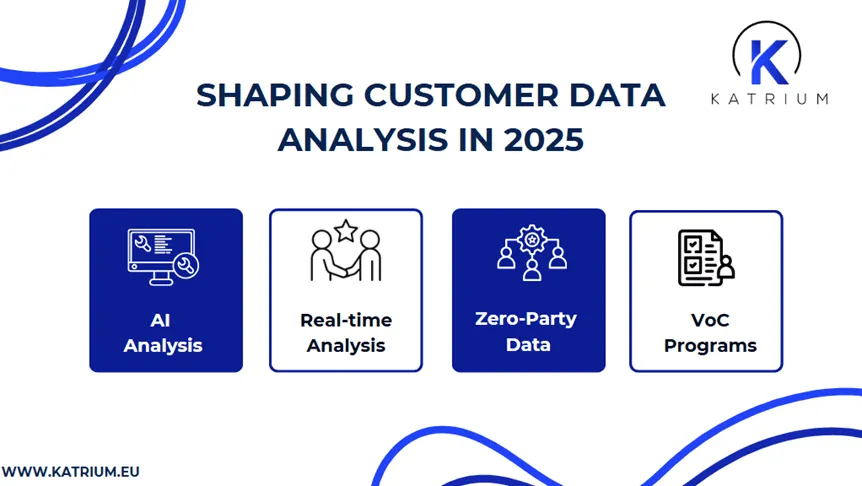
1. AI and Predictive Analytics
Modern platforms now use machine learning to predict future behavior based on past data. This can automate product recommendations or alert teams to churn risk.
2. Real-time Analysis
With cloud-based tools, you can now collect and analyze data instantly, improving your response time to customer needs.
3. Zero-Party Data
Customers willingly share data in exchange for value, like personalized recommendations or exclusive offers.
4. Voice of Customer (VoC) Programs
Combining feedback from multiple sources (chat, email, reviews, and surveys) gives a 360° view of customer sentiment.
Katrium supports clients by building integrated VoC programs tailored to multilingual and multicultural markets across Europe.
Common Mistakes in Customer Data Analysis
Even well-intentioned efforts can go wrong. Avoid these pitfalls:
- Collecting too much data without clear objectives
- Ignoring qualitative feedback
- Not cleaning or verifying the accuracy of data
- Using overly complex tools without training
- Failing to act on insights
At Katrium, we ensure clients avoid these mistakes through expert consultation and tailored training.
Tools That Support Customer Data Analysis
Here are some popular tools that help in collecting, managing, and analyzing customer data:
| Function | Tool Examples |
| Surveys | Google Forms, Typeform, SurveyMonkey |
| CRM | HubSpot, Salesforce |
| Analytics | Google Analytics, Mixpanel |
| Visualization | Tableau, Power BI |
| CDPs | Segment, BlueConic |
Ethical Use of Customer Data
In the age of digital surveillance, customers demand transparency. Ethical customer data analysis means:
- Gaining explicit consent
- Offering opt-outs
- Being transparent about how data is used
- Storing data securely
- Avoiding manipulation or misuse
Respecting data contributes to building trust and long-term loyalty.
At Katrium, these are the values we uphold across all projects.
How Katrium Can Help
We at Katrium have years of experience designing multilingual customer surveys, analyzing complex data sets, and building strategic recommendations.
With the right tools, partners like Katrium, and an ethical, goal-oriented approach, you can unlock the full value of customer insight to drive growth and loyalty.
Conclusion
Customer data analysis helps refine operations based on feedback, transforming opinions and numbers into new opportunities. Whether you’re a startup or a multinational, mastering the art of understanding your customers through data is crucial for businesses of all sizes.
Learn more about our customer survey and analytics services, or contact us for a tailored consultation.