





Business process outsourcing (BPO) is when organizations contract with external service providers to handle specific business-related operations, often referred to as BPO services. Therefore, this approach allows companies to focus on their core strengths, reduce operational costs, and gain access to specialized expertise when required. BPO services initially started in the late 70s. They picked up in the early 80s as a growing need by manufacturing companies, who outsourced part of their supply chain processes to third parties. In today’s world, BPO services have touched every section with service companies being a large part.
BPO service categories and their function
There are several BPO categories depending on what services a company wants to outsource. Understand the subcategories companies can determine which services they need or want to outsource. Familiarize yourself with these subcategories and their functions.
- Front office BPO – As evident by the name ‘front office’, this BPO service deals with the company’s customer interactions.
- Customer service outsourcing: Outsourcing incoming and outgoing call center operations, email support, live chat support, and social media customer engagement.
- Sales and Marketing: Outsourcing telemarketing, sales support, market research, lead generation, and digital marketing campaigns.
- Technical Support: Outsourcing warranty claims processing, product support, and technical troubleshooting.
2. Back office BPO – Opposite to front office BPO, back office BPO deals with services that are back-end operations of a company. Consequently, these operations are internal business functions and therefore do not have any form of direct customer interactions.
- Finance and accounting: Outsourcing payroll processes, bookkeeping, financial analysis, tax preparation, accounts payable and receivable management.
- Human Resources: Outsourcing recruitment, training, onboarding, and performance management.
- Data management: Outsourcing data entry, data processing, data cleansing, and managing the database.
- Information Technology: Outsourcing IT helpdesk support, application maintenance, and software development.
3. Offshore BPO – This category of BPO involves outsourcing services to third parties that are in a foreign country. These services are outsourced offshore to save costs and attain long-term cost-saving.
4. Nearshore BPO – This category of BPO also involves outsourcing services from a foreign country. In this case, the company outsources from countries located nearby or in the same region.
5. Onshore BPO – This category of BPO is also known as Domestic BPO. Evident by its name ‘Domestic’, this involves outsourcing services within the same country as the company.
6. Knowledge process outsourcing – This outsourcing category involves working with a service provider who can offer advanced skills that a company might lack.
- Legal Services: Contract review, compliance check, and litigation support.
- Market Research: examining competition data and industry trends.
- Data analytics: Deriving insights from large amounts of data.
- Content creation: Writing blogs, articles and creating marketing materials.
Inbound and Outbound BPO: Take a closer look!
Now that you are aware of various BPO service categories, let’s look at how a company can further categorize them based on their communication needs. Most companies need to maintain constant communication with their existing clients and reach out to new potential clients to grow their company.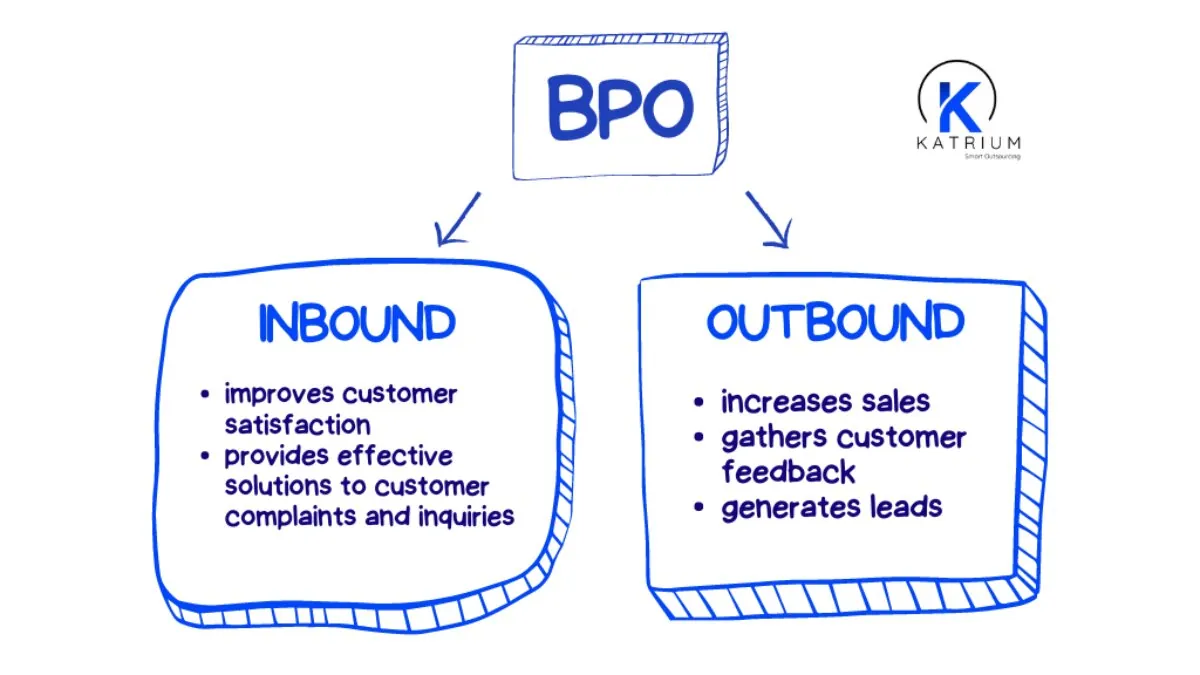
Inbound BPO
Focus: It focuses on managing incoming communications, including requests from clients, customers, and stakeholders.
Includes:
- Customer service and support
- Technical support
- Order processing
- Help desk services
Goal: The main goal is to improve customer satisfaction and provide effective solutions to customer complaints and inquiries.
Outbound BPO
Focus: It focuses on initiating communication with potential clients or existing customers and clients.
Includes:
- Telemarketing
- Sales outreach
- Market research
- Lead generation
Goal: The main goal is to increase sales, gather customer feedback, and generate leads.
Here is a table to simplify the difference between inbound and outbound business process outsourcing.
| Feature | Inbound | Outbound |
|---|---|---|
| Communication Direction | Incoming | Outgoing |
| Initiator | Customer, Client | BPO Provider |
| Primary Goal | Customer satisfaction, issue resolution | Marketing research, increasing sales |
| Common Activities | Customer service, technical support, order processing | Telemarketing, sales outreach, lead generation |
Table 1: Inbound and Outbound Comparison
Multichannel and Multilingual BPO services
Business Process Outsourcing (BPO) can only meet successful outcomes with multichannel and multilingual support. This means that BPO services should be available through multiple channels and languages so that companies can choose which option suits them the best. This is crucial because a company might have a preferred channel they want to use and therefore only access BPO services provided via their channel of preference. A multichannel BPO service allows companies to connect with you through their preferred channels, ensuring a successful market presence.
The same principle follows with languages, 29% of businesses have lost customers due to lack of multilingual services. On the other hand, 70% of clients are more inclined to stick around if they receive services in their mother tongue. A few crucial steps are needed for a BPO organization to add multilingual assistance. First, determine which languages the company needs to cover. This is usually determined by the client’s location and the customers they serve. After identifying the required languages, businesses should hire workers who are fluent in them. Alternatively, they might train current personnel. Making investments in translation software may also be necessary.
Expand your reach and connect with customers on their terms using Katrium’s multilingual BPO services. With service provided in 34 different languages, you can reach a wider clientele and grow your business. Contact Katrium to find out more.
Benefits of BPO services
Reduction of costs is the main driver of outsourcing. By collaborating with outside service providers, businesses can reduce costs associated with hiring more employees and buying new equipment.
Skilled BPO companies use state-of-the-art technology and best practices to flourish in a variety of fields. Increased productivity and efficiency result from this.
By outsourcing non-essential functions to business process outsourcing (BPO) organizations, particularly startups, can focus on their core competencies while mitigating the obstacles associated with supporting additional functions.
BPOs can speed up entering overseas markets by handling jobs that require local knowledge. This enables faster global expansion and greater efficiency.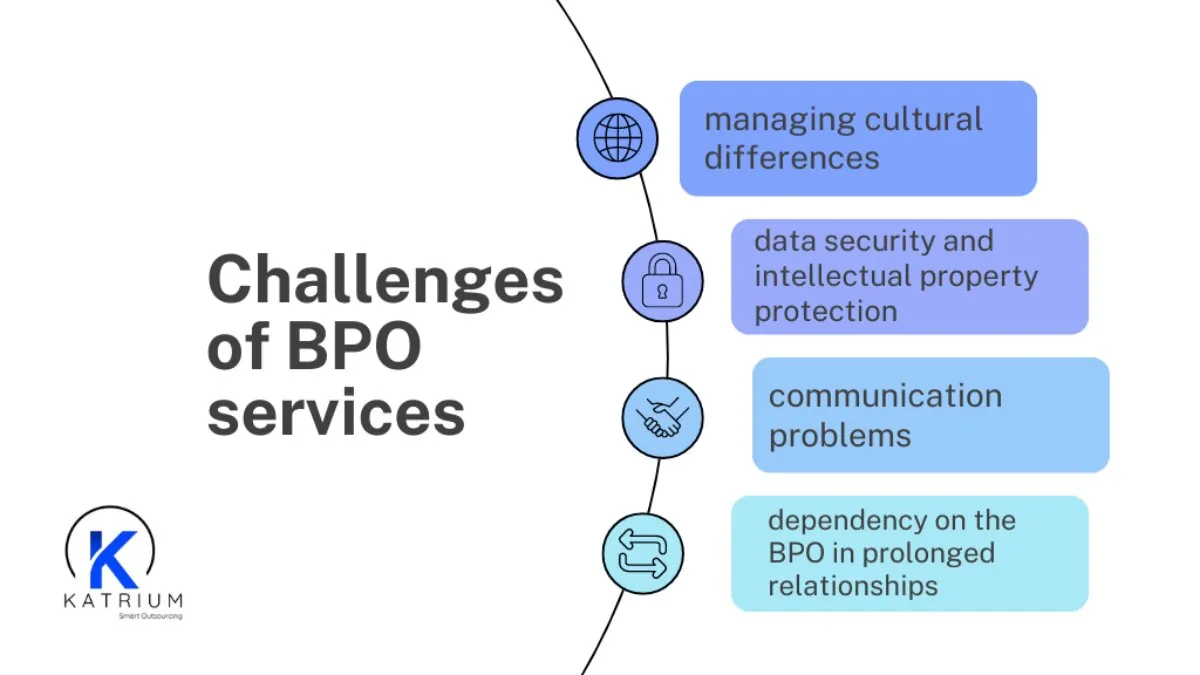
Challenges of BPO services
No area in life comes with all rewards and no challenges, and this is true for BPO services as well. Here are some challenges that you can expect to come across as a company looking to outsource their business processes.
- Businesses can access a worldwide talent pool by partnering with external service providers, but this benefit frequently comes with the challenge of managing cultural differences. The innate differences in the ways that organizations function and communicate give rise to corporate inequities. On the other hand, regional disparities result from the geographic separation of the client and the service provider and can be explained by variations in communication methods, norms, and values.
- When hiring BPO services, data security and intellectual property protection are essential factors to take into account. Businesses prioritize cybersecurity because it is frequently necessary to share confidential company data, workflows, and resources. For businesses of all kinds, protecting intellectual property is crucial. This includes confidential information and strategic plans. Poor data management can have serious, long-lasting effects.
- One of the most common challenges with BPO partnerships is inadequate communication. Misinterpretations and misunderstandings may occur even in situations when both parties speak the same language. If not handled appropriately, the diverse backgrounds, experiences, and viewpoints that each team brings to the table can cause communication problems.
- Prolonged outsourcing relationships can lead to organizational dependency on the BPO provider. This overreliance may result in the company accepting inflated costs due to a lack of alternative options. Prolonged outsourcing relationships can lead to organizational dependency on the BPO provider. This overreliance may result in the company accepting inflated costs due to a lack of alternative options.
How to manage the challenges
Having a plan for every potential challenge that a company might come across, increases the chances of successful outcomes. The same applies to BPO service providers. The solutions provided are based on the challenges stated above.
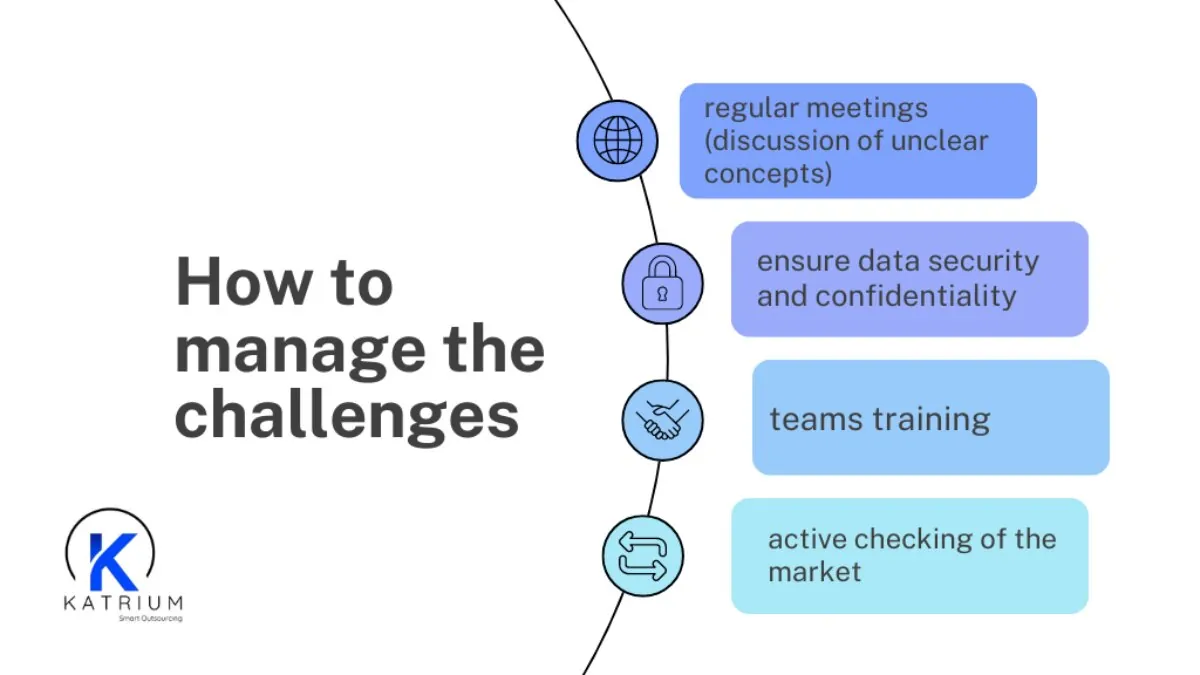
- To combat challenges that might arise from cultural differences between the company and BPO service provider, both counterparts go through thorough training. Specifically, this training will consist of both the in-house team and the service provider team going through their counterparts’ cultures. In the beginning, time can be dedicated to nurturing collaboration and understanding.
- Ensure data security and confidentiality, both sides should sign non-disclosure agreements. Accordingly, this helps both sides to maintain secrecy, as a breach of contract can affect both sides financially and risk the position they have built in the industry. It is also important for BPO service providers to maintain the security standard and protocol set by the company ensuring minimal risk of data breach. A company should wisely choose its BPO service provider, meaning that choosing a BPO service provider that meets its standard of data security.
- Communication is essential for both sides who want to reach the same goal. To make sure there are no issues with communication, regular meetings should be held, and any unclear concept should be brought up immediately for discussion. Additionally, effective communication techniques can be taught to both teams in communication with each other.
- Organizations that are in a prolonged relationship with their BPO service providers can avoid dependency by actively checking the market. This allows them to seek new service providers that could be a better match for their requirements. Meanwhile, companies can opt for shorter contracts that are renewed instead of long-term contracts.
Finding the best BPO service provider for your Business
- Identify what service your company needs, and in which area your company needs to reduce workload. Narrow down your needs as much as possible, this will help you to be more precise when looking for providers.
- Do your research. Now that you know your needs, look for service providers that offer the solutions that you are looking for. Choose a few vendors based on their reviews from former clients.
- Make sure that the service provider offers exactly what you need and are looking for. Plus, they have the experience and the expertise required to fulfill your needs and meet your company standards.
- Decide if you want onshore, nearshore, or offshore BPO service providers. This is important to choose wisely as depending on the location of the service provider the work time, cultural differences, and other aspects will come with it.
- Check if the service provider follows their progress analytically and if they can provide you with customizable reports.
- Check if the provider’s data security is as strong as your company’s, this is a priority concern as data breaches are getting more common in today’s technological world. Around 8% of service providers were victims of data breaches.
- After you have managed to choose a BPO service provider, maintain clear communication. Set clear expectations, deadlines, and clauses on what action is taken if the expectations are not met.
Checklist for choosing the right BPO service provider
Prioritize the following qualities in a Business Process Outsourcing (BPO) partner:
Established Reputation: Look for service providers with a track record of accomplishment supported by positive feedback from clients and referrals. Reputable suppliers will be happy to put you in touch with happy customers so you can hear about their experiences.
Industry expertise: Seek a BPO leader with a track record in a variety of industries, such as manufacturing, e-commerce, insurance, healthcare, and IT.
Extensive Service Portfolio: Choose a supplier from the competitive BPO market whose services match your unique requirements and provide more affordable options than what you could do yourself.
Robust Data Security: Since you will be entrusting them with sensitive information, give preference to vendors who exhibit a strong commitment to data security through strong practices and protections against cyber threats.
Technological Prowess: To take advantage of the most cutting-edge tools for your projects, pick a BPO company that welcomes new technologies and smoothly incorporates them into their operations.
Transparent Communication: Verify that the vendor is willing to perform a free assessment of your operations, detailing their suggested remedies and that they are fully transparent about their methods. They should also take responsibility for any downtime.
Flexibility: Evaluate the provider’s capacity to increase or decrease resources per your changing company needs.
Cultural compatibility: A commitment to providing high-quality services should be reflected in the BPO company’s culture. To promote smooth cooperation, also make an effort to harmonize the work environment and culture of your organization with the BPO provider.
Does BPO have a future?
Yes! The simple answer is Yes! Business Process Outsourcing is bigger than ever and is growing even faster than before. According to 360 Market Updates, the global BPO market demand shows a steady compound annual growth rate of 6,13%. Many changes are happening in the world of BPO, one of those significant changes being the integration of AI and automation. This has opened many doors in the world of BPO and it is adapting to the changes swiftly.
If you are looking for BPO services such as Business support services, Contact center services, Research Services, SEO, Social Media Management and Content creation contact Katrium today!


3 Responses