





The use of AI in customer service has grown rapidly in recent years as AI language models have become better at understanding customers’ needs. While not entirely new, these improvements have made AI faster, more accurate, and more flexible for customer service solutions. As a result, there’s been a significant projected rise in its use across various customer service roles in organizations around the world.
Even with all these developments, AI remains most useful for automating repetitive tasks. This lets human representatives focus on complex, sensitive, and high-value interactions with customers. Contact center support services, like those offered by Katrium, can integrate AI in the coming years to improve efficiency while maintaining the human touch that many consumers still expect. To prepare for this change, businesses will benefit from understanding how AI fits alongside human support. This article will explore what AI in customer service is, its benefits, and how to manage the associated risks.

How is AI used in customer service?
AI in customer service refers to the use of automated AI technologies to offer quick, personalized support in real-time. It can also be used internally by companies for data analysis and streamlining repetitive tasks, allowing for better allocation of employee resources.
These technologies can:
- Understand and handle customer queries
- Pull information from a knowledge base or CRM
- Automate standard responses
- Help support agents with real-time suggestions
Common Examples of AI in Customer Service
The use of AI in customer service is widespread. Here are some use cases that many businesses utilise:
- Chatbots and self-service: Often seen on websites and messaging apps, chatbots provide immediate assistance to commonly asked questions. When combined with self-service options, they allow customers to resolve issues on their own.
- Automated ticket routing: Through ticket analysis, AI can categorize incoming support tickets and assign them to a relevant agent, reducing delays and misrouting.
- AI-powered translation: Enables multilingual support so businesses can offer assistance across different regions.
- Automated follow-ups: After a purchase, support interaction, or consultation, AI can automate follow-up communications such as order updates, satisfaction surveys, or renewal reminders.
5 Benefits of Implementing AI in Customer Service
There is no denying that the use of AI in customer service has many benefits. From around-the-clock availability to building client relations with personalized services, its application has been integrated into every part of the customer journey. The following list of benefits will help you understand the value that using AI can provide:
- 24/7 support: The automated use of AI allows for immediate customer support, no matter the date or time. This direct availability reduces customer frustration and enables support agents to focus on more complex cases.
- Enhanced predictions: Past trends and data can be efficiently analysed by AI and used by a business to make informed decisions and prepare for future customer needs or market changes.
- Personalized customer care: Using data analysis, AI can tailor customer support to meet the expectations of individual consumers. Purchase history, buying behaviour, and communication preferences can be used for automatic personalized correspondence, product recommendations, and tailored offers. With the rising expectations from consumers for personalized interactions, using AI to enhance these relationships is highly beneficial and strategic.
- Improved agent productivity: AI can be used to provide summaries of customer support cases, generate relevant insights for more informed decision-making, and provide training opportunities for agents to prepare them for varying customer support scenarios.
- Load management: High support volumes can lead to employee burnout, which in turn can lead to dissatisfied customers due to long wait times or unanswered questions. AI agents can relieve this load and help manage incoming requests during busy periods, allowing teams to maintain service quality.

Consumer Concerns
While the use of AI in customer service is widespread and proven to be beneficial, it also has important responsibilities and considerable risk factors to consider. In fact, lack of trust in AI remains a key barrier for its integration, with 64% of customers preferring companies that do not rely on AI for customer support. Being aware of these opinions will help businesses navigate this new age of buyer care by building trust and ensuring consumers are aware of how important their satisfaction is.
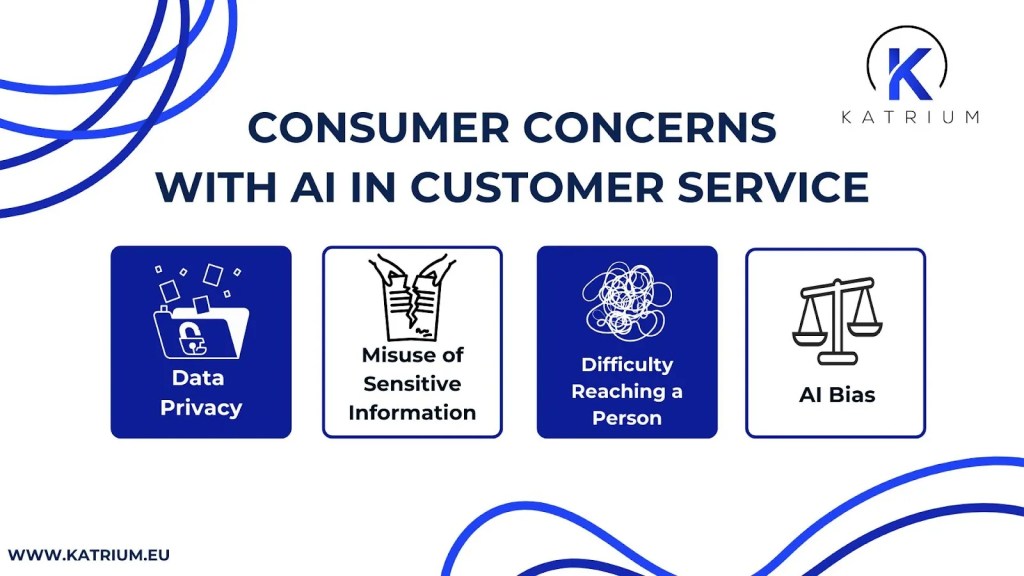
Below are some customer concerns you should consider when looking to integrate AI in your support services.
- Data privacy: Since AI requires large amounts of customer data, concerns about data collection, storage, and usage are high. Compliance with regulations, such as GDPR, is essential to ensure proper data processing measures.
- Misuse of sensitive information: Many fear the misuse and mishandling of sensitive data by AI.
- Difficulty reaching a person: Customers are concerned with getting stuck in an automated loop with an AI agent and not being able to reach a real person.
- AI bias: Certain customer groups may face unfair or discriminatory treatment from AI agents due to possible biases in the data used to train them.
With these concerns, the importance of human interference cannot be overstated. It can be challenging to keep up with the rapidly changing landscape of AI and its use in any business operations. The experts at Katrium are equipped to handle these new advancements, allowing you to focus on more important matters.
Conclusion
AI in customer service is already an expected addition in business operations, meaning that in order to meet and exceed client expectations, companies must understand its benefits and proper usage. The most effective use can be achieved by combining the speed and efficiency of AI with the expertise and emotional approach of human support.
At Katrium, we are knowledgeable and prepared to work alongside you to ensure you understand the implications of AI in customer service and how it can work for you to support long-term success. Contact us today, and let us help your business prepare for the future.